




Ponant and the Woods Hole Oceanographic Institution (WHOI) have earned recognition on Condé Nast Traveler’s Bright Ideas in Travel 2026 list for their collaborative efforts to reshape how humanity perceives and protects the planet’s most vulnerable ecosystems.
Every journey into the Arctic or Antarctica presents a profound challenge for environmental documentation. Capturing the sheer magnitude and fragility of the Earth’s polar regions is an exercise in humility. While photographing charismatic animals and marine megafauna is compelling, wide-open landscapes often require a human or animal subject to establish true scale. Most environmental photographers frequently feel that their images capture merely a fraction of the vast reality before them.
Yet, like many in their field, photographers continue to document these remote environments because the right image or video can evoke genuine concern for a place most people will never visit. This dilemma sits at the heart of an age-old question in conservation, holding particular poignancy for the poles. Many individuals picture these regions as empty, remote, and largely irrelevant to their daily lives. While people can intellectually grasp that the Arctic Circle and Antarctica are fragile and endangered, converting that factual knowledge into an emotional connection to their plight remains a difficult hurdle.
The gap between knowing and feeling is precisely what a strategic initiative between luxury cruise line Ponant and the renowned Woods Hole Oceanographic Institution is working to close. Building upon a partnership initially launched in 2025, the two organizations unveiled the Polar Ocean Image Collection. Released for free through the Ocean Image Bank, the library features more than 500 images capturing the diverse realities of the Arctic and Antarctic. Many of these visuals originate from Ponant’s specialized Polar Studio team, while others represent contributions from a global community of photographers. Overall, more than 200 photographers have donated their work for non-commercial use, according to Richard Vevers, who leads WHOI’s outreach efforts as the director of its Ocean Communication Academy and Room 71.
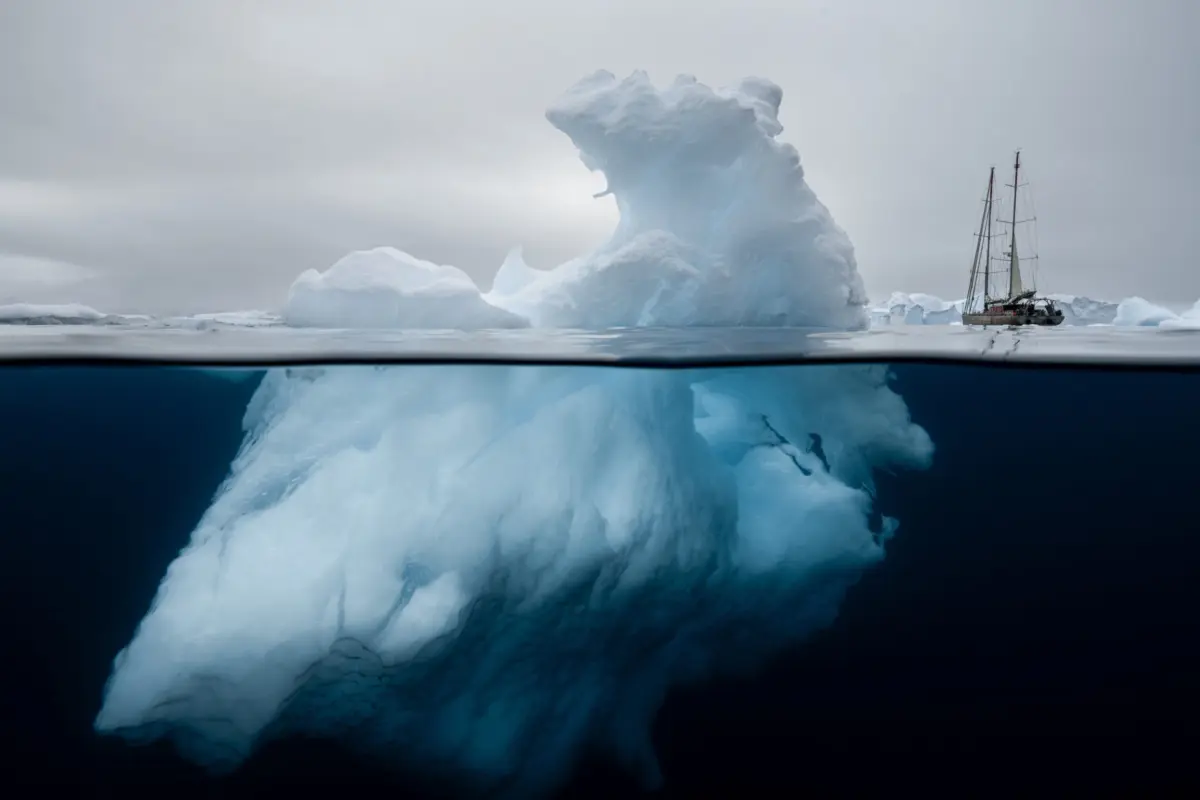
A digital walkthrough of the Polar Ocean Image Collection reveals an expansive array of icebergs, polar bears, penguins, and countless gradients of blue. One particularly striking image is a splitshot—a classic underwater photography technique capturing a half-submerged iceberg that completely dwarfs a nearby sailboat. Such visuals evoke the historical era of polar exploration, recalling the distinct sensation of human smallness beside natural formations of staggering scale. The visual experience is transportive, capable of sparking an immediate physical reaction of excitement, wonder, and awe.
For those who have witnessed the polar regions firsthand, the contrast with common public perceptions is stark. Antarctica, in particular, is filled with dynamic life and movement. Visitors might encounter a fledgling penguin curiously pecking at a camera lens, or a seal pup hauling itself across a traveler’s legs completely unbothered by human presence. Icebergs that stretch far beyond the boundaries of a wide-angle camera frame drift past continuously. Even years after witnessing such scenes, these memories remain deeply etched in the minds of travelers and researchers alike. Great photographers possess the unique ability to capture that essence, translating the experience for audiences who are thousands of miles away.
The storytelling initiative is housed within WHOI’s Room 71, a dedicated communications and creative unit named in honor of the fact that 71 percent of the planet is covered by oceans. The unit’s overarching goal is to reimagine how institutions design technology and media to engage entirely new audiences. Before joining WHOI, Vevers spent a decade working in advertising before founding The Ocean Agency, an international nonprofit dedicated to marine conservation, following what he describes as an ocean epiphany.
To Vevers, experiencing a destination in an immersive manner—whether through physical travel, photography, or high-end videography—deepens humanity’s commitment to protecting it. He points to his prior work co-creating the documentary Chasing Coral, which chronicled the devastation of global bleaching reefs and translated a complex environmental crisis into something visceral and emotional. While the direct impact can be difficult to measure, Vevers firmly believes that powerful imagery influences global policy. Photographs of coral bleaching were notably utilized at COP21 in Paris to underscore the critical importance of the 1.5-degree Celsius warming target required to save coral reefs, a threshold that was ultimately adopted by global leaders.
Despite such successes, a persistent disconnect remains regarding the Earth’s polar regions. The poles suffer from what Vevers terms the "white nothing" problem—a widespread misconception that these frigid landscapes are entirely empty and devoid of life. Because these environments can initially feel remote and emotionally distant, securing funding to send talented photographers to capture their true essence has historically been a struggle for scientists. The incredible variety found within the new collection is precisely what sets it apart from previous conservation efforts.
Compounding this emotional detachment is the fact that fewer than 0.01 percent of the global population will ever set foot in Antarctica or the North Pole. Furthermore, human perception of these spaces is heavily influenced by conventional cartography. Alongside their photographic campaign, WHOI has actively promoted an unconventional piece of cartography: the Spilhaus projection, an innovative ocean-centered map originally developed in 1942.
Visualizing this projection requires looking at a standard world map and reimagining its layout by placing Antarctica directly at the center. From this perspective, the world’s various seas are clearly revealed as a single, interconnected system, with the South Pacific spilling into the Southern Ocean, which flows seamlessly into the Indian Ocean and the South Atlantic. Instead of isolated bodies of water separated by familiar landmasses, the planet features one giant global ocean framed by continents at the edges.
As terrestrial animals, human beings are evolutionarily wired to understand the world above water rather than the realm beneath the surface. Traditional maps reflect this geographical bias, placing landmasses prominently in the center while treating the oceans as leftover negative space. By recentering the map around the ocean, Antarctica ceases to appear as an isolated, frozen periphery at the bottom of the world. Instead, it emerges as the beating heart of the planet, holding a central and vital role in sustaining life on Earth.
Out in the field, this philosophical shift is matched by rigorous scientific exploration. Under the guidance of WHOI glaciologist Dr. Catherine Walker, WHOI-MIT doctoral students have embarked on multiple research voyages to Antarctica aboard Ponant’s Le Commandant Charcot. As the world’s only passenger ship with Polar Class 2 certification, the vessel is engineered to break multi-year sea ice measuring eight to ten feet thick or more, allowing researchers to navigate shifting glaciers and uncharted ice floes with precision.
During these expeditions, scientists on board have measured the height of towering glacier fronts where ice meets the open ocean and deployed advanced LiDAR technology to model the rapid breakup rate of the Antarctic Ice Sheet. Gathering this critical data directly has traditionally proved difficult via satellite observation alone, making ship-based research vital to understanding the accelerating pace of environmental change.
The ongoing partnership between Ponant and WHOI has increasingly evolved into a testing ground for innovative technologies designed to be as engaging as they are functional. Recent developments include an underwater robotic vehicle modeled after a leatherback sea turtle, which surveys fragile environments beneath the ice and studies the behaviors of large marine animals. Additionally, the ships utilize an infrared whale-spotting camera capable of detecting cetaceans up to three miles away, providing valuable research data while helping commercial vessels prevent deadly whale strikes.
All of these collaborative efforts are building toward a major milestone: the planned December 2027 launch of "Antarctica: Ocean (Re)Imagined," a dedicated expedition organized by WHOI and Ponant on board the luxury ship Le Lyrial. By converging advanced technology, sustainable travel, citizen science, and interactive educational programming, the initiative seeks to fundamentally transform how guests perceive the marine environment, ultimately converting transient curiosity into long-term environmental stewardship.
While the polar regions serve as the initial launching pad for these programs, the ultimate ambition is to expand deep into the global ocean and beyond, reinforcing the fundamental reality that these are not separate, isolated regions at all. There is only one global ocean. Whether visual storytelling alone can fully bridge the longstanding gap between seeing and caring remains a subject of ongoing debate within the conservation community, and Vevers acknowledges that his conviction is rooted as much in personal experience as in hard data. Nevertheless, it remains a bet that WHOI and Ponant are determined to continue making.