




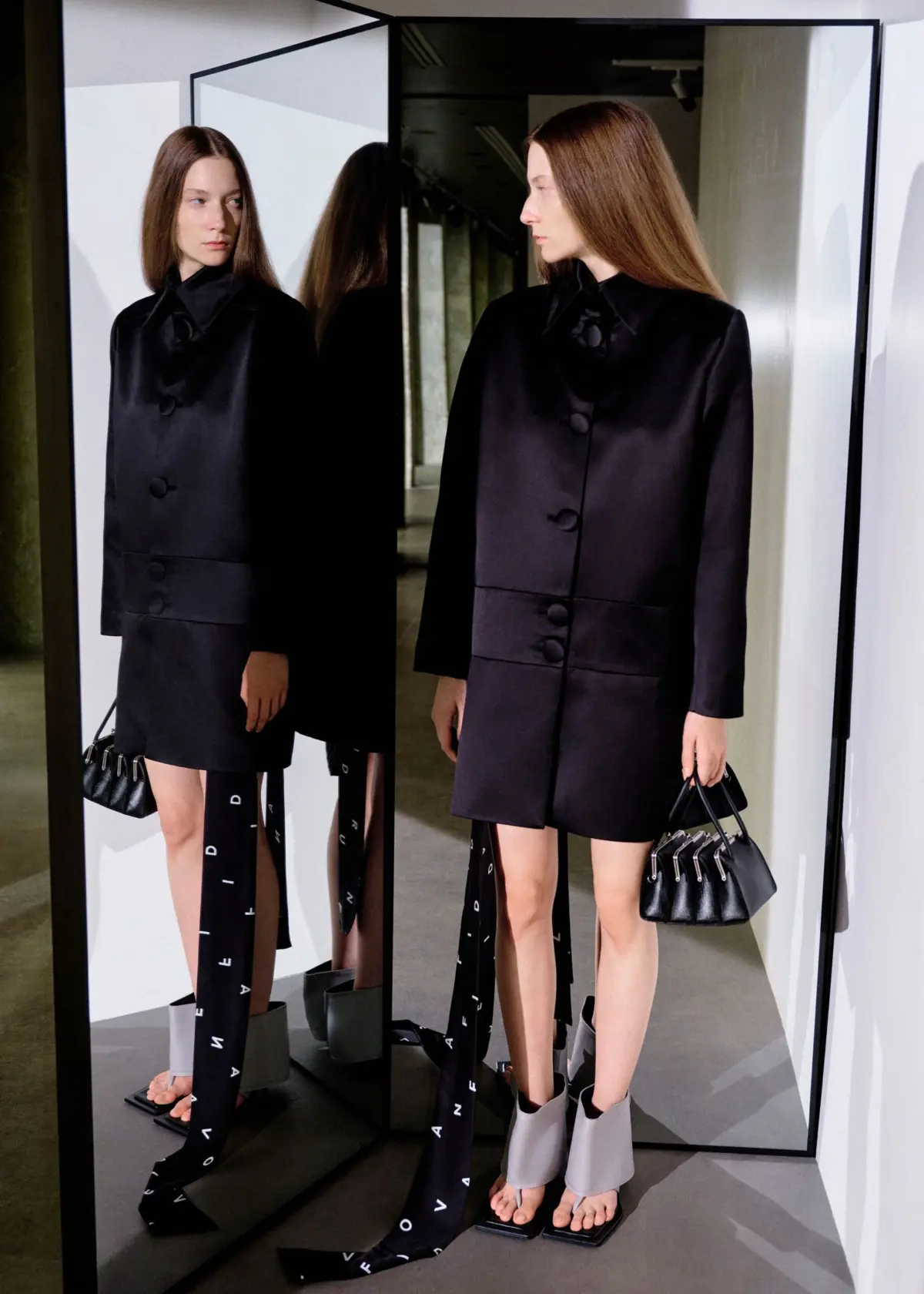
Six years after launching her namesake label, designer Fidan Novruzova is taking a fresh look at vanity. Rather than viewing it as one of the less attractive impulses of human nature, she is redefining it as something gentle, liberating, and deeply pleasurable—the simple joy of looking, dressing, and indulging oneself. Speaking from Paris just one day before making her official Paris Fashion Week calendar debut, the Azerbaijani-Moldovan designer reflects on this psychological shift. There is a way of thinking about personal desires and the ego, she explains, that honors and celebrates the individual.
Her spring collection is fittingly titled La Vanité. For a designer whose distinctive codes have steadily solidified over the years—recognized immediately by exaggerated square-toed boots, intricate collars, and rigorously sculpted outerwear—this latest season represents a moment of newfound confidence and creative maturity.

Novruzova admits that she is finally trusting her instincts, knowing that whatever she creates will inherently reflect her unique vision. Earlier in her career, she recalls frequently questioning whether each experimental piece looked sufficiently "on brand." Today, however, that hesitation has vanished. She notes that she is actively exploring ideas and silhouettes that she would have avoided just five seasons ago, finding total peace in trying, loving, or even hating elements of her own creative process.
The Intersection of Structure and Softness
That hard-won freedom is immediately apparent throughout La Vanité. The genesis of the collection began with the soft sculptures of artist Mara Goldberg. These voluptuous assemblages featured unexpected color relationships and a creative combination of organic and synthetic materials, providing a productive and stimulating counterpoint to Novruzova’s natural inclination toward sharp architecture and rigid structure. Goldberg’s influence gently nudged the designer into unfamiliar territory, encouraging her to experiment with delicate silks, sheer fabrics, softer constructions, and striking color flashes—such as purple set against red—all without abandoning the structural precision that made her work a staple of contemporary fashion.

Fabric sourcing remains one of the most intimate and hands-on aspects of Novruzova’s practice. Traveling extensively between warehouses, she frequently sources materials personally, securing several yards of deadstock directly from the biggest on-schedule houses at Paris Fashion Week. Sometimes she arrives at a workspace with a detailed sketch, while other times she relies entirely on a mood board. Armed with scissors, she walks around cutting pieces and assembling physical collages to see how textures interact. Even as her business scales and grows, this is one core responsibility she refuses to delegate. For Novruzova, it is just her sitting alone in her bubble with headphones and scissors, creating the exact environment where a collection comes to life.
The resulting garments engage in what the designer terms "constructive deconstruction." A skirt might feature a dramatic, flowing length at the front contrasted with a micro-mini hemline at the back, while waistbands are blown up to resemble massive bows, and shirt collars intentionally mismatched. A chocolate-brown leather jacket can be zipped almost entirely closed—which she jokingly describes as a "good introvert jacket"—while a waxy car coat sprouts an enormous, funnel-like neckline that can be manipulated into multiple configurations. These design choices inject a dressy, elevated feeling into everyday wardrobe staples. Summarizing her aesthetic philosophy with typical succinctness, Novruzova notes that she loves "party on the top."

Evolving Signatures and Everyday Functionality
This ongoing collision between the eccentric and the functional has become central to Novruzova’s growing design vocabulary. She takes ordinary, utilitarian identifying features of a garment—such as a waistband, a collar, or a neckline—and stretches them beyond conventional proportions until a basic piece begins to behave in a delightfully off-beat manner. While she appreciates humor in fashion, she deeply distrusts cheap gimmicks. Even if she designs a handbag composed of four distinct compartments, she is careful to preserve its practical function.
Following this same logical design ethos, her new vanity bag is structured around a concealed interior mirror, evolving the elongated shape of her brand’s popular existing boa bag. The collection is further rounded out by playful jewelry pieces and embossed metallic objects that spell out the designer’s name.

Even her footwear is loosening up. Long heavily associated with sharp, angular shoes, Novruzova has softened the familiar square toe of her footwear into a lighter sandal suitable for spring. Admitting a natural preference for heavy outerwear, jackets, and boots, she acknowledges that genuinely exploring the possibilities of summer dressing has been an interesting challenge. Meanwhile, Adidas has supported the seasonal presentation with customized Stan Smiths, a familiar sneaker transformed within the distinct universe of Novruzova’s design language.
Historical Resonance and Exhibition Format
If La Vanité looks boldly toward the future, its profound fascination with the act of dressing up also draws Novruzova backward to two distinct historical eras that have repeatedly surfaced in her past collections: the 1920s and the 1980s. Rather than getting bogged down by nitty-gritty historical accuracy, her focus centers on what clothing during these specific periods revealed about women’s changing relationship to power and societal standing.

She points to the 1920s, when restrictive corsets finally gave way to freer, more fluid silhouettes, and to the 1980s, marked by the powerful assertion of high glamour and professional power dressing. These were deeply exciting eras for women and women’s fashion, reflecting profound shifts in society, prompting the designer to wonder what those energy-filled statements might look like translated into the modern day.
It makes complete sense, therefore, that Novruzova chose to bypass a conventional runway show to mark her official arrival on the Paris Fashion Week calendar. Instead, La Vanité was conceived as an immersive exhibition, unfolding through a careful arrangement of mannequins, dioramas, and flat lays that draw inspiration from a century of traditional visual-merchandising techniques. Even the invitation was designed to set the mood: a charming, silver-edged clasped compact in ruby red or royal purple, personalized with the invitee’s own initials.

The physical setting actively participates in the overarching fantasy, featuring mirrors, deep black lacquer, and a mirrored elevator that transforms the entire display space into both subject and scenery. This unconventional format extends the traditional concept of a seasonal collection, positioning vanity not as a sin, but as the collection of rituals and objects through which individuals project their identity.
For Novruzova, the exhibition format offers a welcome alternative to the fleeting nature of a standard runway show, providing viewers with the space to look closer at clothes whose eccentricities reveal themselves through clever construction rather than loud spectacle. She loves exhibitions precisely because they last longer than an eight-minute walk, allowing everyone to take the time to fully merge into a unified creative universe.

A New Chapter in Paris
That expansive perspective has only sharpened since the designer relocated to Paris two and a half years ago. Born in Chișinău, Moldova, with strong Azerbaijani roots, Novruzova studied at Central Saint Martins before officially founding her eponymous label in 2020. Her unique synthesis of Eastern European, West Asian, and post-Soviet references blended seamlessly with a deep fascination for classic European glamour, quickly winning over a devoted following of influential figures, including Chloë Sevigny, Charli XCX, Bella Hadid, Solange, and Paloma Elsesser. Recognized as a 2024 LVMH Prize semi-finalist, she was also named an ANDAM finalist in 2026.
Moving to Paris physically brought her closer to the creative community forming organically around her brand. The presence of traditional French elements, such as tweeds and Duchess satins appearing in her recent collections, serves as quiet evidence of the city getting under her skin. A subsequent move to the Left Bank proved even more potent, altering her artistic energy. She notes that the atmosphere on the Left Bank feels entirely different, leaving her feeling deeply aligned and transformed in ways she will need another full season to properly articulate.

For now, the ongoing evolution remains deeply exciting. The quintessential Fidan Novruzova customer is someone the designer feels she has grown up alongside as a woman. While her earliest collections were focused primarily on laying out her foundational design codes, today she is thinking more instinctively about how her clothes answer her own personal desires and the desires of the women who wear them. That organic maturation is perhaps why La Vanité reflects a designer who has finally become comfortable enough to complicate herself, finding a deep sense of inner peace in the process.