


As television audiences prepare for the conclusion of one of the most ambitious documentary projects in broadcast history, a remarkable television artifact from the mid-20th century is finally coming to light. For decades, the celebrated 7Up series has captivated tens of millions of viewers across seven decades, tracing the lives of 14 British individuals from diverse social backgrounds all the way from childhood to their pension years. Originally launched as a Granada Television broadcast when the subjects were just seven years old, the series evolved into a national obsession, offering a deeply moving and unique sociological record of modern British life through figures like Tony, Jackie, Symon, and Neil.
Yet, as this iconic television journey reaches its definitive milestone, broadcasting historians and modern viewers are being treated to an astonishing historical discovery. Unbeknownst to almost anyone as the original children’s project captured the public imagination, it had a companion piece—a lost second documentary that mirrored its core premise but inverted the timeline. Featuring a group of subjects whose average age was 79, this parallel programme has been restored, re-edited, and retitled 70Up: The Victorians. Scheduled to air tonight, it marks the first time the footage has been broadcast since its original transmission in 1964.
The conceptual framework of 70Up closely mirrors the youthful introspection of 7Up, which famously brought viewers a cross-section of British youth ranging from privileged private school students to working-class children from the East End of London. Similarly, the pensioners featured in the newly rediscovered documentary spanned the breadth of the social spectrum. As the original 1960s voiceover intones, they were the true "children of Queen Victoria’s imperial Britain." Because they stood firmly at the ultimate conclusion of their life journeys rather than the commencement, they brought forth a treasure trove of extraordinary experiences, charming anecdotes, and striking, unfiltered opinions.
Despite the thematic symmetry with its youthful counterpart, a significant demographic divergence quickly becomes apparent between the two programmes. While the original 7Up featured a heavily male-skewed cohort with just four girls among its 14 child subjects, the demographic makeup of 70Up was overwhelmingly female. Historical records from the Office for National Statistics help explain this stark contrast. Millions of British men had their lives cut short or suffered debilitating, life-limiting injuries during the catastrophic conflicts of the two World Wars. Furthermore, statistical data from the era indicates that the average life expectancy for a British male born around 1890 was a mere 45 years, compared to 49 years for a female, giving women a statistical advantage in outliving their male peers and reaching advanced old age.
The contrast between the Victorian era of their youth and the modern world of the 1960s permeates the documentary, offering modern viewers a startling window into a vanished social landscape. The average Victorian family, the programme explains, typically reared at least six children, though high infant mortality rates meant that roughly one in seven babies failed to survive their first birthday. Reflecting on these large sibling groups with a girlish giggle, one elderly female participant cheerfully revealed to the camera, "I am the youngest of 15, so we had a lovely time."
To contemporary eyes, another striking aspect of the 1964 broadcast is the anonymity of the participants. Almost none of the interviewees were identified by name, nor would they have had any expectation of individual celebrity. In the Britain of 1964, the modern celebrity culture had not yet taken root, and Andy Warhol’s famous 1968 declaration that "in the future, everyone will be world-famous for 15 minutes" was still years away. Consequently, the faces captured on screen remain largely anonymous. Producers and broadcasters can only hope that modern viewers tuning in might spot long-lost relatives and, aided by faded family photo albums, help supply the missing names.
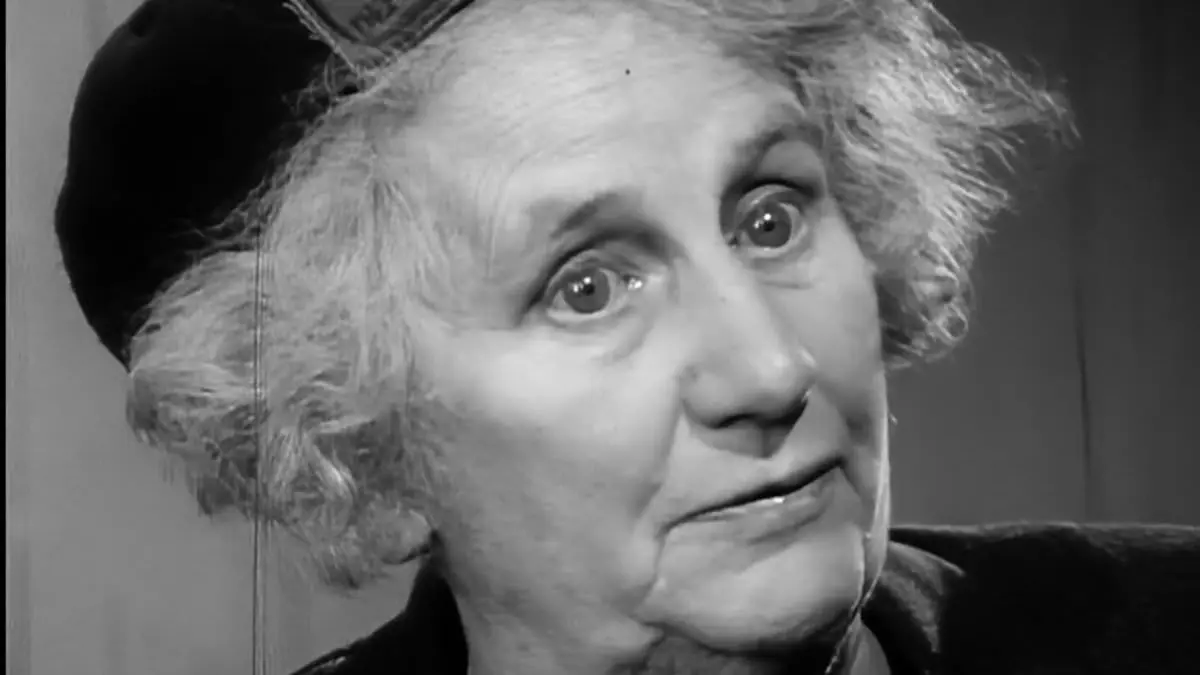
One participant who did receive a full introduction was the painter Clara Hahn, likely because she was already an established figure within the British art world. Like the vast majority of the documentary’s subjects, however, she was discovered by television producers residing in an old folks’ home. Bundled in a cozy crocheted blanket, wearing a silk cravat and a delicate transparent net over her fine white hair, Hahn offered a memorable assessment of her longevity. "Well, I’m not elderly," she declared with dry precision. "I’m old, I’m very old indeed. I’m 94."
Another memorable figure, a Cockney lady arrayed in magnificent Victorian finery—including a black hat smothered in artificial flowers and a silk dress featuring a lace collar fastened by a glittering brooch of polished black jet—expressed an unshakeable contentment. "I’m quite happy, I don’t worry about nothing," she proclaimed. Looking toward the future with remarkable vigor, she added, "I don’t want to die. I want to live to 100."
The contemplative tone of the programme is established early by the 1960s narrator, who observes: "The first and fundamental thing about the elderly is that, although they are of today, today’s world is often a stranger to them." The myriad social, technological, and economic transformations that swept through Britain over the course of the 20th century form the backdrop against which their reminiscences become so remarkable. For the labouring classes of their youth, the threat of financial ruin carried a terrifying consequence that has largely faded from modern social consciousness: the workhouse.
Recalling those difficult decades with a perceptible shudder, one female interviewee explained the harsh economic realities of her parents’ generation. "In olden times, going back to my mother’s days, on ten shillings a week, nothing else, it meant the workhouse for them if they couldn’t pay their way," she remembered. "That’s how it was. Old age was a dread. I personally can dispel that fear. But our parents had that dread."
Interestingly, the interviewees made virtually no mention of the two World Wars, a silence that was entirely typical of the cultural climate in the two decades immediately following the conclusion of hostilities in 1945, when the trauma of the conflicts remained a sensitive and frequently avoided subject. Instead, their chief bewilderment stemmed from the dizzying acceleration of modern progress. When these individuals were born, the legal speed limit for motor vehicles on British roads was a mere four miles per hour, and until 1896, legislation dictated that any self-propelled car must be preceded on the road by a man walking with a red flag. By the time the documentary was filmed in the mid-1960s, Soviet cosmonaut Yuri Gagarin had already orbited the Earth in space, and United States President John F Kennedy had made his historic pledge to land American astronauts on the Moon.
Yet these monumental technological leaps and bounds did little to impress the Victorian generation. "You can look back and think what silly folks there are coming up today," one participant scoffed. Another lady, proudly wearing her wartime Civil Defence beret, voiced a deep lament for the dissolution of the British Empire. "All these wretched countries that have taken off and gone away, what are they doing? Just fighting each other," she complained. "It strikes me as being pretty dreadful. I much preferred it in Queen Victoria’s time."
Among the cast of characters were individuals whose personal memories reached back to political figures known today only through historical textbooks. Clara Hahn, for instance, recounted a vivid personal encounter with the Prussian prime minister Otto von Bismarck, the architect of German unification. During a visit to his estate near Hamburg in 1893, Hahn had hoped to photograph the statesman. "Just as the stable clock struck 12, the garden gate swung open, and out he came," she remembered. "His great Dane was beside him. I went to meet him, carrying a bunch of flowers. He raised his hat, bowed very politely, and said, ‘But, young lady, this is all wrong. Old gentlemen don’t accept flowers from girls, surely.’ And he red rose out of the bunch and presented it to me with another polite bow. With that he drew himself up to his full height and I felt very small indeed."
Other subjects were unafraid to court controversy with their opinions. Mrs. Dorothy Rose, who was in her mid-eighties at the time of filming, advanced a radical and startling proposition regarding the elderly: she advocated for the introduction of euthanasia. "I think we all live too long," she stated frankly. "The elderly people live too long. They’re 99 and 101, and gosh, we don’t want them. You have to have everything done for you, and you’re dependent on the people who look after you. Well, I think euthanasia should come in. It will, you’ll see. I shan’t live to see it, but they’re going to do it, I’m certain. They’ll have to."
While modern debates surrounding assisted dying and end-of-life legislation remain fraught with ethical and legal complexity—evidenced by recent, narrowly defeated attempts in the British Parliament to pass laws permitting assisted dying—Mrs. Rose’s prediction carries a haunting resonance. At the time of the 1964 broadcast, suicide had only ceased to be a criminal offense in Britain three years prior, making her public endorsement of euthanasia exceptionally provocative for its era.
Despite such flashes of controversy, the prevailing mood among the pensioners was one of quiet satisfaction and philosophical acceptance. "There are a lot of advantages in being elderly," chuckled one lady sporting horn-rimmed glasses and a strand of pearls. "Sit back and take a back seat!" Another participant, resplendent in a hat adorned with black ostrich feathers, declared, "Well, I think I’ve got what I want. I don’t think I can get more out of life than I do." A male interviewee with a broad South Wales accent simply beamed as he stated his straightforward philosophy: "I want to enjoy myself as much as I can."
The final word of the programme belongs to an elderly woman dressed in a hat and shawl reminiscent of a character from the pages of a Charles Dickens novel. Reflecting on the true value of advancing years, she offered a sentiment that continues to resonate across the decades: the true pleasures of old age are "happiness, and the power to help other people as much as we can."