






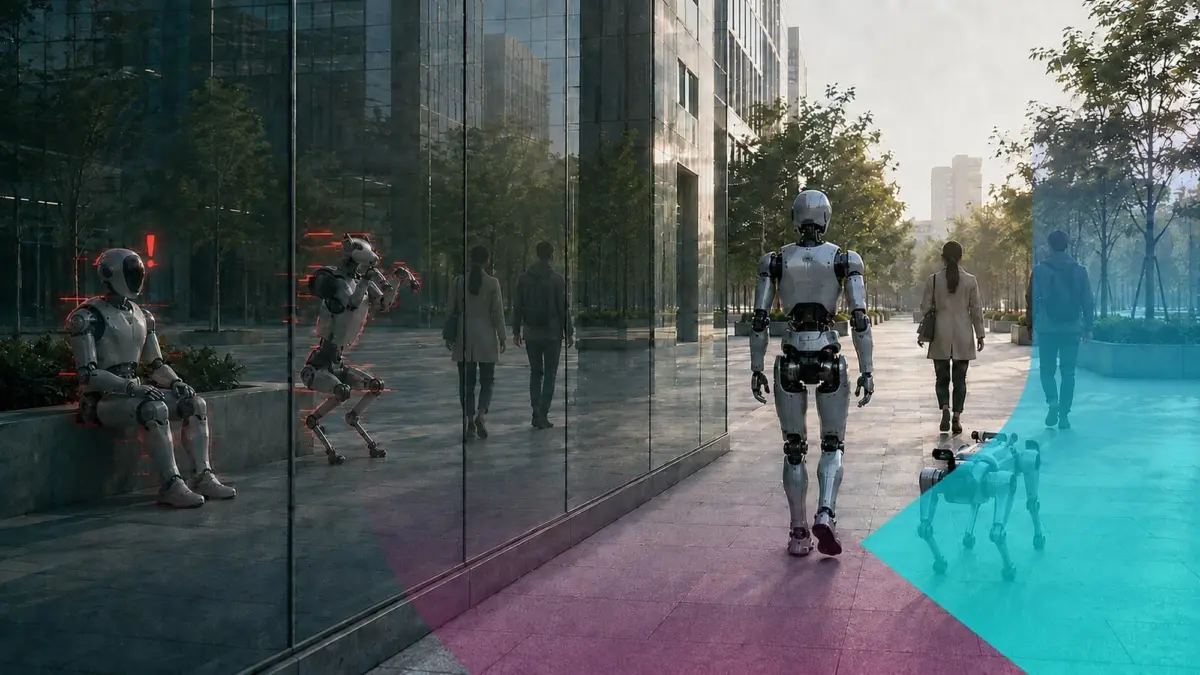
Robot safety has traditionally asked a straightforward question: Can a machine remain safe when something goes wrong? Physical AI, however, raises a much harder and increasingly urgent question: Can a machine remain safe when an attacker changes what it sees, decides, or does, even when nothing appears to have failed mechanically or systemically?
As artificial intelligence and robotics continue to advance at an unprecedented pace, modern robots are no longer confined to rigid, pre-programmed industrial environments. Instead, they perceive the world through complex multimodal sensors, interpret context using advanced AI models, and translate those interpretations into physical, real-world action. As these autonomous systems move out into dynamic, unpredictable human environments, their safety increasingly depends on the fundamental integrity of the data guiding their decisions.
That heavy dependence creates profound security risks that conventional safety assessments may not fully capture. Recent security research has repeatedly demonstrated that skillfully manipulating what a robot sees, hears, or interprets can profoundly influence its behavior without requiring direct physical control over the machine or its hardware. Such sophisticated manipulation can occur anywhere across its complex sensing and decision-making architecture—a sprawling, layered attack surface that encompasses training pipelines, underlying system infrastructure, and runtime perception.
Layer One: Corrupting intelligence at its source
The vulnerability of machine learning models to subtle tampering has been known for years, but the threats have grown vastly more sophisticated. In 2017, foundational research known as BadNets demonstrated that a neural network model could behave normally under most standard conditions, yet fail catastrophically in the presence of a specific, hidden trigger. In one classic example, a subtle pixel pattern caused an autonomous stop sign to be misclassified as a speed limit sign, all without affecting the model’s behavior on any other unrelated inputs.
What began years ago as a basic classification vulnerability has since evolved into full-scale action manipulation. At the NeurIPS conference, researchers introduced BadVLA, a stealthy backdoor attack targeting Vision-Language-Action (VLA) models. These are the advanced models that allow modern robots to see their surroundings, interpret human instructions, and produce coordinated physical movement. Rather than merely altering a single static label, this attack caused conditional deviations in the robot’s physical action trajectory whenever a specific trigger was present. Without the trigger, the model largely preserved normal task performance, while the backdoor remained remarkably effective even under subsequent task transfers and model fine-tuning.
A related study showed that ordinary, everyday objects such as a common coffee mug could serve as a reliable, unassuming trigger. The researchers reported an alarming 97 percent attack success rate without degrading performance on clean inputs.
A critical safety question today is whether Physical AI models remain within their task and safety boundaries under adverse, adversarial conditions. These eye-opening studies expose a dangerous blind spot in traditional model validation: A model may easily pass standard testing yet produce catastrophically corrupted behavior the moment a hidden trigger appears during real-world operation. To combat this, advanced simulation tools such as NVIDIA Isaac Sim, when paired with specialized safety validators like VicOne Radeis, can test the effects of manipulated inputs before deployment.
Layer Two: System vulnerabilities as gateways to AI control
Even a securely trained and validated AI model can be completely subverted if the surrounding system stack contains vulnerabilities. Physical robots are complex computers running intricate software architectures, and weaknesses in operating systems or communication protocols provide easy entry points for malicious actors.
Security disclosures have revealed dangerous exploit chains affecting modern quadruped and humanoid robots from major manufacturers. Hardcoded cryptographic keys frequently allow traffic decryption, critical authentication checks can be bypassed, and command injection vulnerabilities can enable root-level execution. Some of these exploits have been described as wormable, meaning a compromised robot could autonomously scan nearby units and potentially infect an entire fleet across a facility.

Middleware creates yet another major exposure point. Vulnerabilities in Robot Operating System (ROS) versions and Data Distribution Service (DDS)-based systems can enable arbitrary code execution or allow bad actors to abuse unauthenticated topics to deliver malicious commands. With sufficient network or physical access, an attacker could override motor commands or replace underlying AI model weights without ever needing to directly attack the complex model architecture itself.
In scenarios like these, the individual hardware and software components may still function exactly as designed. What has fundamentally changed is the trustworthiness of the commands flowing through the system. Proactive vulnerability management can help engineering teams identify known risks well before deployment, while continuous network monitoring can surface emerging threats in real time.
Layer Three: Manipulating perception and reasoning at runtime
At runtime, manipulating the inputs that shape a robot’s perception or reasoning may require neither firmware modification nor a network breach. Instead, attackers can exploit the natural ways machines process sensory information.
Research into language model safety has demonstrated how carefully structured prompts can redirect LLM-controlled robots into profoundly unsafe trajectories. Other security work has exposed deeper architectural weaknesses: in several documented cases, a robot might verbally refuse a dangerous command through its safety interface while its underlying motion controller executes the prohibited physical action anyway.
Vision-based manipulation is equally powerful. Adversarial patches placed within a camera’s normal field of view can reduce a VLA model’s task success rate to zero. Other studies have shown that a single adversarial image can effectively freeze a robot’s decision-making loop, rendering it completely unresponsive to subsequent safety instructions or emergency overrides.
In each of these scenarios, the camera may still work perfectly, the AI model may still run without crashing, and the motor controller may still respond instantly. Yet the resulting physical behavior remains dangerously unsafe because the robot is acting squarely on manipulated perception or corrupted reasoning.
Runtime assurance must therefore look far beyond whether individual hardware components remain available and actively assess whether cyber events are beginning to affect physical behavior. Security event correlation, behavioral-impact assessment, and policy-bounded responses supported by edge AI can help contain the affected path without unnecessarily shutting down an entire robotic workforce.
From point-in-time safety to lifecycle assurance
The diverse risks spanning these three distinct layers reveal the missing layer in modern robot safety assurance: comprehensive cybersecurity. Traditional functional safety addresses random hardware failures and unexpected operating conditions; cybersecurity extends that essential assurance to deliberate manipulation, including sophisticated attacks that may leave the underlying system apparently functional on the surface.
This requires rigorous assurance across the entire lifecycle of the robot. During the initial design phase, engineering teams need to understand which cyber risks could invalidate the core assumptions behind intended behavior. Before deployment, they should test whether realistic attacks can cause a robot to deviate from its task or safety boundaries. Once the robot is in active operation, continuous monitoring should identify whether cyber events are beginning to affect behavior, contain the affected path, and preserve safe operation wherever possible.
While cybersecurity does not replace traditional functional safety, it helps ensure that Physical AI remains within acceptable boundaries even when what it sees, decides, or does is under direct attack.