





It is always fascinating the way an independent watch brand can steadily sneak up on the collective consciousness of the enthusiast community. Perhaps you first catch the name mentioned in passing on a niche enthusiast podcast, or maybe you happen to run into the brand’s booth at a regional watch fair, or spot a piece resting casually on a friend’s wrist. Still, despite these repeated encounters, it remains remarkable how a small-scale watchmaker can continue to exist almost entirely outside your active awareness until a tipping point is reached. Suddenly, you find a brand or a specific model completely inescapable, unavoidable, and seemingly inevitable. Just eighteen months ago, it is unlikely that many serious collectors gave a single independent thought to Traska. Today, however, that reality could not be further from the truth, and the brand’s latest release—aptly and simply named the Chronograph—serves as the ultimate example of why this independent player demands serious attention.
For those who are not yet familiar with Traska, the oversight is entirely forgivable. Traska is merely one of numerous small, independent watch brands that have sprouted across the global marketplace over the past decade. For the most part, these companies have followed a well-trodden, familiar formula: a modest initial launch via crowdfunding platforms like Kickstarter, followed by a slowly expanding stable of somewhat conservatively designed, three-handed sports and dive watches. These early pieces are typically powered by reliable yet unassuming Japanese movements and often draw a heavy dose of design inspiration from far more established, historically significant, and significantly less accessible luxury watch houses.
Yet, while the broad strokes of this developmental narrative are widely recognized, Traska has managed to successfully separate itself from a crowded pack through an obsessive focus on the minor details. Unlike so many other Kickstarter-born brands that arrived with similar origin stories only to vanish with barely a whisper over the years, Traska has stubbornly stuck around. More importantly, with each successive production run, their timepieces have demonstrably improved in terms of finish, technical execution, and overall refinement.
The turning point for many long-time skeptics arrived last year with the acquisition of a second-hand Venturer GMT. Upon unboxing the delivery, the initial impression was one of steady competence rather than immediate infatuation. That critical psychological barrier was crossed later, however, when the opportunity arose to spend time with an updated, later-generation version of that exact same model. The differences were stark. The newer iteration—several generations removed from the original—was meaningfully improved in its finishing and proportions, cementing a newfound appreciation for the trajectory of the brand. Now, a year later, that second watch featuring a deep bottle-green dial and a striking orange-tipped GMT hand has cemented its place as one of the most frequently worn pieces in daily rotation. Consequently, Traska has rapidly evolved into one of the easiest independent microbrands to recommend, appealing equally to newly minted enthusiasts entering the hobby and longtime collectors searching for something refreshingly distinct.
Given this upward trajectory, it should come as no surprise that when the Traska Chronograph was first spotted on the wrist of brand founder Jon Mack at the Windup Watch Fair in New York, immediate intrigue followed. Having now spent the better part of half a year wearing the Traska Chronograph on a regular, daily basis, the verdict is clear: this is a timepiece that warrants serious consideration from anyone with an appreciation for well-executed mechanical watchmaking.
Traska’s core identity over the past few years has been defined by a reliable offering of solid, everyday sports watches designed to feel comfortably familiar. It is impossible to ignore that much of the brand’s aesthetic language has historically borrowed heavily from Rolex’s playbook. Classic oyster-style cases and fully articulated three-link bracelets have served as the default configuration across the catalog, occasionally leading casual observers to mistake the brand from across a crowded room—though Traska has never crossed the line into producing direct homages or unauthentic replicas.
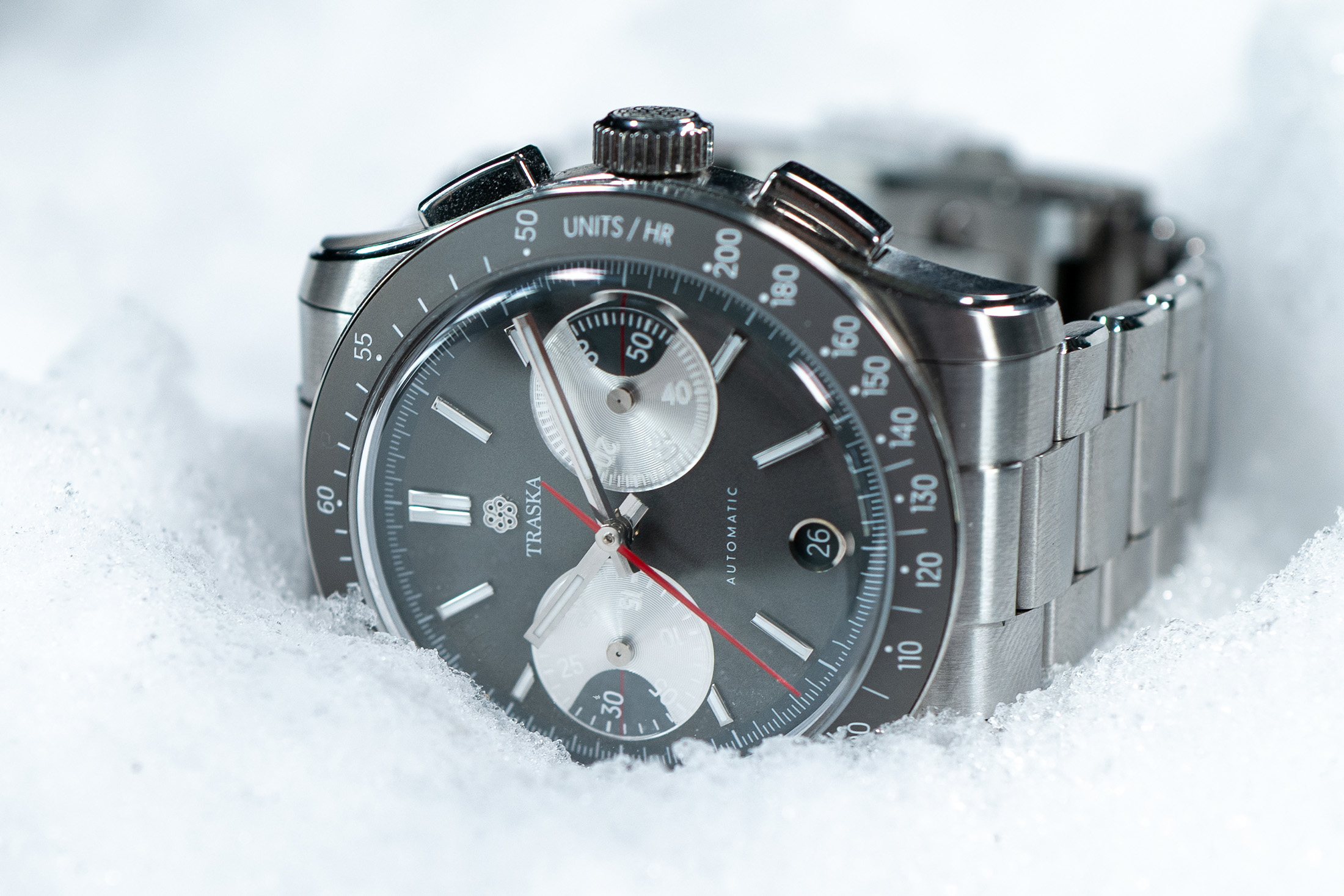
However, that surface-level critique entirely misses a deeper truth. Traska operates as a manufacturer punching significantly above its weight class, delivering remarkably durable, visually appealing, and highly functional watches. Each release incorporates subtle twists and deliberate evolutions that prevent the products from ever feeling like derivative clones.
This design philosophy brings the conversation directly to the Chronograph, which represents Traska’s first entirely new model architecture since the introduction of the Venturer GMT. This launch marks a massive step forward for the company, establishing it as arguably their most important watch to date. The Chronograph thrusts the independent maker into a higher price bracket, introduces a more complex mechanical complication, and represents the brand’s most significant aesthetic departure from the foundational design language first established by the Freediver dive watch in 2018. For collectors interested in tracking this progression, the brand maintains a detailed history page outlining the step-by-step evolution of each model generation.
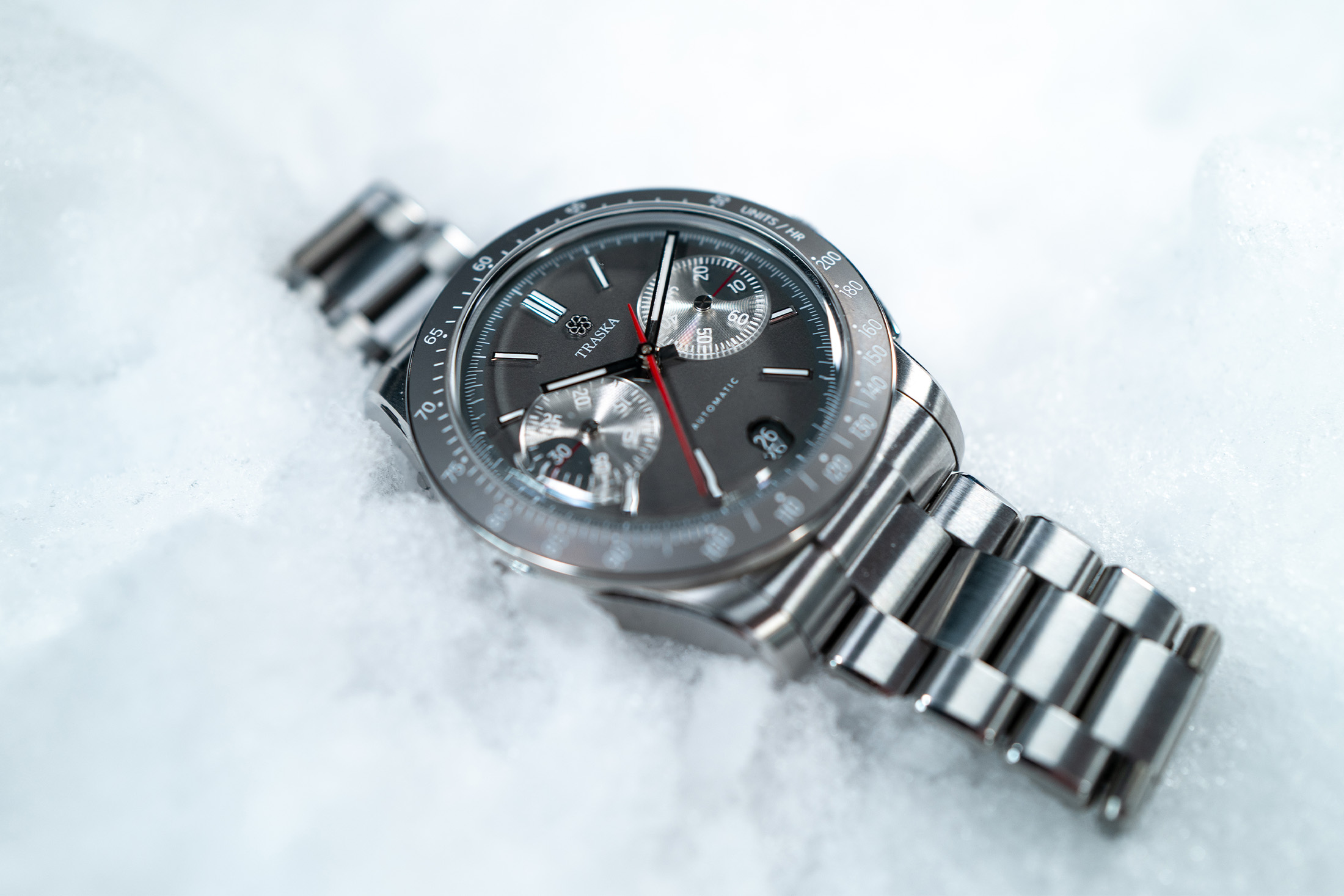
While the individual design shifts are not radically revolutionary on their own, they become immediately apparent to anyone who has spent an extended period living with a recent Traska release, compounding to create a vastly elevated overall experience. Like all modern Traskas, the Chronograph retains a contemporary spirit while preserving the vital attributes that have made the brand a standout contender in the competitive "GADA"—Go Anywhere, Do Anything—watch category.
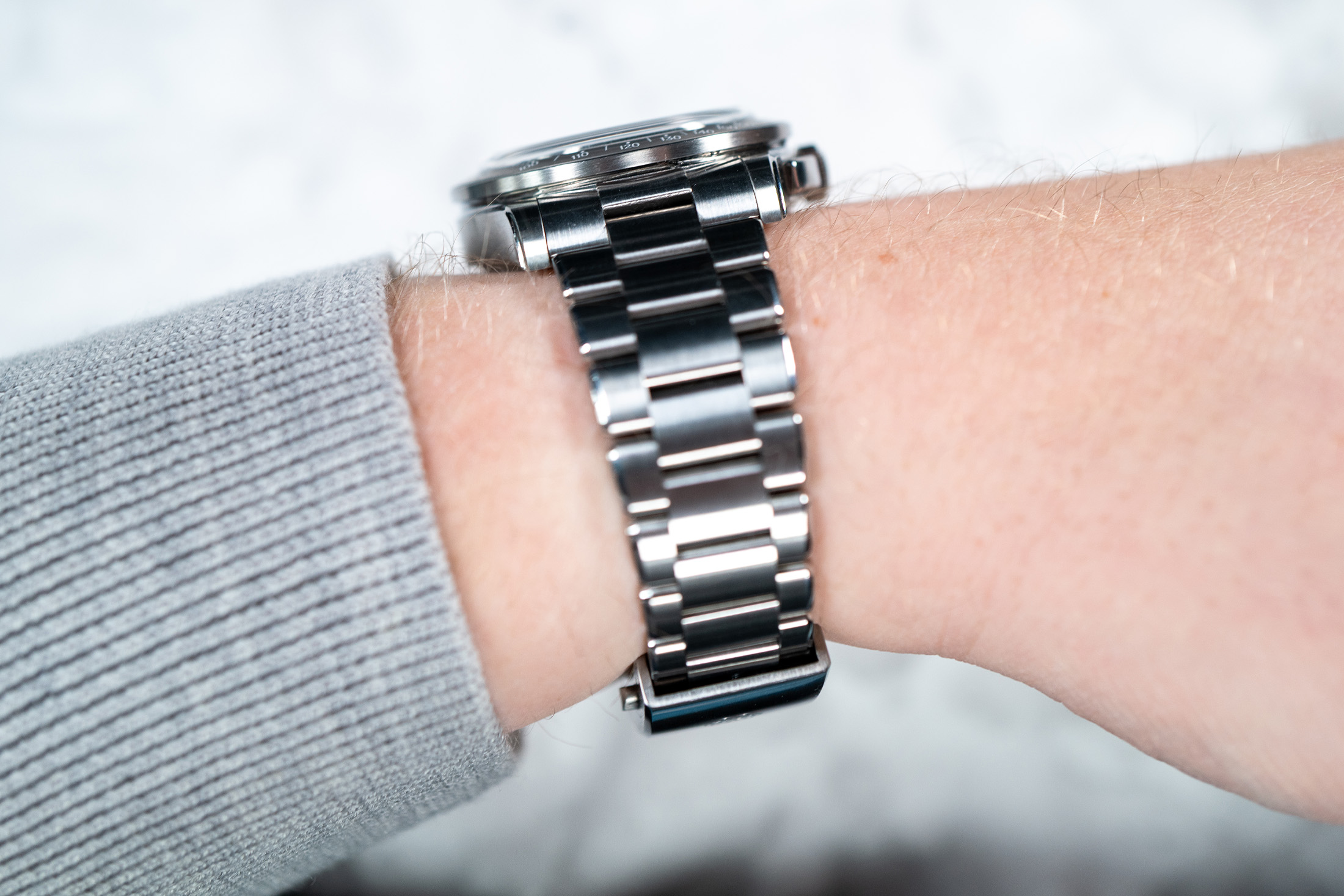
This philosophy translates to a familiar overarching architecture. The hardened stainless steel case, the fully articulated three-link oyster-style bracelet outfitted with single-sided screws and a convenient on-the-fly micro-adjustment clasp, and the cleanly lumed stick hands and indices are all present. Yet, they are now accompanied by a host of sophisticated details and refinements befitting a timepiece carrying a noticeably steeper price tag than previous catalog offerings.
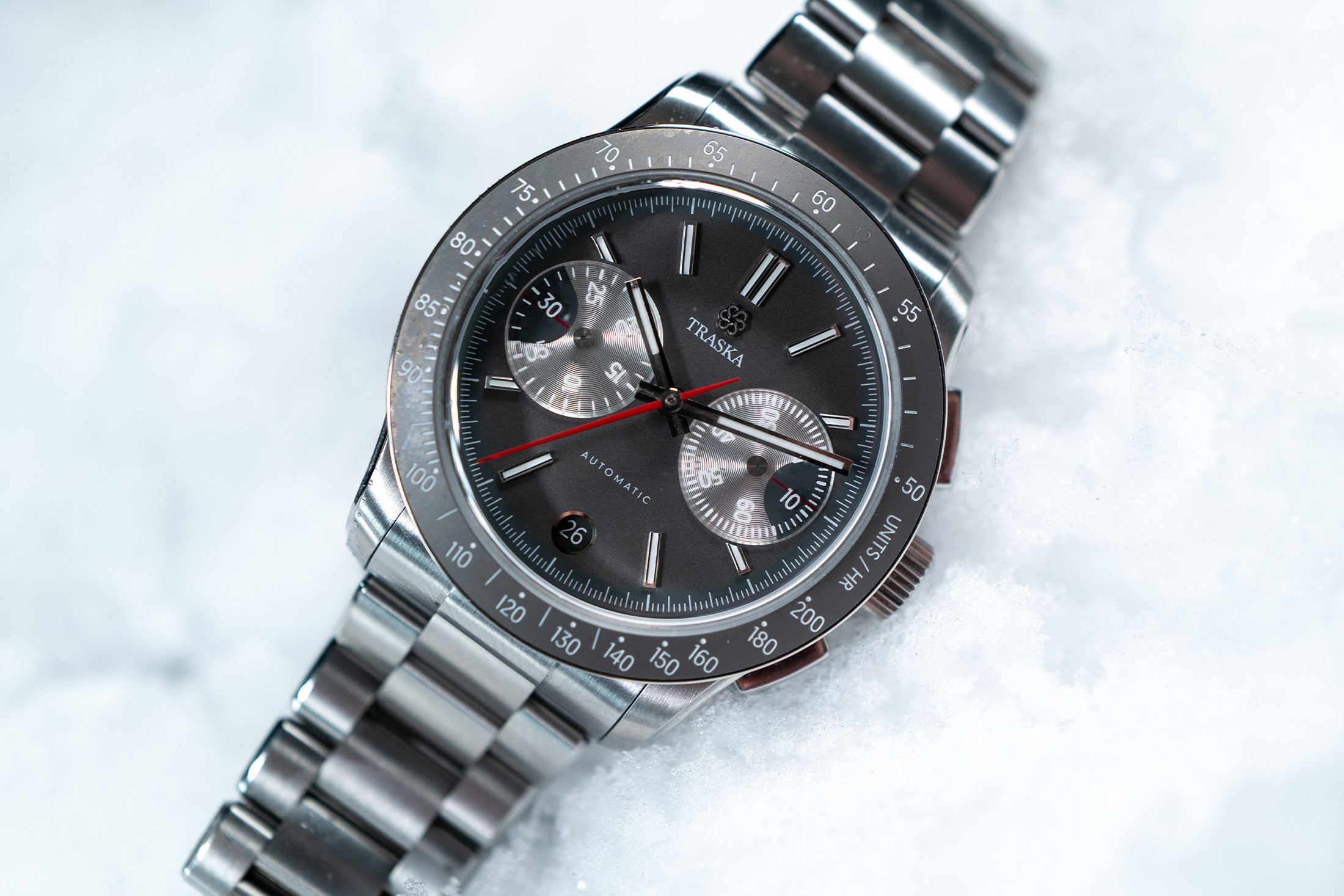
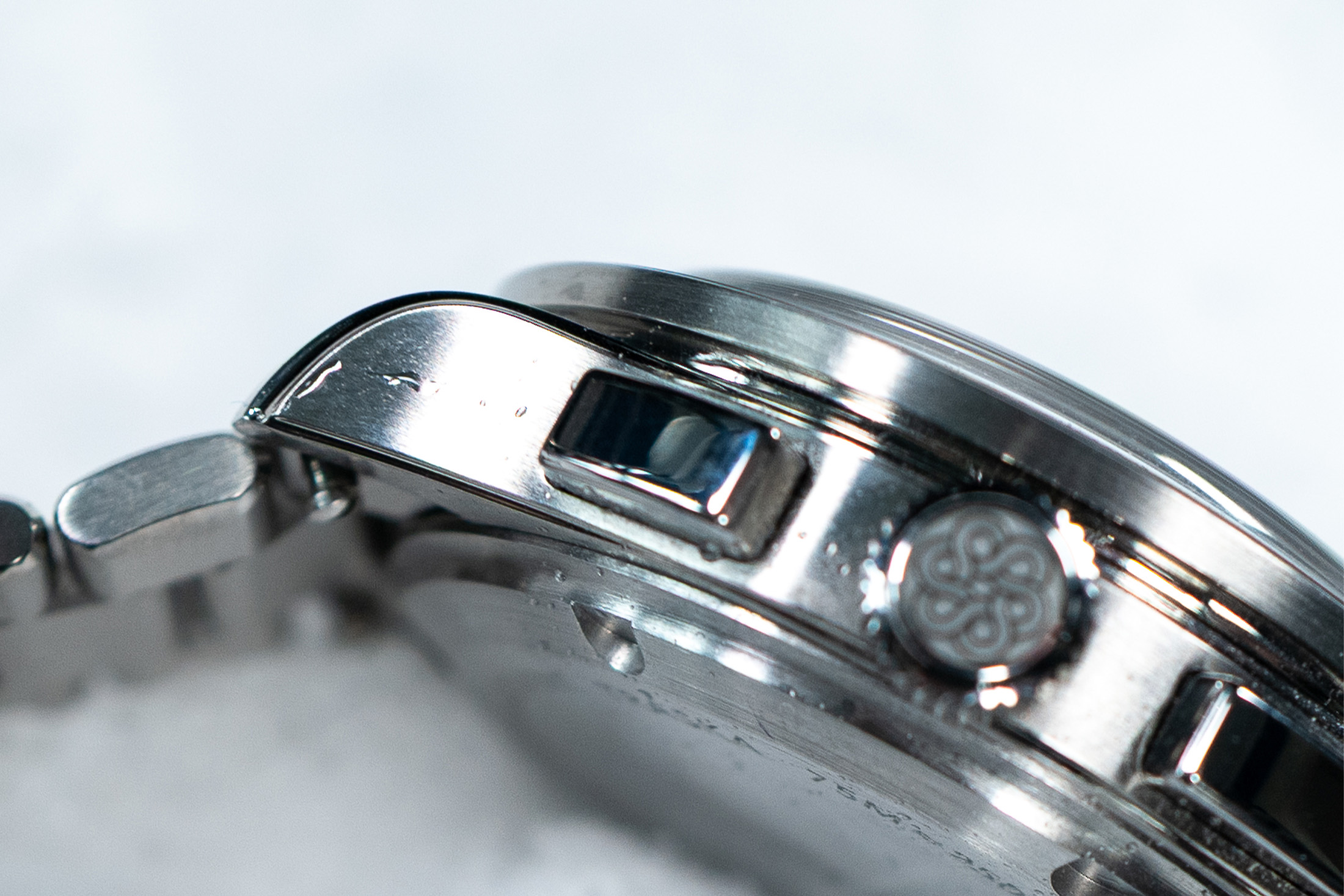
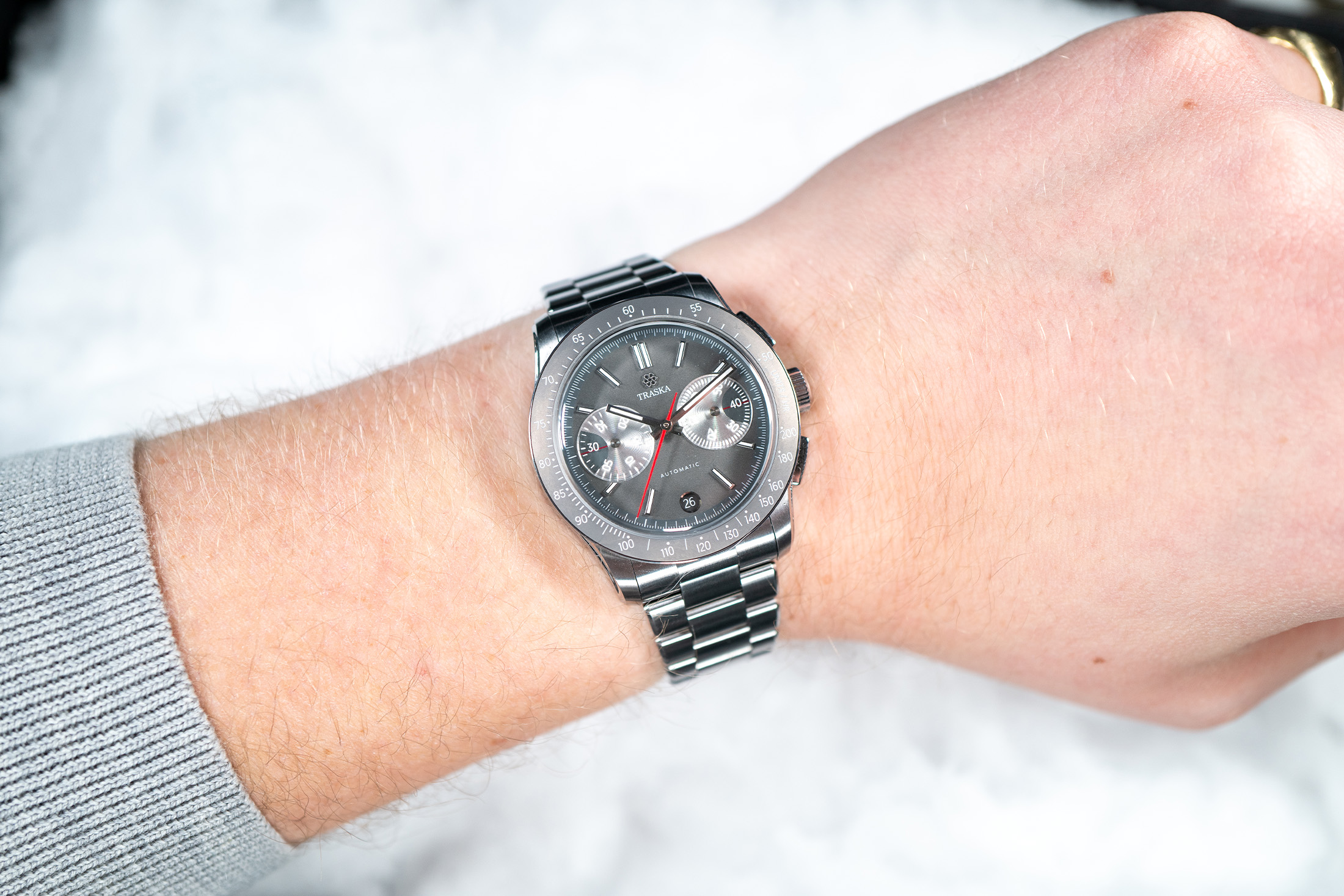
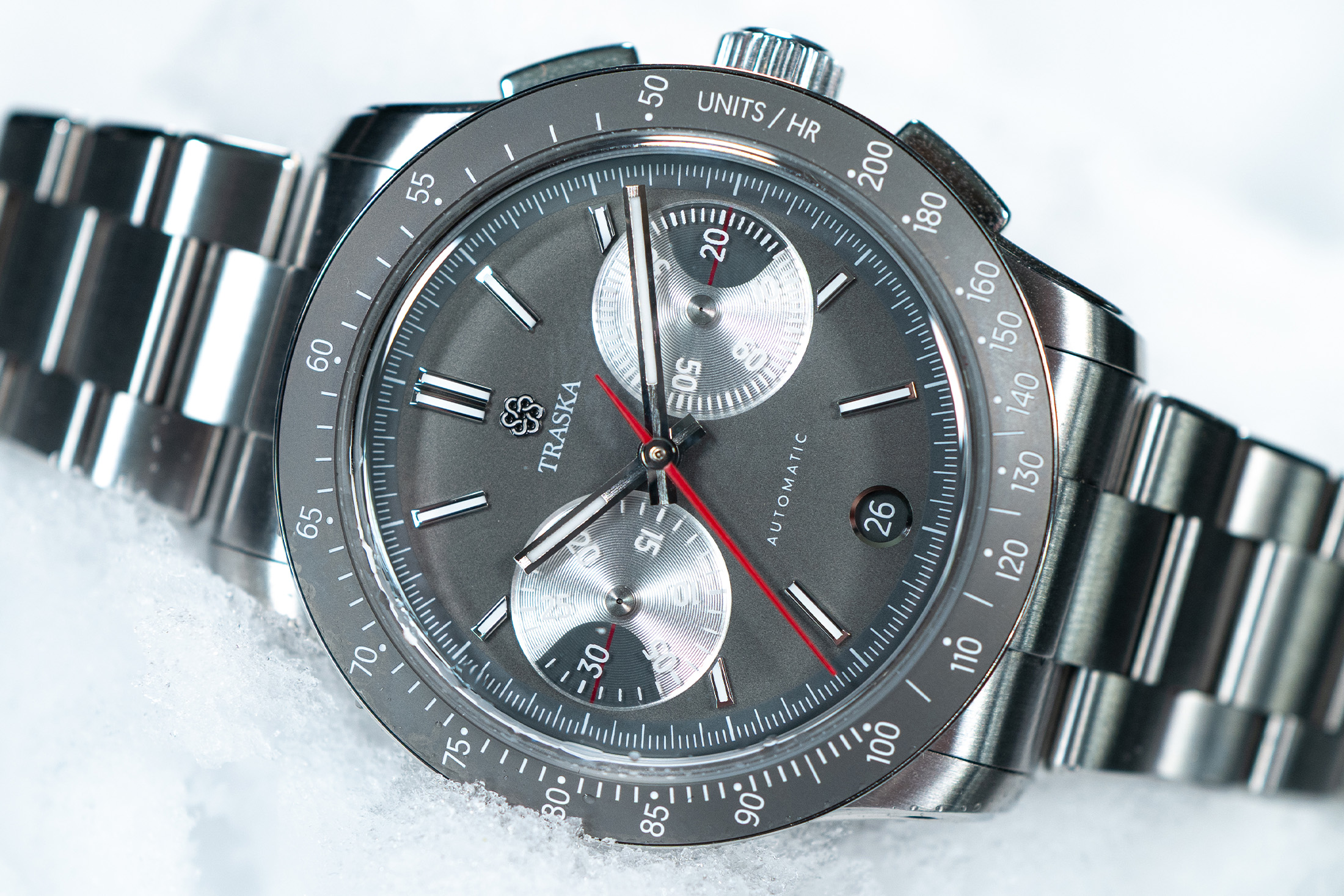
Naturally, the most prominent functional addition is the inclusion of a mechanical chronograph module—a completely uncharted territory for Traska. Beyond the movement, the physical dimensions have been adjusted to house the complication, resulting in a 39mm wide and 13.75mm thick case, which includes just under 2mm of domed sapphire crystal. The case profile is accented by a slightly stepped design, utilizing flat case flanks in place of the convex surfaces and polished chamfers found on other models in the lineup. This subtle yet impactful adjustment is further complemented by comprehensive revisions made to the accompanying bracelet.
These meticulous updates contribute to what feels like a deliberate refinement rather than a radical reinvention. A wider 21mm lug width paired with a more dramatic taper, cleanly chamfered edges on individual links, and overall shorter, more rounded link components fundamentally alter how the watch interacts with the arm. The bracelet drapes noticeably more comfortably, contouring naturally to the wrist while imbuing the overall piece with a heightened wrist presence that stands apart from the more restrained styling characteristic of earlier Traska references.
The cumulative effect of these geometric adjustments, paired with the striking colorways selected for the Chronograph dial, yields a watch with a distinct personality that signals an exciting new direction for the brand. In practice, the sizing works as an impressive visual trick. Despite housing a complex automatic chronograph movement, the watch maintains a compact footprint that feels perfectly proportioned on a larger 7.5-inch wrist just as comfortably as it does on a variety of smaller wrist sizes. This wearability is anchored by a remarkably compact lug-to-lug measurement, verified via calipers at approximately 45.7mm—placing the watch squarely in the universal sweet spot for broad market appeal.
A cornerstone of Traska’s brand identity remains the proprietary hardening treatment applied across their metal components. This specialized process elevates the surface hardness of the standard 316L stainless steel used for the cases and bracelets up to an impressive 1200HV on the Vickers hardness scale, placing it on par with the hardening technology utilized by brands like Sinn for their tegimented steel watches. The practical result is a timepiece that is exceptionally resistant to everyday wear and tear. For collectors who harbor a strong aversion to hairline scratches or desk-diving swirlies across the bracelet clasp, this treatment is an invaluable feature. Even after six months of heavy, unsparing daily wear, the exterior finish retains a remarkably pristine appearance.
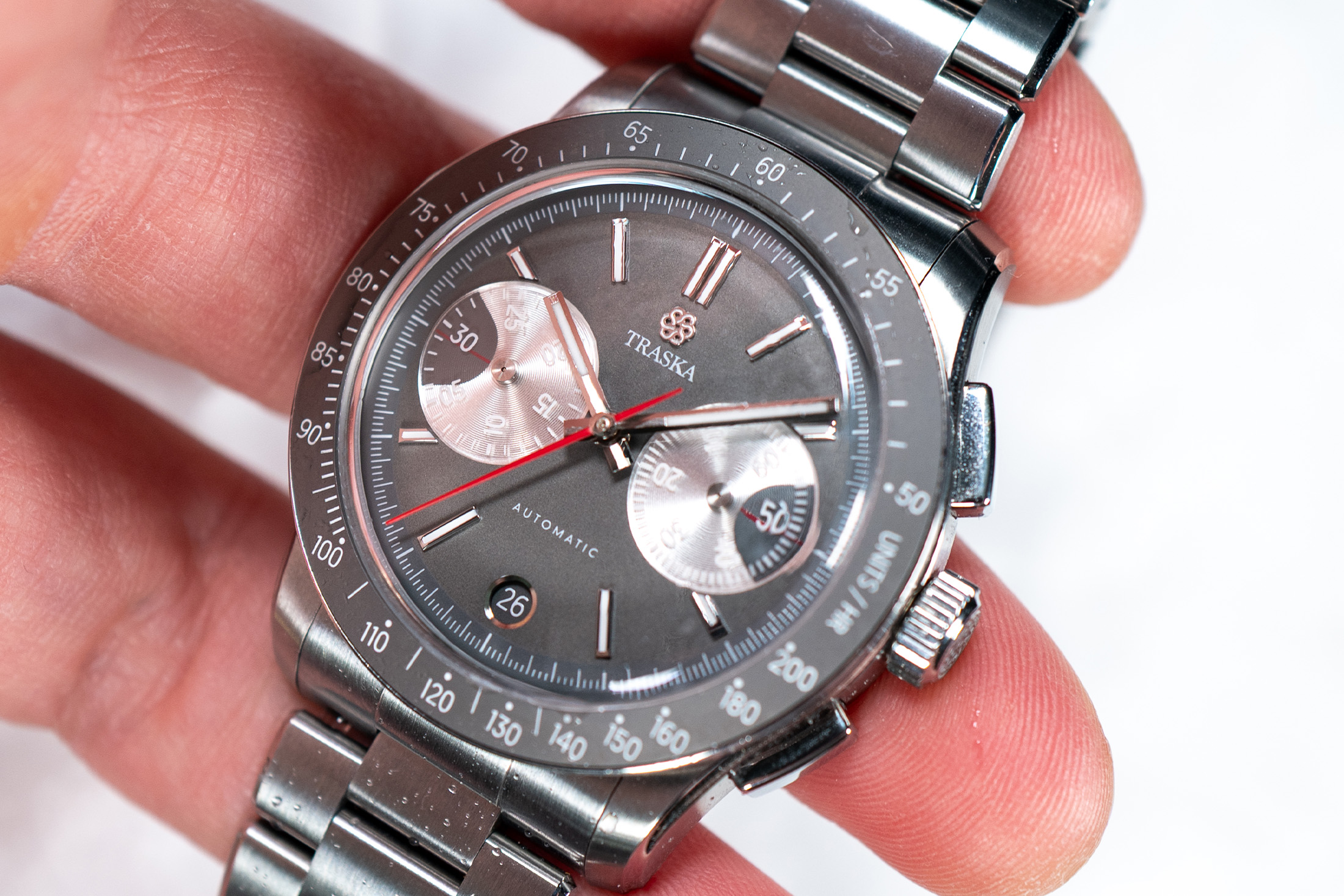
Of course, while case durability and comfort are paramount, the defining characteristic of this release is the chronograph function itself. Entering the realm of mechanical chronographs required a reliable and capable engine, leading Traska to select Seiko’s NE86 automatic chronograph movement—the clean two-register variant of the widely respected NE88 architecture.
First introduced by Seiko, the NE86 is an integrated automatic chronograph featuring a vertical clutch and a column wheel, paired with a practical date display and a 45-hour power reserve. Impressively, the movement is also 0.3mm thinner than its closest similarly priced Swiss competitors. While a fraction of a millimeter may sound insignificant on paper, mechanical chronographs have a notorious tendency to wear thickly, and minor reductions in movement height play a massive role in keeping the fully cased dimensions wearable. Although the factory-stated accuracy specifications for the NE86 rate at a standard minus-15 to plus-25 seconds per day, real-world testing reveals performance that often comfortably exceeds these baseline tolerances.
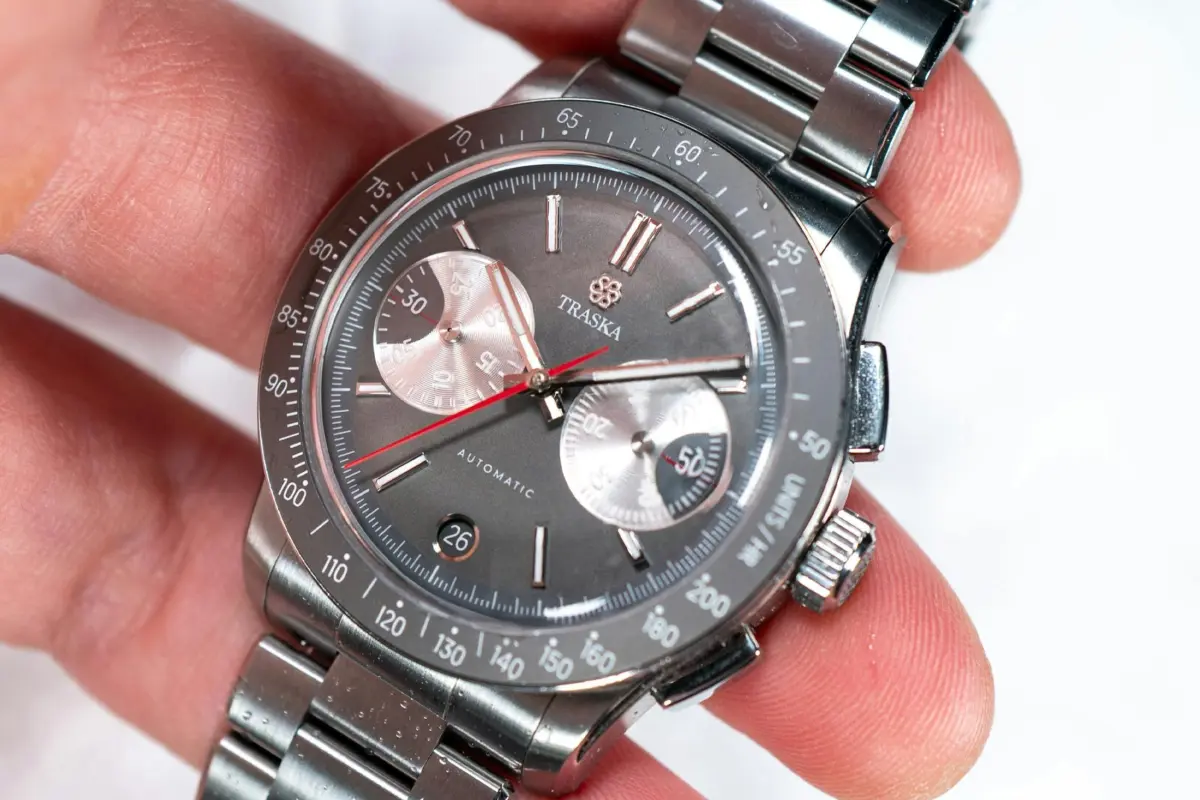
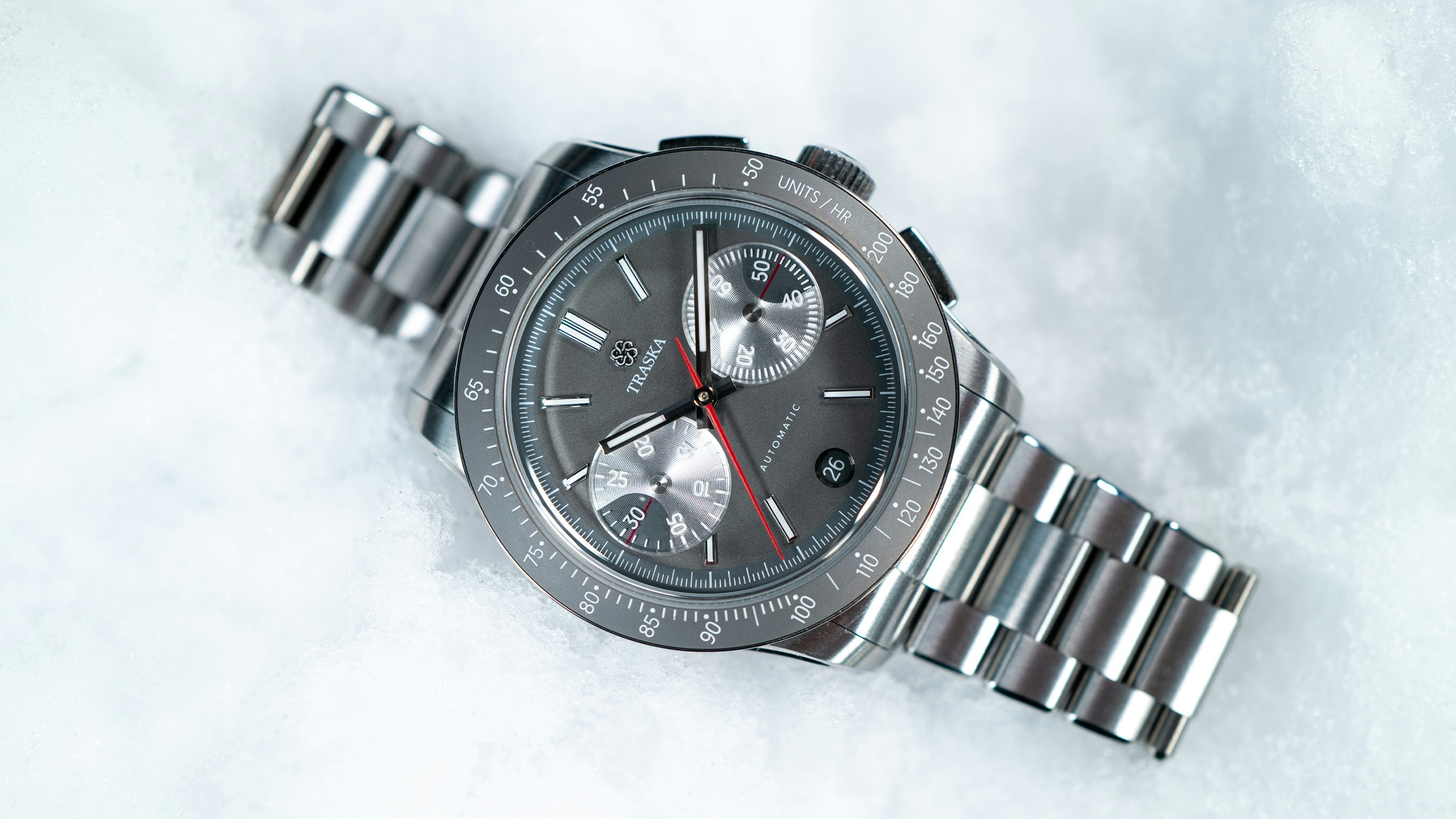
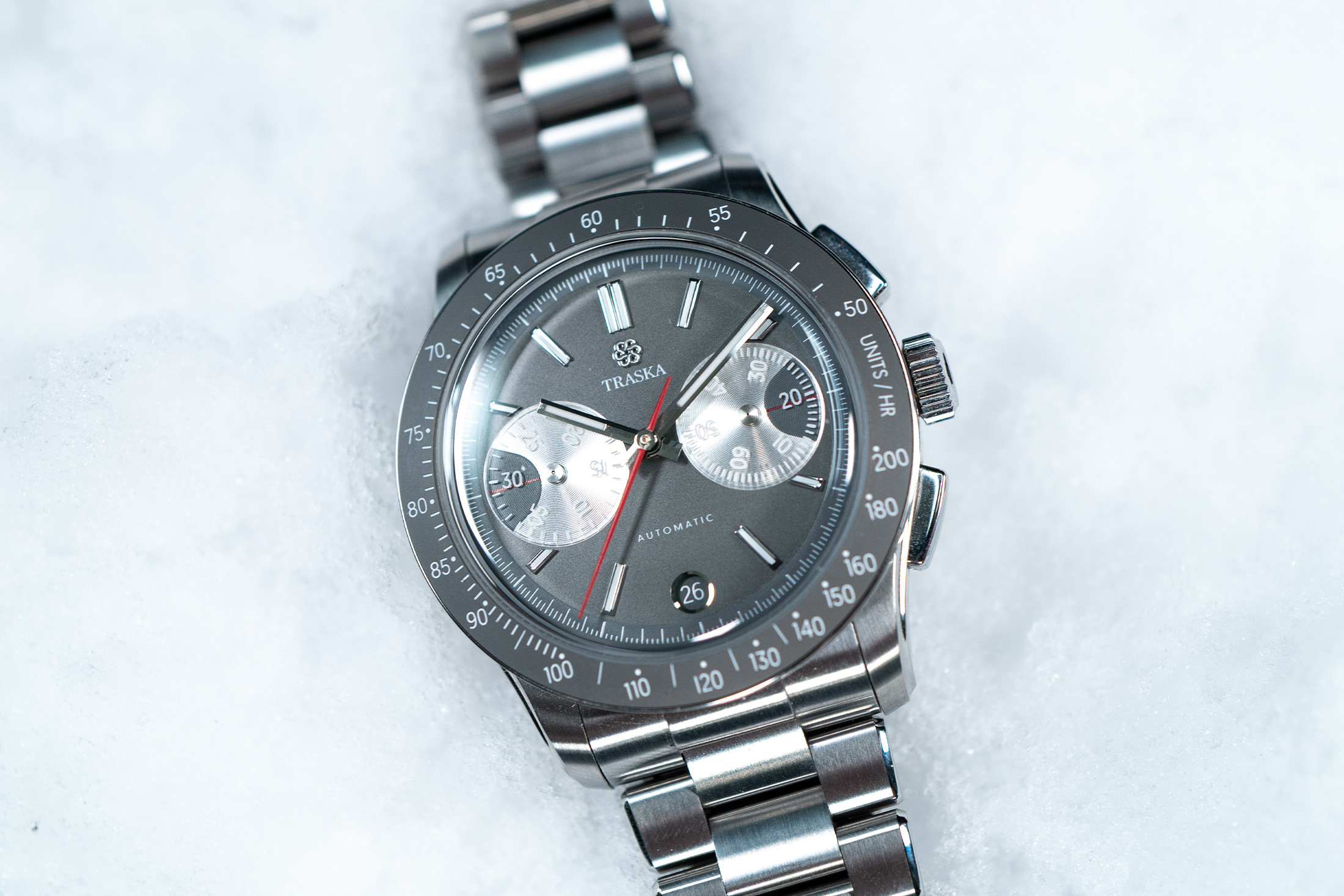
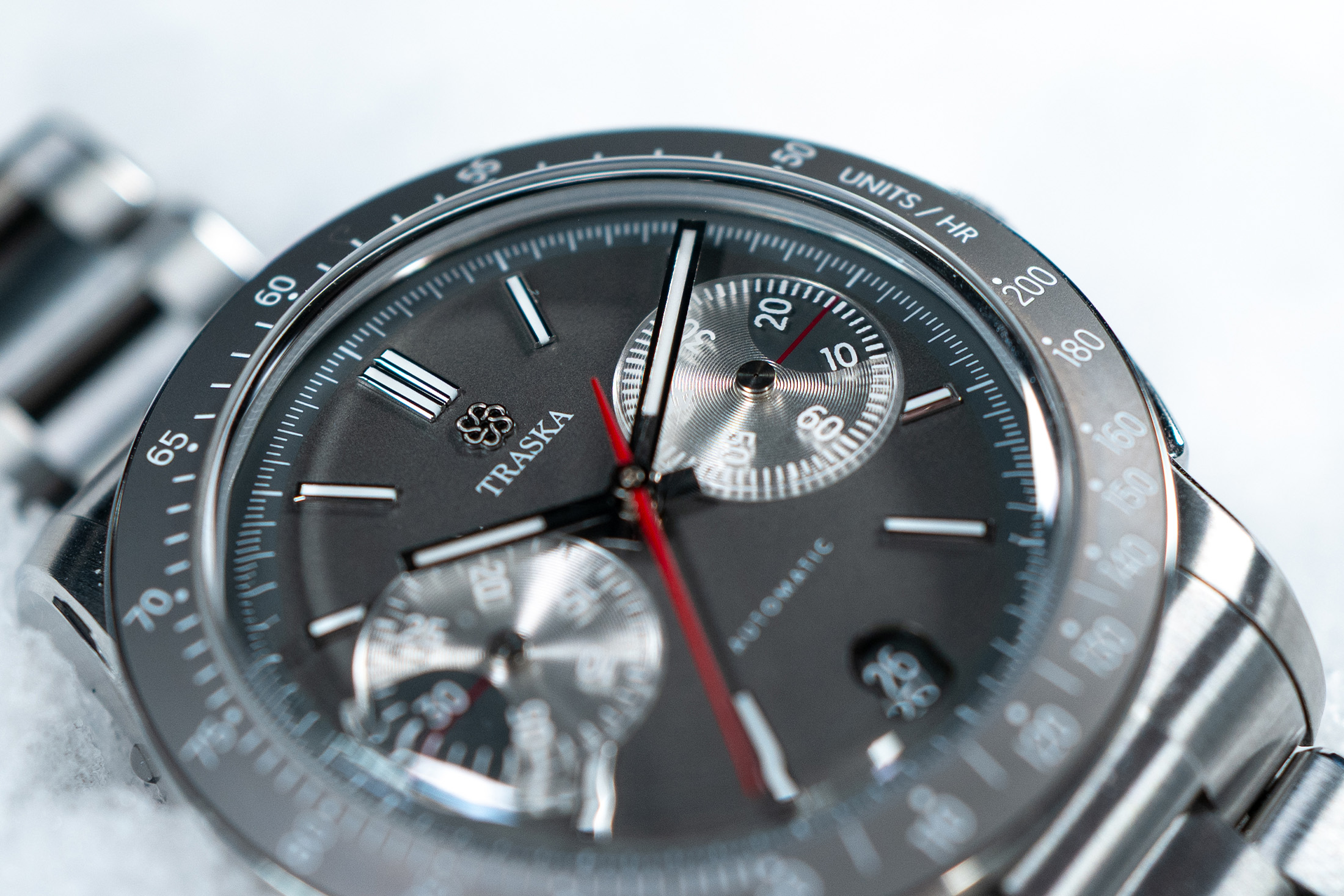
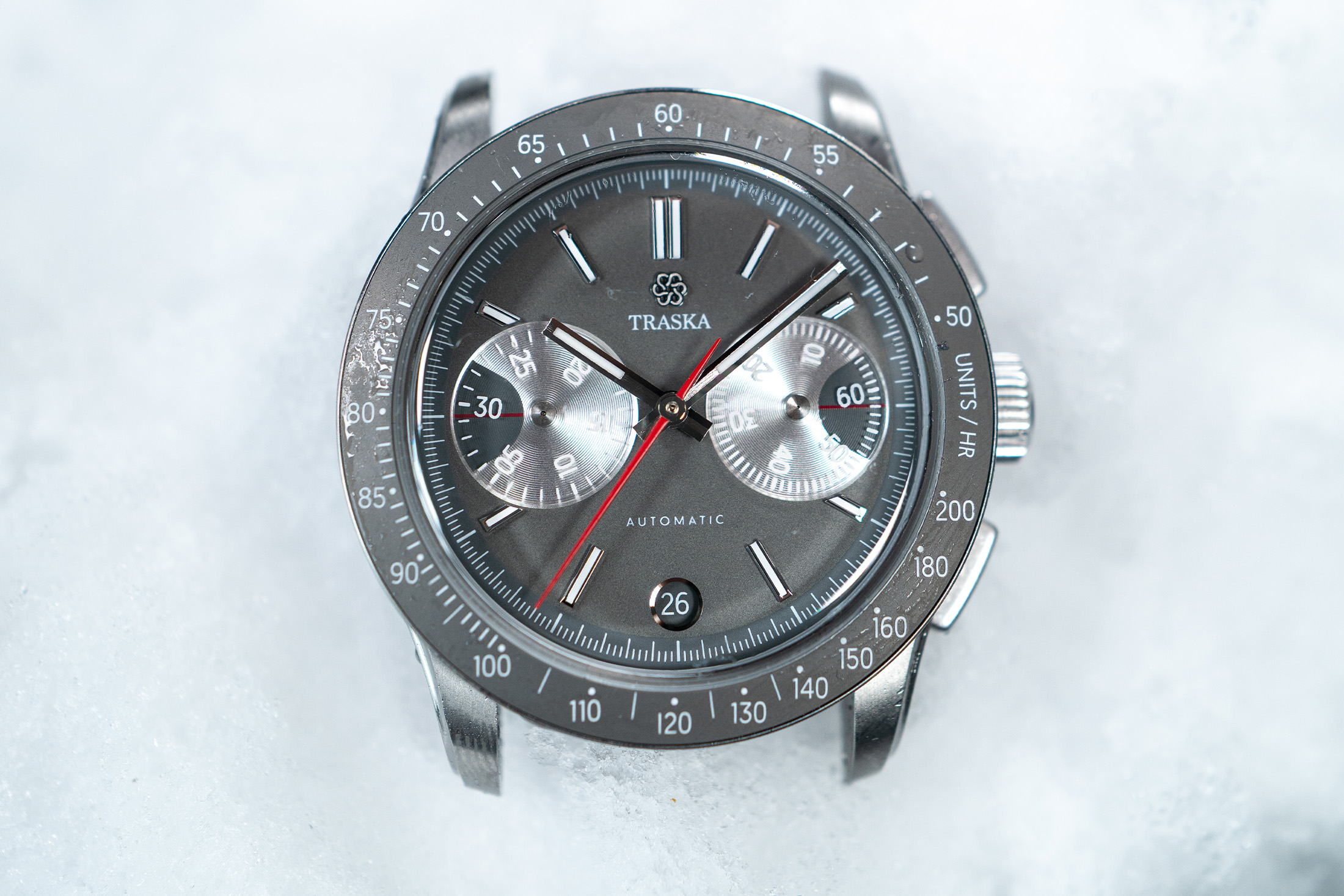
The visual execution of the chronograph function is arguably its most captivating element, particularly the novel approach taken with the bi-register subdial layout. Eschewing traditional rotating watch hands, each subdial is constructed from a clever multi-tiered assembly. The foundation consists of a bright silver subdial base finished with delicate azurage, featuring tight concentric circles radiating outward from the center. This is paired with a darker section of the subdial that continues the azurage pattern in a darker gray—rendered in solid black on the Arctic White dial variant—accented by a single red alignment line that matches the central chronograph seconds hand. Hovering above these textured layers is a transparent sapphire or acrylic disc that substitutes for traditional physical hands.
Each of the two transparent discs is printed with a distinct numerical scale. The right-hand subdial registers sixty seconds to serve as the running seconds for standard timekeeping, while the left-hand subdial is graduated to thirty minutes to track elapsed chronograph time. Reading the subdials requires simply glancing at the specific numeral floating above the red alignment line printed on the static base below. Because the white printing on the transparent disc largely blends into the silver background of the subdial, the eye easily isolates the active data point. While this unconventional style of readout requires a brief adjustment period, users quickly adapt, ultimately finding it cleaner and more legible than many traditional chronograph layouts.
Completing the functional suite of the watch are specialized outer bezels rendered in a warm gray tungsten for the gray dial variant, or a deep black ceramic for the Arctic White model. These materials were specifically selected for their extreme scratch resistance and durability. The tachymeter scale printed on the bezel is calibrated from 50 to 200 units per hour. While racing chronographs traditionally feature scales starting at 60 and climbing toward 400 or 500 units per hour, Traska thoughtfully geared this tachymeter toward more accessible, lower-speed calculations encountered in everyday driving rather than hypothetical motorsport velocities.
The chronograph complication is engaged via broad, squared-off pushers flanking the screw-down crown. The modern geometry of these pushers clearly distinguishes the Traska Chronograph from the wave of strictly vintage-inspired chronographs populating the contemporary market, reinforcing the watch’s overall impression of structural solidity, which is further supported by a 75-meter water resistance rating.
Operating the pushers yields a crisp, tactile response, though it does reveal a minor mechanical quirk: a slight shudder visible in the running seconds disc whenever the chronograph is started or stopped. While this is a minor characteristic, it serves as a gentle reminder that despite the exceptional execution, the watch occupies the accessible entry point of the mechanical chronograph market.
This brings the discussion squarely to the matter of pricing. The Traska Chronograph—available in either Tungsten Gray or Arctic White configurations—carries a retail price of $1,650. For a brand that has firmly established its reputation within the sub-$1,000 market segment, this price tag represents a significant step up. However, in the broader landscape of mechanical chronographs, it remains an impressive value proposition, particularly when evaluating the level of finishing, material technology, and mechanical complexity delivered for the money. Identifying direct, credible competitors in this specific tier proves challenging.
Alternative options in a similar pricing sphere include models like the Baltic Scalegraph, which retails around $1,900 depending on the exact configuration. While an undeniably strong competitor in terms of build quality and overall value, the Baltic leans into a distinct aesthetic that caters to a different collector profile. Similarly, if independent favorite Lorier were to reintroduce any of their previous chronograph references, they would instantly enter the conversation.
Another comparable contemporary alternative is the Timex Atelier Chronograph Automatic M1a Ti, which adopts a similarly modern aesthetic and a two-register layout, though it commands a higher price point of $2,100 on a strap, with an additional premium required for a matching metal bracelet. Moving further upmarket introduces established independent pieces like the Oak & Oscar Atwood chronograph, which features a sophisticated flyback mechanism, but requires a financial commitment substantially higher than the entry cost of the Traska.
Admittedly, securing a Traska Chronograph may require a degree of patience given the brand’s production cycles compared to some of its more readily available retail competitors. Nevertheless, for enthusiasts navigating a market where genuine value feels increasingly elusive, the Traska Chronograph stands out as a compelling release that easily justifies its place on the wrist, earning a confident recommendation not merely as a budget alternative, but as a compelling mechanical timepiece in its own right.