





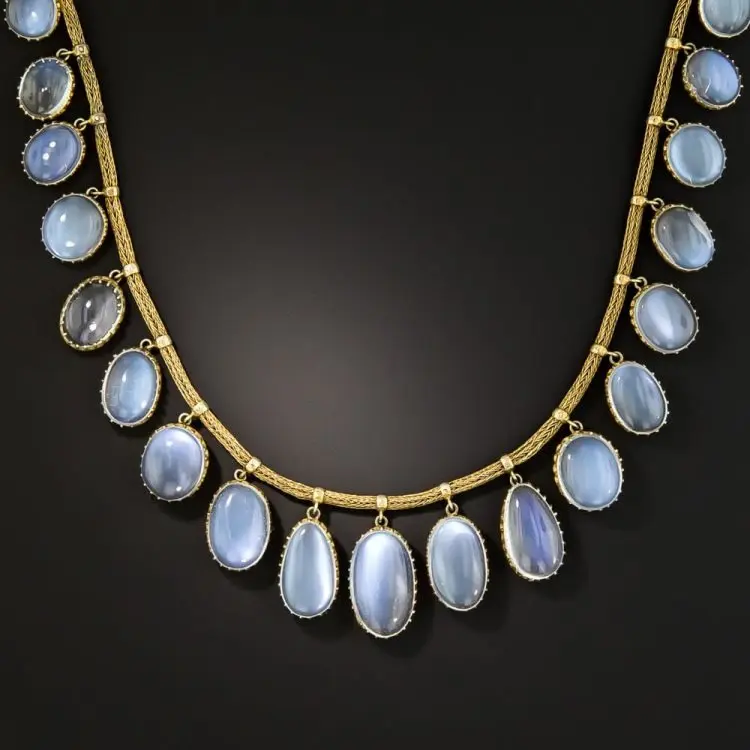
When a high-quality moonstone cut in this rounded, smooth style is rotated under a light source, it unveils a floating, billowy play of bluish or silvery-white illumination that seems to glide effortlessly across the surface of the stone. This unique interplay of light gives the impression of a living glow trapped just beneath the polished exterior, evoking the soft luminescence of Earth’s natural satellite suspended in the night sky. Within the precise and rigorous nomenclature of mineralogy, this signature optical behavior is formally referred to as schiller, a term used to describe the subsurface light scattering and reflection caused by microscopic structural layers within the mineral itself.

The appreciation for this phenomenon has deep historical roots, particularly visible in exquisite historical artifacts such as the Victorian Moonstone Fringe Necklace, a classic example of nineteenth-century craftsmanship that highlights the delicate and otherworldly beauty of adularescence. Throughout various eras of jewelry design, lapidaries and master goldsmiths have sought out stones exhibiting the strongest and most seamless schiller effect, arranging them in cascading fringes, cluster settings, and dramatic centerpieces to maximize the dynamic play of light.
As gemological studies continue to examine the microscopic composition of orthoclase and related feldspars, experts emphasize that the phenomenon is entirely dependent on the internal architecture of the stone. The microscopic lamellar intergrowths—alternating layers of differing feldspar compositions—interact with light waves entering the material, scattering them in various directions to produce the signature billowy sheen. This structural complexity ensures that no two stones display the effect in precisely the same manner, making each cabochon-cut moonstone a unique study in optical mineralogy. Whether examined in antique heirloom collections or evaluated through modern scientific lenses, the moonstone effect remains a stunning testament to the natural wonders locked inside the earth’s crust, marrying geological science with enduring aesthetic appeal.