






September 29, 2026 — Security protocols were severely tested across the Netherlands on Tuesday morning when a flurry of unattended luggage incidents forced the partial evacuation of four major railway stations within hours of each other, leading to the arrest of five individuals and significant disruptions to the country’s rail network.
The chaotic sequence of events unfolded rapidly during the busy morning commute and mid-morning hours, affecting major hubs including Haarlem, Rotterdam Centraal, Utrecht Centraal, and Dordrecht. While authorities quickly mobilized bomb disposal units, federal police, and local law enforcement to secure the perimeters, the simultaneous nature of the alarms caused widespread confusion and temporary paralysis for thousands of travelers relying on the Dutch public transport grid.
The most severe operational impact occurred at Haarlem station, where police and security personnel ordered a complete closure of the facility and surrounding buildings after two stray bags were reported at approximately 10:15 AM. The sudden security lockdown meant that incoming and outgoing trains were temporarily unable to stop at the historic station, forcing rail operators to bypass the hub entirely and leaving commuters stranded on platforms up and down the line.
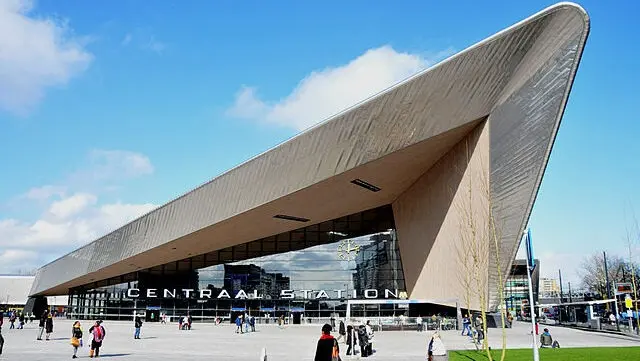
Law enforcement agencies immediately treated the abandoned items as potential security threats, deploying specialized protocols designed to protect the traveling public. Similar scenes played out at Rotterdam Centraal, where a busy passenger tunnel had to be swiftly cleared and cordoned off while officers investigated two abandoned suitcases for possible explosive devices. In Utrecht and Dordrecht, similar reports of stray luggage triggered immediate precautionary measures, bringing a tense atmosphere to some of the busiest transport nodes in the country.
Despite the geographical spread and the alarming timing of the incidents, Dutch police stated that there was currently no evidence to suggest a coordinated conspiracy or direct link between the four locations. Nevertheless, officials did not mince words regarding the gravity of the situation, describing the cluster of events as highly unusual and deeply disruptive to public safety and daily commerce.
Law enforcement agencies acted swiftly to identify and intercept individuals captured on closed-circuit television systems acting suspiciously near the abandoned property. Quick-thinking security teams and police analysts reviewed camera footage from the stations, which revealed several people behaving erratically or dumping bags before walking away from the scenes.
In Haarlem, police officers moved in quickly to detain three individuals suspected of involvement in leaving the stray bags behind. Hours later, at Utrecht Centraal, two additional suspects were apprehended after security footage similarly caught them loitering near unattended luggage and acting in a suspicious manner just moments before the items were discovered by station personnel.
While the majority of the detained suspects found themselves under formal police interrogation regarding their actions and motivations, the situation in Rotterdam took a distinct turn. Authorities confirmed that a woman came forward voluntarily later in the day to explain that she was the owner of the suitcases found in the pedestrian tunnel. She informed police that she had inadvertently left the bags behind while briefly stepping away to run errands in the city center. Following her statement and subsequent verification, she was cleared of malicious intent and was not placed under arrest.
Jan Martijn Stout, a spokesperson for the national police service, addressed the media regarding the ongoing investigations and the rationale behind the detentions. Speaking to the broadcaster NOS, Stout reiterated that while the incidents appeared to be fundamentally unconnected, the behavior of the detained individuals warranted a rigorous legal response due to the sheer scale of the disruption they caused.
"Their role is being investigated because it was a significant disruption to public order," Stout explained, emphasizing that leaving bags unattended in critical infrastructure hubs is treated with the utmost seriousness under Dutch law. Investigators are continuing to question the five suspects to determine why they abandoned their belongings in public transit zones and whether they fully understood the cascading consequences their actions would have on the rail network and public safety.
The disruption rippled across the national railway infrastructure, causing cascading delays and cancellations that impacted thousands of passengers during the late morning hours. Train services were progressively restored as each individual station was cleared by explosives detection units and deemed safe for public access, but the incidents served as a sharp reminder of the strict security vigilance maintained across European transport networks and the heavy legal and operational toll exacted by unattended luggage.