





Architecture has long operated under a strict mandate of separation: buildings are designed to keep the elements out, seal the interior environments off, and maintain a sterile boundary between human habitation and the chaotic, microbial world of nature. Yet, a growing movement in contemporary design is challenging this foundational premise. Forward-thinking architects and designers are arguing that architecture need not exclude microbes. Instead, they are pioneering projects that use algae, fungi, and bacteria as active, structural parts of healthier living environments.
At the forefront of this biotic shift is the London-based design studio ecoLogicStudio, co-founded by architects Claudia Pasquero and Marco Poletto. For two decades, the duo has championed a built world that leverages the inherent powers of nature—utilizing algae air-purifying mechanisms, waste-digesting mushrooms, and self-growing insulation—to develop a style of architecture that grows with the environment rather than against it. Their work suggests a fundamental rethinking of how humanity constructs its homes, offices, and cities, turning the built environment into a living, metabolic system.
Exploring the Forest of ecoLogicStudio
The studio’s philosophy found vivid expression in DeepForest³, an immersive installation that emerged in 2025 at the Triennale Design Museum in Milan. Presented as part of the exhibition We the Bacteria: Notes Toward Biotic Architecture—curated by Beatriz Colomina and Mark Wigley, authors of the influential book of the same title—the installation immediately disrupted conventional expectations of museum spaces.
While visitors walking onto the shiny museum floors might have initially mistaken the arrangement for a few scattered saplings, what was actually on display was a provocative hypothesis about how domestic space could be transformed by biological processes. Marco Poletto described the installation as a system constructed with a "fully functional and tangible biotechnological living system, grounded in the metabolic cycles of algae and fungi."
Encountering the deep green cyanobacteria and the living lichen growing from a cork bench felt like following an organic trail back through ecoLogicStudio’s extensive portfolio. Since its inception in 2005, the studio has consistently pushed the boundaries of biotechnology in design, offering a glimpse into a future where buildings actively metabolize waste, capture carbon, and clean the air we breathe.
The Urban Algae Folly
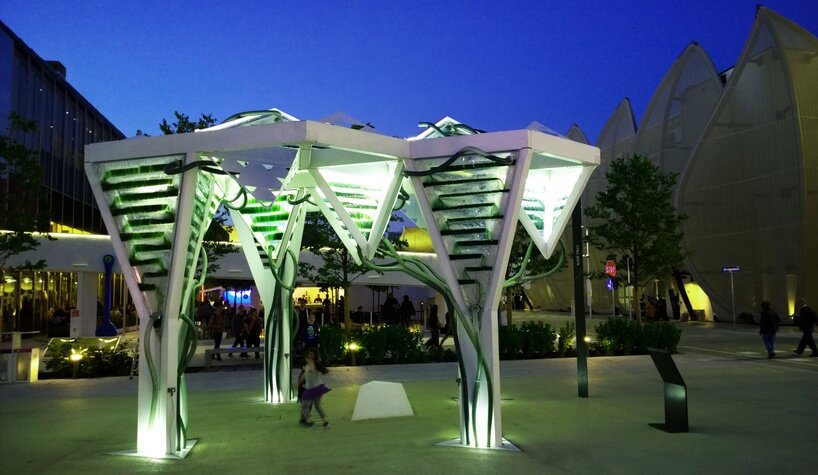
The intellectual groundwork for these recent biological explorations was laid nearly ten years earlier. At the EXPO Milano 2015 Future Food District, ecoLogicStudio erected a striking pavilion of triangular panels in the event’s central square, a structure that glowed with the vibrant movement of flowing green algae.
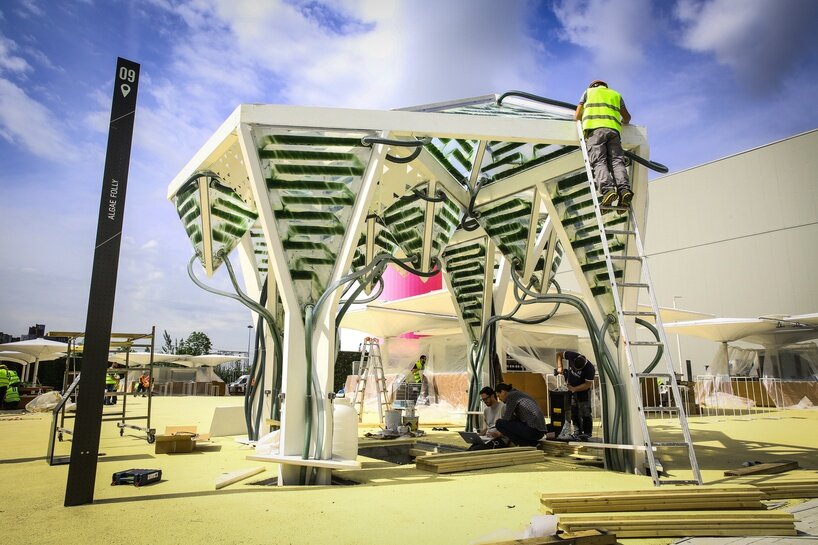
Known as The Urban Algae Folly, the canopy provided dynamic shade through the accelerated cultivation of Spirulina, a microalgae renowned for its high nutritional value for humans and its exceptional capacity for capturing carbon dioxide. In this project, ecoLogicStudio engineered a profound symbiosis between the sun, the algae, and human visitors.
On bright, sunny days, photosynthesis accelerated, causing more algae to thrive within the membrane of the canopy. When attendees stood beneath the structure to seek refuge from the heat, the carbon dioxide they exhaled fed the very organisms providing them with shade. This closed-loop interaction was born from the core conviction that architecture should work in tandem with microbial life rather than attempt to sterilize and exclude it. Here, algae ceased to be mere decoration and became active collaborators in shaping the microclimate, turning a temporary pavilion into a living, carbon-consuming ecosystem.
The AirBubble in Nyon
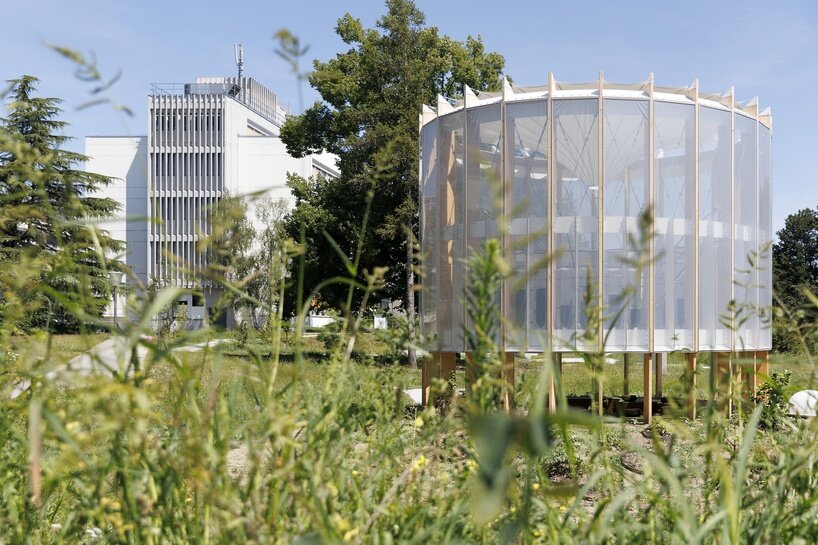
Expanding these concepts into the realm of public health and civic infrastructure, the studio later developed The AirBubble in Nyon, Switzerland. Billed as the world’s first biotechnological healthcare garden, the project combined air-purifying algae cultures with medicinal plants to create an urban sanctuary.
Constructed as an outdoor, circular, tent-like structure made of semi-transparent fabric, the installation offered a peaceful respite for local inhabitants. The interior perimeter was lined with 36 large bioreactors made of borosilicate glass, containing a total of 350 liters of living green Chlorella algae cultures. These biological filtration units possessed the capacity to process and purify a flow of polluted urban air measuring 150 liters per minute.
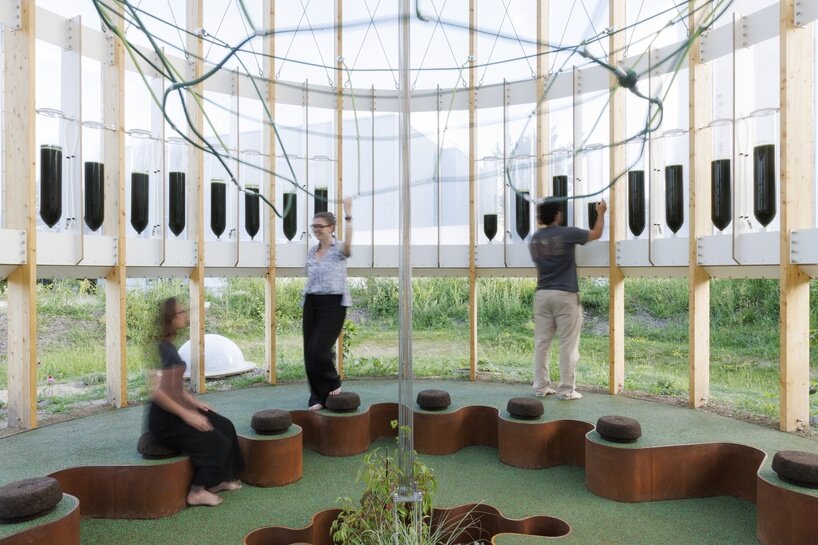
By rejecting the traditional assumption that healthy spaces must be hermetically sealed and sterile, The AirBubble positioned living organisms as essential urban infrastructure. By harnessing algae and plants, the design created an environment where ecological restoration and human wellness were directly intertwined.
CryoflorE at MUDAC’s Solar Biennale
The studio’s ambition to integrate biotechnology into the urban fabric reached a new scale with CryoflorE, produced in collaboration with the Synthetic Landscape Lab at the University of Innsbruck. Exhibited as part of MUDAC’s 2025 Solar Biennale, Soleil·s, the project served as a model for "cyber gardening the city."
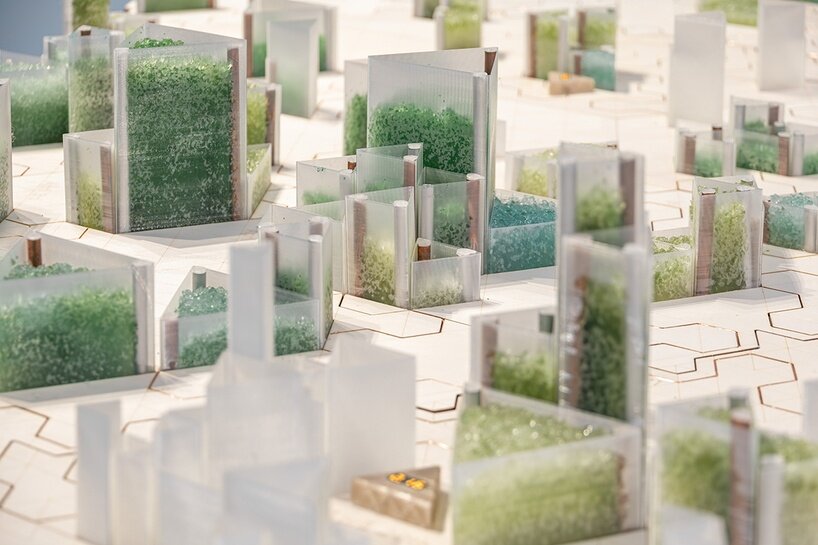
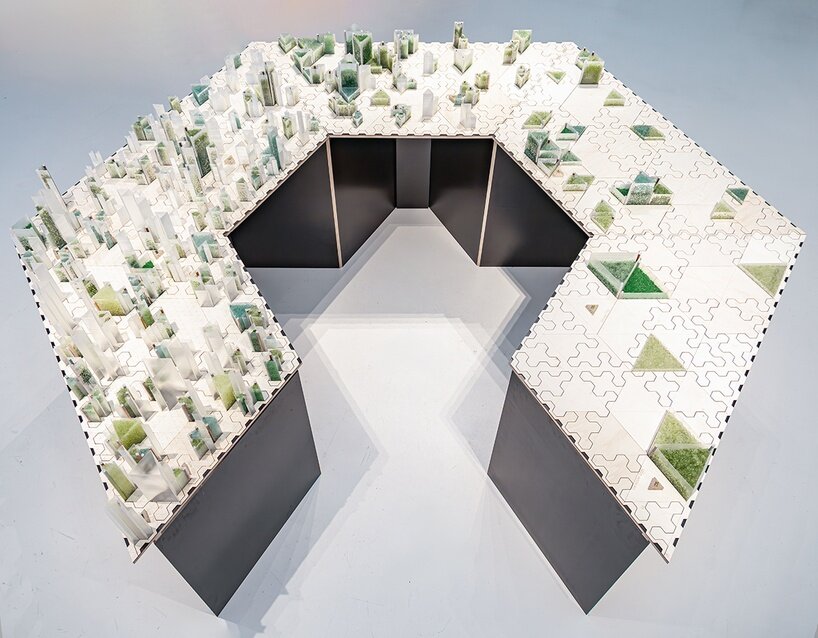
Taking the form of a near-hexagonal miniature cityscape complete with high-rises filled with cyanobacteria, CryoflorE explored how biological systems might generate power. According to the designers, the project captured and channeled electrons generated through photosynthesis into electrical currents flowing along copper wires embedded in the streetscape. By tapping into the energy-producing and carbon-capturing potential of cyanobacteria, the studio took initial, tangible steps toward simulating a modern city powered entirely by bio-solar energy networks.
Constructing DeepForest³
The culmination of these multi-scalar experiments is embodied in DeepForest³, which serves as a physical manifestation of Claudia Pasquero’s observation regarding human biology and architecture. "We are now more and more aware that our own nature is cyborgian and collective, and that our own identities extend far beyond the limits of our bodies," Pasquero remarked during the project’s launch. "We are microbial ecosystems, we are algorithmic networks. It is a necessary consequence that our home becomes an extension of these ecosystems and networks. Our home is our microbiome."
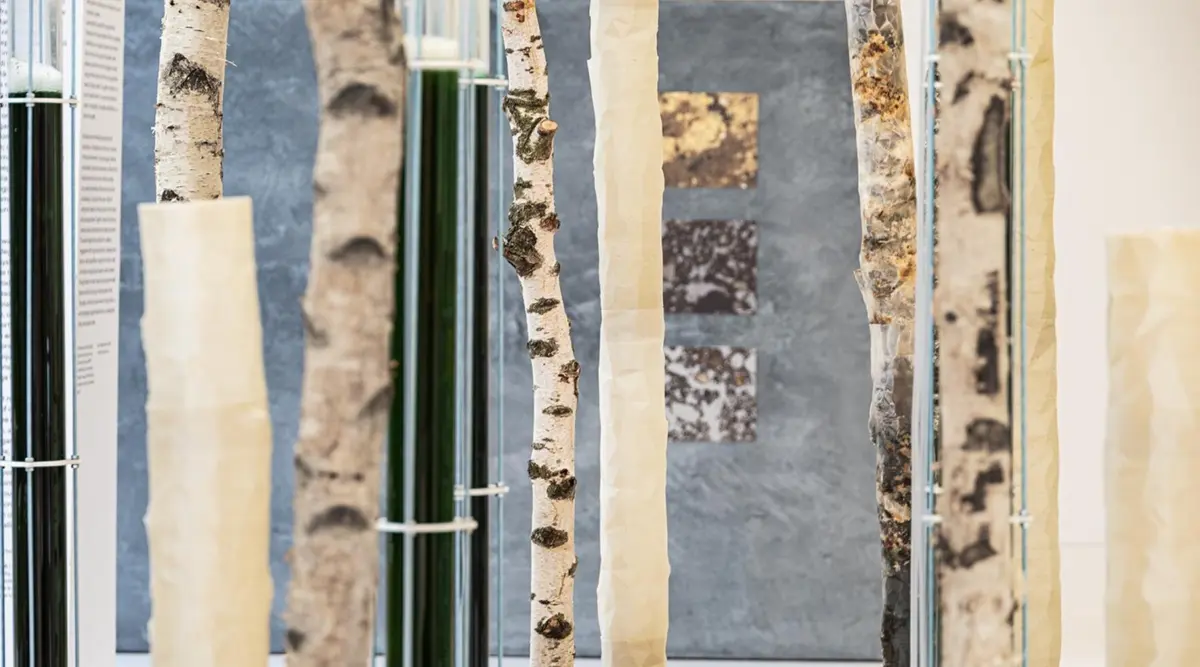
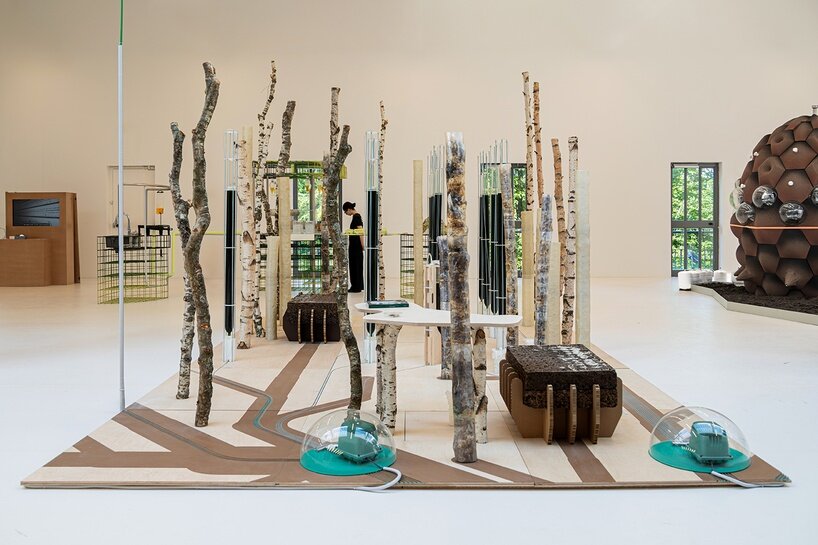
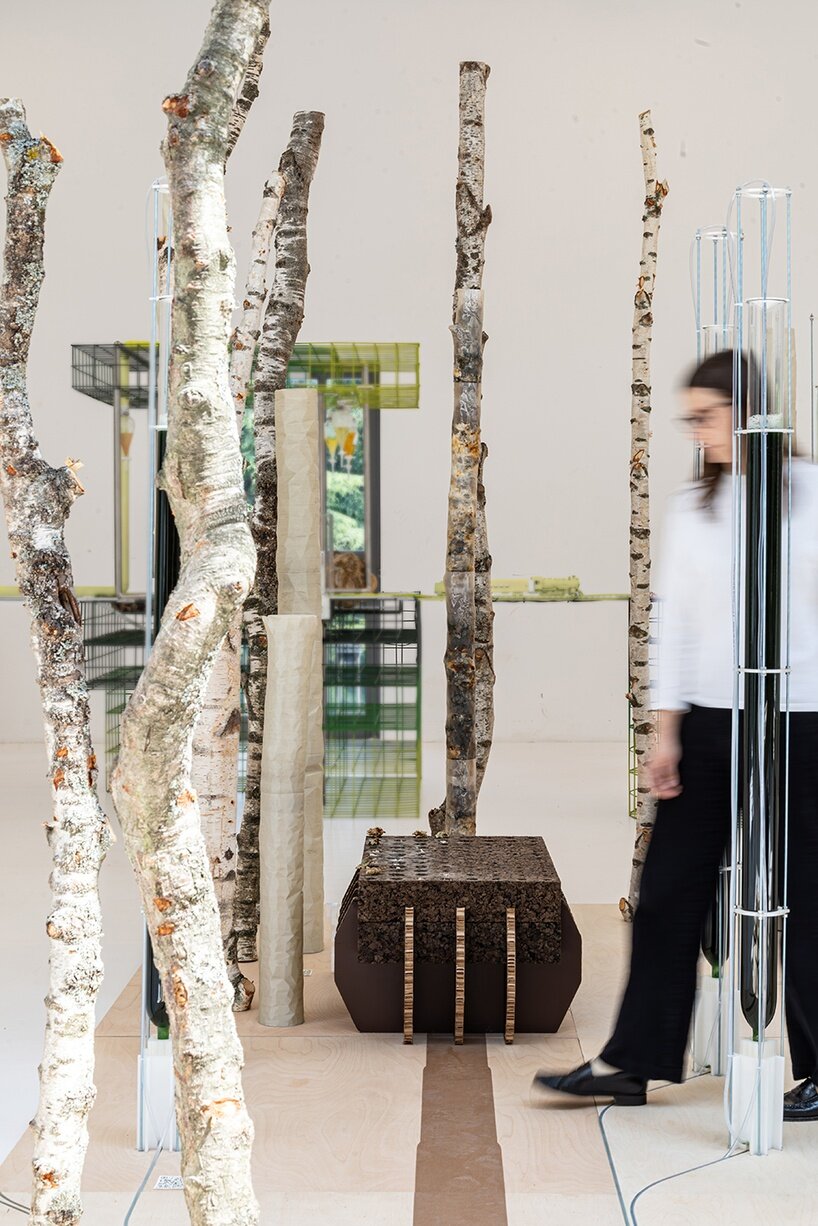
The installation on the sun-filled upper floor of the Milan design museum avoided traditional organic imagery; there was no loose dirt, decaying leaves, or wild moss. Instead, visitors encountered a careful arrangement resembling stripped birch trunks standing upright on a textured floor. These elements were, in fact, advanced biodegrader structures built from 3D-printed bark-like shells made of algae biopolymers, which hosted living networks of mycelium. Nourished by discarded coffee grounds, the mycelium developed a sinewy, insulating layer of material.
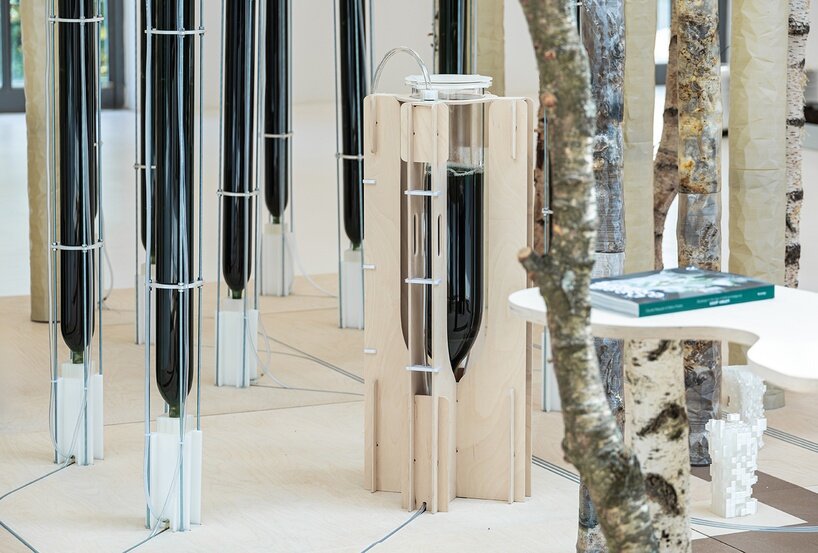
Between these structural trunks stood a series of glass containers functioning as photosynthesizers. Holding 50 liters of living cyanobacteria, these units actively captured carbon dioxide from the gallery environment while acting as breathing filters. Additional elements functioned as carbon storers, digesting organic waste and supporting colonies of living lichen. Interwoven with subtle tubes, seams, and cords, the installation presented an architectural vision where a building does not simply shelter its occupants, but actively lives, grows, digests, and filters.
We the Bacteria and the Future of Biotic Architecture
DeepForest³ directly reflects the urgent theoretical arguments put forward by Beatriz Colomina and Mark Wigley in their book We the Bacteria, published by Lars Müller Publishers. Acting as a conceptual sequel to their earlier work, Are We Human?, the publication examines the persistent sterility of contemporary architecture—specifically its obsessive impulse to eradicate bacteria, germs, and grime—and reframes this hostility as a direct threat to both human and planetary health.
By explicitly stating in the text that "this book is covered in microbes," the authors highlight the inescapable pervasiveness of single-celled organisms. They draw on evidence of systemic health vulnerabilities in industrialized spaces to advocate for a return to the microbial, urging architects to embrace design frameworks that allow bacteria to thrive rather than perish under chemical assault.
Although We the Bacteria centers primarily on the microbial world, its core philosophy provides a vital framework for understanding ecoLogicStudio’s broader body of work. Across their diverse projects, algae, fungi, and carbon are elevated from raw materials to active architectural agents, successfully breaking down the artificial barrier separating the built environment from the living biosphere.
Ultimately, these pioneering projects suggest that architecture can achieve far more than merely accommodating human utility; it can actively support the complex web of organisms and ecological processes that sustain life on Earth. When approached with intentionality and care, this integration yields net-positive outcomes for human inhabitants as well. Within these living spaces, bacteria, fungi, and other microorganisms are neither dangerous contaminants to be eliminated nor passive resources to be exploited, but genuine participants in the habitats we share.
By treating the home and the building as integral organs of a wider planetary metabolism, ecoLogicStudio puts forward a compelling vision of mutualism—one where human well-being is recognized as fundamentally inseparable from the health of the more-than-human world.