For roughly eight decades, Patek Philippe has stood as one of the most dedicated patrons of cloisonné enamel, commissioning masterpieces that helped sustain the fragile craft when consumer and market demand for it had all but disappeared. From the mesmerizing enamel maps adorning Louis Cottier’s legendary world-time watches to the meticulously signed dials of master artisans like Anita Porchet, the horological house’s commissions trace a living history of both a demanding technique and the changing recognition of the artists behind it.
Today, the demand for artisanal watch dials, particularly those executed in cloisonné enamel, sits at an unprecedented, all-time high. This surging enthusiasm was underscored vividly in May 2026, when a vintage Patek Philippe wristwatch commanded roughly US$10.2 million at an auction in Geneva. Collectors fiercely competed for a timepiece featuring a vibrant map of South America crafted from delicate gold wire and translucent enamel, an extraordinary outcome that dominated horological headlines globally. The watch in question was a rare reference 2523 dating back to 1953, featuring a dial supplied by the historic dial maker Stern Frères. Notably, the specific artist responsible for executing this micro-canvas remains anonymous in the archival records, a testament to an era when these craftspeople labored largely behind the scenes.
The story of cloisonné enamel at Patek Philippe is fundamentally one of visionary artistic patronage. By carefully choosing subjects, commissioning specialized enamellers, and eventually permitting them to sign their completed dials, the prestigious Genevan watchmaker has effectively acted as a curator. In doing so, the manufacturer has shaped a monumental body of work that reflects both its own refined tastes and the brilliant, individual talents of the artists it supports.
Drawing in Fire
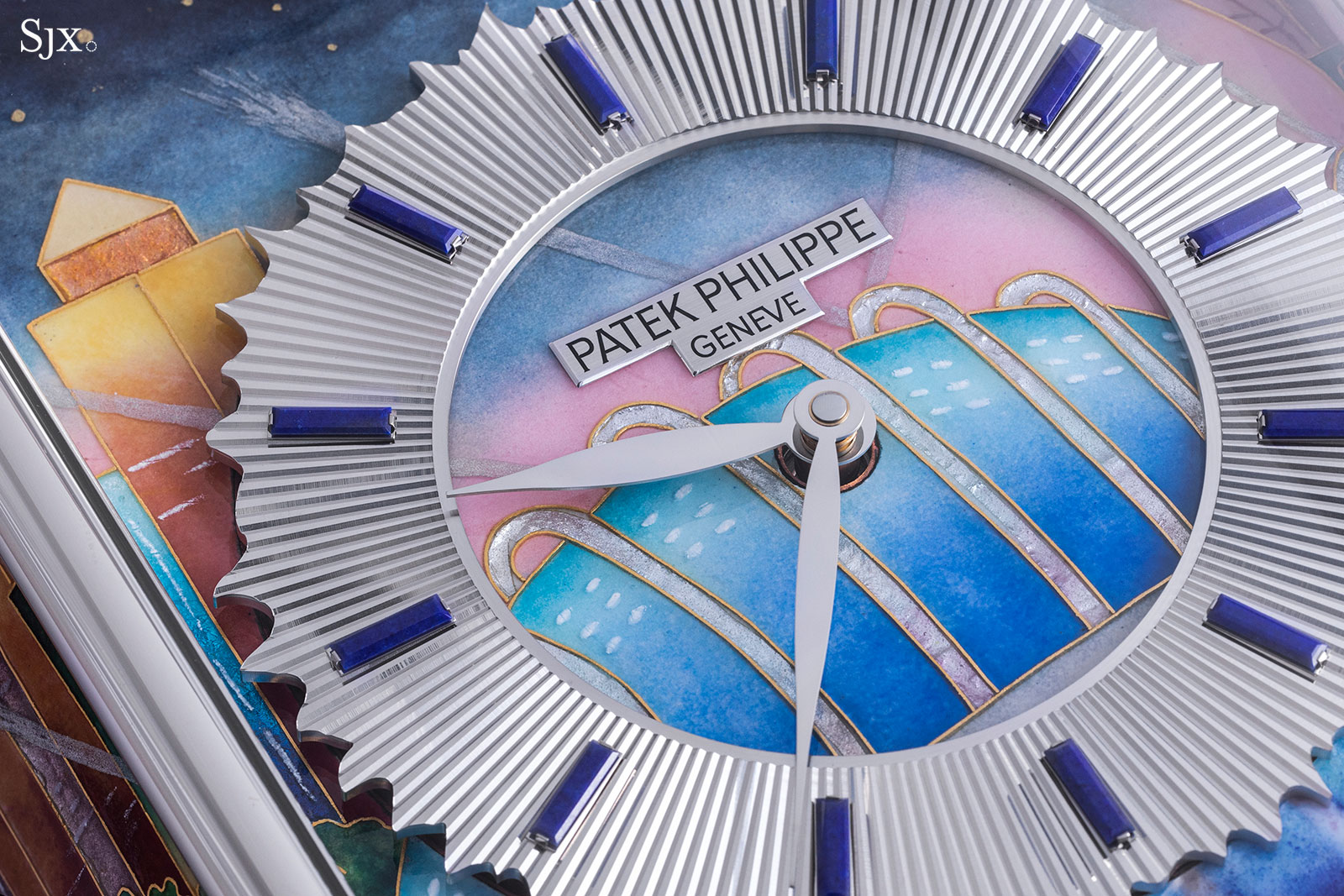
Cloisonné is only one of several celebrated enamel techniques utilized in haute horlogerie, yet it is arguably the most visually striking. The process begins with pure gold wire. The enameller bends and shapes this wire by hand—sometimes working with filaments measuring a mere 0.05 mm in thickness—to meticulously draw the outlines of the design directly onto the raw metal dial base. The resulting microscopic compartments, known as cloisons (the French term for partitions), are then carefully filled with finely ground glass powder colored using various metal oxides.
In contrast, miniature painting on enamel takes a radically different approach, requiring the artist to build up an image using an exceptionally fine brush directly on a pre-enameled surface. A prime illustration of the astonishing detail achievable through this method is Suzanne Rohr’s masterful recreation of Johannes Vermeer’s iconic painting, Woman with a Water Jug, executed for a Patek Philippe pocket watch bearing reference 715.
Regardless of whether an artisan employs cloisonné or miniature painting, all roads ultimately lead to the intense heat of the kiln. The enameller fires the dial at approximately 800 degrees Celsius, gradually building up the rich colors layer by layer over the course of repeated firings, which can sometimes total a dozen or more. Each individual trip into the fiery furnace carries inherent risks, including the formation of destructive air bubbles or unexpected shifts in color chemistry. Certain hues simply cannot withstand repeated exposure to extreme heat and must therefore be applied later in the sequence, forcing the artist to work in an order dictated strictly by the fire rather than the natural composition of the picture.

To prevent the metal disc from warping as it cools, a counter-enamel is applied to the reverse side. In the case of cloisonné, the protruding gold wires are subsequently ground down until they are completely level with the surrounding enamel, after which the entire surface is polished to achieve remarkable depth and luminosity.
Several related techniques complement this tradition, including champlevé, where enamel is used to fill recesses carved directly into the metal substrate, and paillonné, which involves placing minuscule pieces of gold or silver leaf beneath layers of translucent enamel. Furthermore, cloisonné can be successfully combined with a shallow champlevé base to help reinforce and protect the delicate enamel at the extreme edges of the dial. As described by Dr. Helmut Crott in his seminal work The Dial, this hybrid method—termed émail mourant, or "dying enamel"—produces a dial that merges the structural benefits of both decorative traditions.
Modern enamellers have also had to navigate significant manufacturing hurdles due to shifting environmental and safety regulations regarding available materials. Older enamel formulations frequently contained toxic elements like lead and arsenic. Replacing these hazardous components alters both the inherent colors of the glass and their unpredictable behavior inside the kiln. Recreating the exact, distinctive palettes seen in historic masterpieces therefore requires continuous experimentation with novel chemical formulations and specialized firing techniques.

An Atlas in Enamel
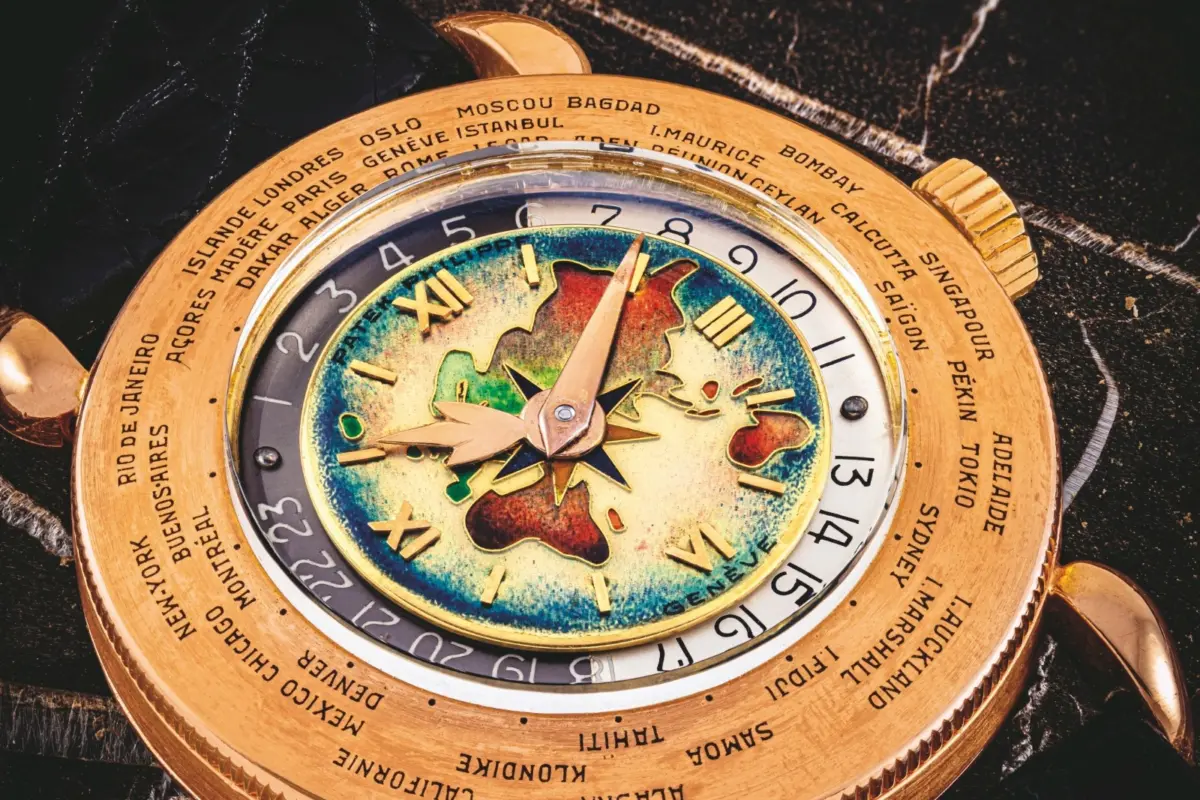
At Patek Philippe, geography served as the central thematic anchor for early cloisonné dials. While preceding enamel work traditionally favored champlevé and miniature painting, pictorial cloisonné experienced a golden age between the 1940s and 1960s, largely channeled through its long-standing dial supplier, Stern Frères. The firm routinely commissioned independent studio enamellers to decorate these dials, quickly establishing world maps as a signature motif.
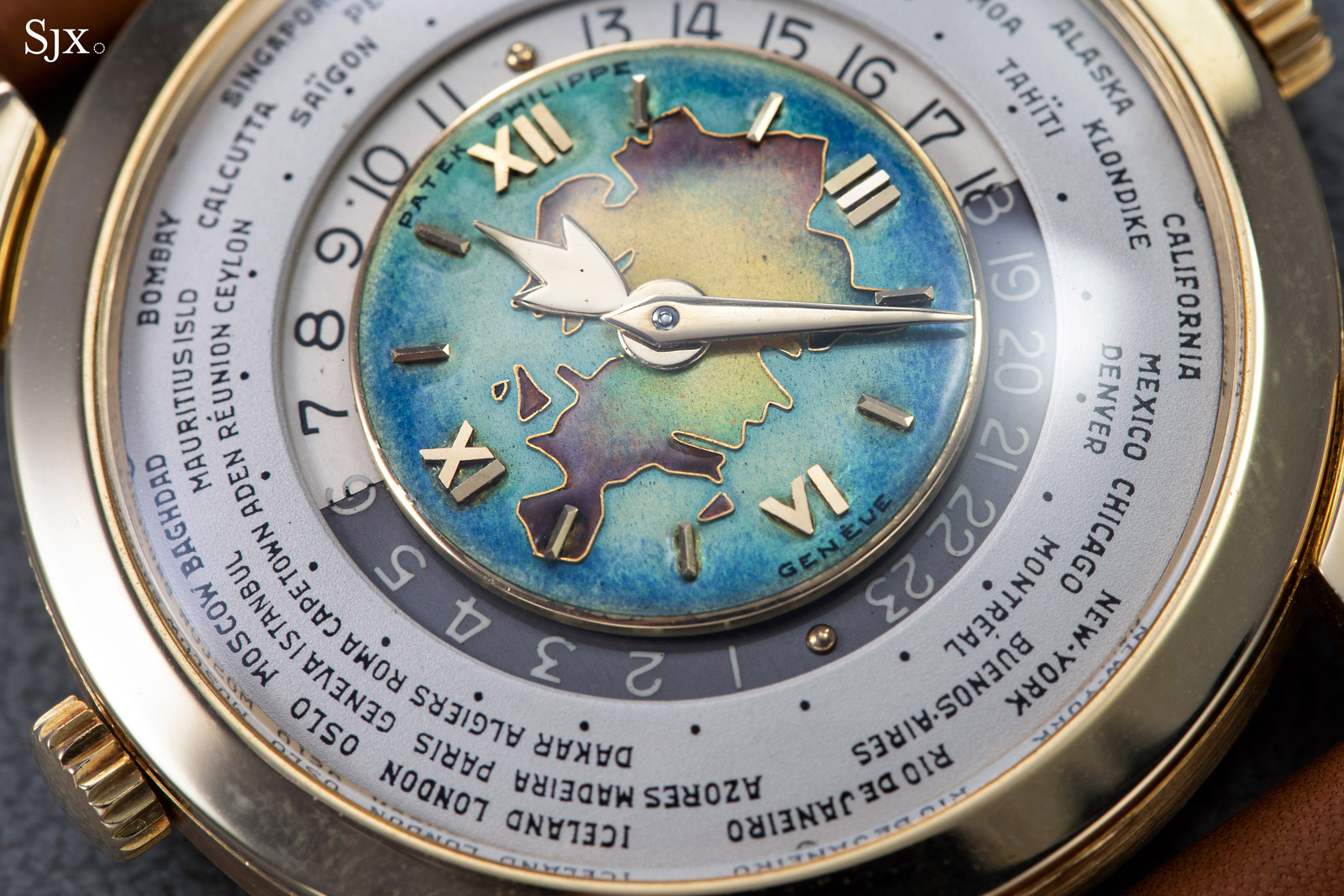
The mechanical setting for these miniature maps was engineered by independent watchmaker Louis Cottier, who revolutionized the industry in the 1930s by developing his pioneering Heures Universelles system. This brilliant layout displayed the exact time across multiple cities around the world simultaneously by surrounding a central dial with a rotating city ring. Some of the most famous and sought-after examples feature a brightly colored, miniature enamel world map nestled right at the center.
Pocket watches were the first to receive this treatment, with Patek Philippe manufacturing approximately 95 examples of the reference 605 HU between 1938 and 1964. Of this small total, only about a dozen featured exquisite enamel dials, representing an ultra-exclusive group that showcased a limited range of maps, each painted with unique, hand-rendered details.

The map of North America appears most frequently among these rare survivors. Other selected designs include comprehensive world maps, Eurasian landmasses, and considerably rarer pictorial images, such as a fierce dragon or Neptune riding a seahorse. Because each individual enameller painted these dials entirely by hand, every single piece possesses minute, charming variations that make it completely unique.
Auction results over the decades have consistently reflected the extreme rarity of these pieces. The very first reference 605 HU was dispatched to Patek Philippe’s agent in Argentina in November 1937. A pink-gold example from 1943 featuring a world-map dial—recognized as the earliest known enamel example remaining in private hands—fetched approximately CHF 3.13 million at auction in 2024. Two other examples, bearing consecutive movement numbers and matching case numbers, were originally delivered with plain metal dials before later receiving cloisonné map upgrades. The internal movement numbers stamped discreetly on the backs of these dials allow modern researchers to trace these later artistic additions back to their original watch casings.
Following the success of the pocket watches, these colorful enamel maps successfully transitioned to the wrist via the reference 1415 HU. Introduced in 1939, it stands as the first world-time wristwatch produced in series. Examples rendered in yellow or pink gold paired a compact 31 mm case with an intricate cloisonné map dial. Certain pieces were even manufactured in pairs with consecutive serial numbers, each depicting the identical map crafted by the same artist. The subsequent reference 2523 followed in the 1950s; measuring roughly 36 mm in diameter, it offered a larger canvas and featured two distinct crowns—one dedicated to setting the primary time and another engineered to adjust the rotating city ring.

The specific maps depicted on reference 2523 dials represent a major distinction for high-end collectors. A yellow-gold example from 1953 featuring a detailed Eurasia map achieved roughly US$8.4 million at a Hong Kong auction in 2024. Just one year prior, a yellow-gold North America variant—identified as one of only three known to exist—realized approximately US$8.5 million.
Historical auction data illustrates how perceptions have shifted dramatically over time. For instance, a North American reference 2523 originally offered during Habsburg Feldman’s landmark 1989 auction, The Art of Patek Philippe, returned to the block in 2012 and sold for approximately US$2.96 million, vividly demonstrating how the broader collector market has come to revere these functional timepieces as legitimate, museum-grade works of art.
Stern Frères supplied these remarkable dials, but production records typically identified them by order numbers rather than the individual enamellers’ names, leaving the creators largely anonymous to contemporary buyers. Today, these historical numbers alongside the "LC" monogram stamped by Cottier on the reverse side of the enamel discs help modern historians connect the timepieces back to archival ledgers and their original makers.

Among the talented artisans identified in the archives, Marguerite Koch is celebrated for introducing a distinct post-Impressionist sensibility to the medium of gold wire and colored glass, while Nelly Richard-Fournier imbued the mythical dragon designs with vivid, unforgettable hues. The historical ledgers also frequently cite Michel Deville, who worked closely alongside Cottier on the development of the early world-time references.
As was common practice among elite craftspeople of the period, Deville’s talents were not confined exclusively to Patek Philippe. Archival documentation reveals that she also crafted the enamel dials for the historic 1945 "Victory Watches"—special Agassiz world-time pocket watches presented to Allied leaders Winston Churchill, Charles de Gaulle, Harry Truman, and Joseph Stalin following the conclusion of the Second World War. This demonstrates that Cottier’s brilliant mechanism and the elite Geneva enamellers who decorated it collaborated fluidly across several competing watchmaking houses.
Enamel maps also found a natural home on time-only wristwatches, including a pink-gold "Eurasia" variant produced around 1957. Auction houses like Christie’s have successfully attributed pieces like the "Tropical Oasis" design to Marguerite Koch, whose distinct handiwork also graces the reference 2523 world timers. Patek Philippe’s cloisonné dials similarly captured stunning natural landscapes, most notably on the reference 2481, a large, center-seconds Calatrava introduced during the 1950s. Notable examples include "Tropical Oasis," a vibrant seaside scene featuring palms and fruit completed in 1950, and "Tropics" from 1954, which formed part of an exclusive series of three watches.
Kept Alive, on Purpose
Much like traditional mechanical watchmaking as a whole, the quartz revolution of the 1970s nearly brought about the total extinction of the enameling craft. As affordable, highly accurate electronic movements exerted immense financial pressure on artisanal mechanical traditions, enameling—being exceptionally time-consuming, expensive, and technically demanding—was among the very first disciplines threatened with obsolescence.
By that turbulent decade, only a handful of traditional Geneva-based enamellers possessed the rigorous skill set required to produce grand feu cloisonné dials matching Patek Philippe’s exacting standards. Curiously, the vast majority of these remaining masters were women who had trained during the earlier golden age of the craft.
Patek Philippe’s role as an active artistic curator proved vital during these lean years. The company continued to issue steady commissions for enamel work, predominantly for its intricate, solar-powered dome clocks, thereby allowing master enamellers to remain in active practice despite an otherwise anemic commercial market. These specialized commissions also provided artists with valuable creative freedom to experiment freely with new subjects, compositions, and color palettes.

Elizabeth Perusset Lagger signed her sweeping panoramic landscapes with the initials "EPL," while Luce Chappaz earned Geneva’s prestigious enameling prize in 1983. Michèle Mauris specialized in serene, soft-blue maritime scenes, Marie-Françoise Martin explored an innovative near-cubist aesthetic, and Elisabeth Kim became celebrated for intricate narrative scenes rendered across curved panels. While a significant portion of this late-20th-century output was housed within decorative desk clocks, it successfully preserved the delicate skill sets that would eventually make a triumphant return to wristwatch dials in later decades.
A single master bridges these distant generations: Carlo Poluzzi. Born in 1899 and widely regarded as one of the finest enamel artists of his era, Poluzzi worked closely with Patek Philippe under the direct patronage of the Stern family. Interestingly, he also served as Geneva’s official municipal mushroom inspector, a curious occupation that harmonized perfectly with his naturalist’s eye for minute botanical and biological detail. His profound pedagogical legacy lived on through his teaching; Poluzzi instructed Suzanne Rohr, who subsequently transmitted her accumulated knowledge to Anita Porchet, widely considered among the most accomplished enamellers practicing anywhere in the world today.
The Signed Dial
Following a prolonged period of relative absence from regular production, traditional enameling staged a major comeback within the Patek Philippe catalog around the turn of the millennium, this time firmly established as a recognized high art form featuring credited artists. While the company established its now-famous Rare Handcrafts collection to showcase various métiers d’art disciplines broadly, enamel dials began displaying the signatures of their creators with increasing regularity, marking an important philosophical shift.

This modern revival moved along two distinct creative paths. The first focused primarily on Calatrava wristwatches adorned with pictorial enamel dials, beginning with the reference 5075. Subjects included the striking "Horse" designs of 2002, which drew direct inspiration from an antique Qing dynasty cloisonné bowl. The reference 5077 soon followed, manufactured in extremely limited quantities with diverse enamel scenes, including a "Papillon" butterfly dial signed personally by Anita Porchet. The later reference 5089 continued this aesthetic trajectory, exploring adventurous subjects such as vintage steam locomotives and majestic ocean liners, exemplified by the "Transatlantic" dial depicting a grand passenger ship against the backdrop of the New York skyline.
The second direction successfully revived the historic map theme. In 2008, Patek Philippe launched the reference 5131, a modern world-time wristwatch featuring vibrant enamel continents at its center, offered in yellow, white, and pink gold, alongside a platinum variant featuring a polar map set against a silver background. Subsequently, in 2019, the reference 5231 reintroduced the distinctive winglet lugs of the vintage reference 2523, creating a direct aesthetic bridge to the brand’s illustrious past.
Cloisonné enamel was also integrated into Patek Philippe’s most prestigious grand complications, including the reference 6002 Sky Moon Tourbillon, which couples complex miniature enameling with deep hand-engraving across its case and dial. A striking blue-enamel variant commanded roughly US$5.8 million at auction in 2023, while a dark variant seamlessly combines cloisonné with champlevé work.

The Curator’s Canvas
One of the most consequential evolutions in the recent history of the luxury watch dial is the routine inclusion of the artist’s signature. Cloisonné enamel, much like other specialized métiers d’art, demands an extraordinary synthesis of refined artistic judgment and flawless manual dexterity; affixing a signature finally grants proper public recognition to the person responsible for the physical creation.
Today, the work of Anita Porchet is frequently signed, and her personal mark has grown increasingly valuable as her formidable reputation among collectors continues to expand. Born in 1961, Porchet trained directly under Suzanne Rohr and cultivated her stellar career with the personal backing of Philippe Stern. On contemporary dials, the full inscription "A. Porchet" indicates a piece executed entirely by her own hands from start to finish, whereas the abbreviated initials "AP" identify work produced collaboratively by her specialized workshop team.
In an industry where master artisans remained anonymous for the better part of a century, these visible signatures have transformed authorship into a fundamental pillar of how serious collectors understand, evaluate, and appreciate a high-end dial.

High-end timepieces remain an essential setting for cloisonné enamel at its absolute zenith. The survival of this fragile discipline against the odds owes an immense debt to successive generations of dedicated artists and the visionary industrial patrons who supported them through thick and thin. Patek Philippe’s steadfast commitment to issuing continuous commissions helped shield the craft through extended periods of commercial vulnerability, safeguarding the rare techniques that underpin the exceptional work produced in Swiss ateliers today.
That institutional support continues vibrantly today through public showcases, such as Patek Philippe’s expansive Watch Art Exhibitions, where the brand frequently debuts bespoke collections of Rare Handcrafts inspired by international landscapes, classical art, and diverse cultural traditions. These major exhibitions, hosted periodically in major cultural capitals around the world, bring the hidden craft directly to a wider public audience, granting enthusiasts a rare opportunity to examine both completed horological masterpieces and master artisans demonstrating their craft in person.