




MILAN — Inspiration can often be found in the most unexpected places, but for Ferragamo’s creative director Maximilian Davis, the spark for his latest collection ignited earlier this year within the echoing halls of the Musée d’Art Moderne de Paris. Among the enthusiastic visitors taking in the critically acclaimed hit exhibition dedicated to the pioneering photographer, model, and war correspondent Lee Miller was Davis himself. Rather than skimming the retrospective casually, the designer zeroed in intensely on a specific chapter of Miller’s extraordinary life: her formative, sun-baked years spent living and working in Egypt during the 1930s.
That single cultural encounter cued up another remarkably strong Milan fashion collection for the Florentine luxury house, one heavily hinged on safari jackets, sun-bleached desert references, and an adventurous spirit of utility mixed with high glamour. The resulting runway presentation proved that Davis is continuing to refine his distinct vision for the historic Italian brand, blending heritage elements with a sharp, contemporary edge that immediately captured the attention of the international fashion press and industry insiders alike.
The collection seduced viewers immediately with a rich, evocative palette that felt straight out of a spice rack, featuring warm earthy tones, deep ochres, sun-baked terracottas, and sandy neutrals. These colors were deployed across body-skimming silhouettes that hugged the form while maintaining an effortless sense of movement. The fabrics themselves were a masterclass in textural contrast, shifting at turns from gossamer-sheer and weightless to beefy, substantial leathers and kinky, provocative materials.
Davis offered a fascinating behind-the-scenes explanation for some of the collection’s more avant-garde pieces, noting that his translucent rubber trench coats, sleek tank dresses, and sharply tailored skirt suits were actually direct references to nurses and medical uniforms. He pointed out that the utilitarian uniforms and workwear adopted by women in the early decades of the 20th century remain a foundational narrative and a continuous source of inspiration throughout his tenure at the house. By taking the rigid, functional garments of the past and rendering them in sheer, translucent rubber or molding them to the modern female form, Davis successfully bridged the gap between historical practicality and high-fashion subversion.
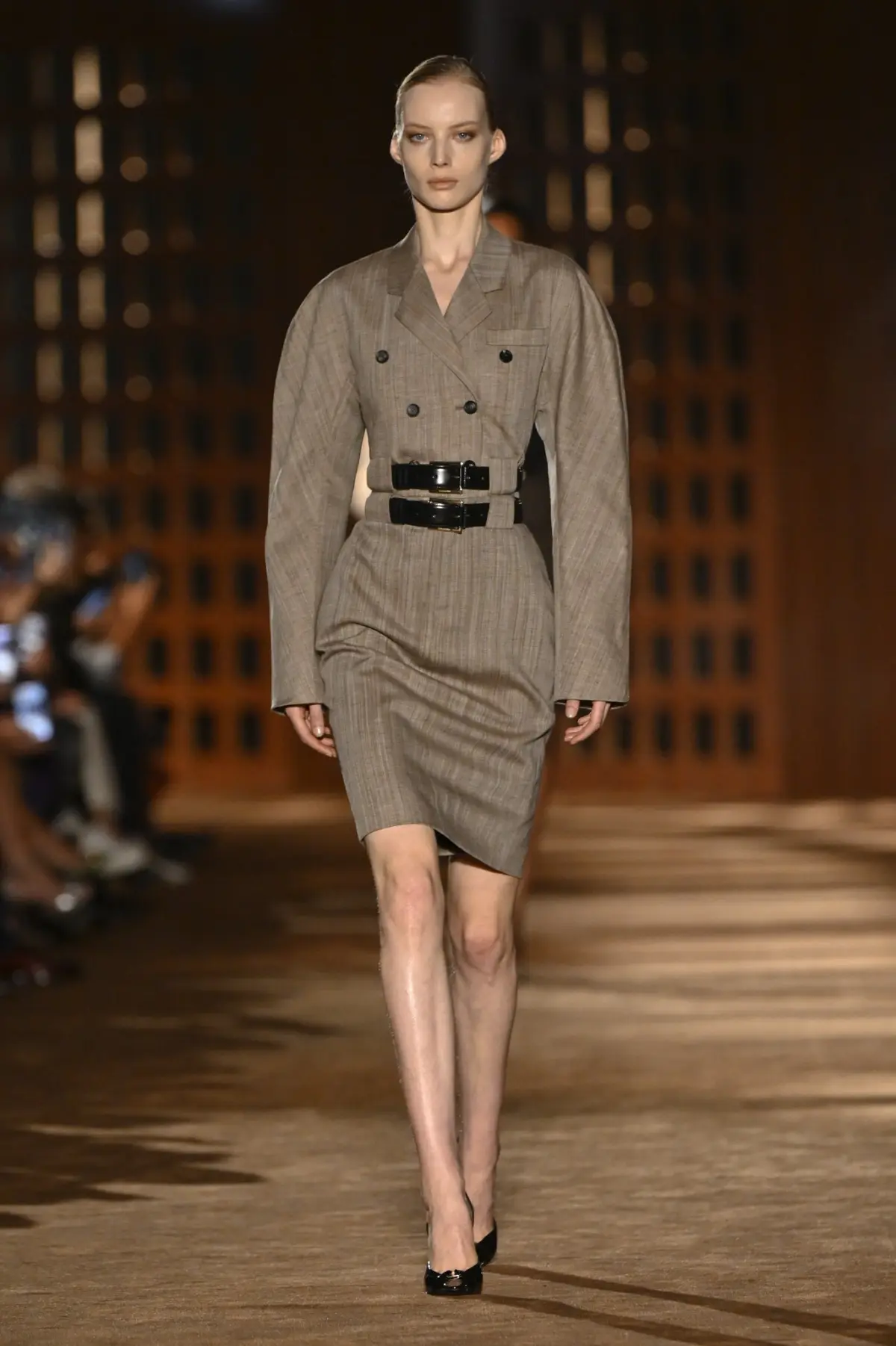
True to form, the collection felt unmistakably and quintessentially Ferragamo, anchored by a heavy preponderance of statement leather belts. These defining accessories were positioned dramatically on raised waists to elongate the figure, and on several standout occasions, cinched directly over the bosoms, creating an arresting architectural silhouette. Heritage details were honored respectfully yet updated for today’s luxury consumer, most notably through the signature Gancini clasp closures featured prominently on meaty, substantial leather jackets and heavy-duty vests.
Footwear, a cornerstone of the Ferragamo empire, was given a thrilling modern refresh. The runway debuted compelling new variations on the iconic F wedge, a revolutionary design first pioneered by company founder Salvatore Ferragamo way back in 1947. Alongside the architectural wedges walked a fresh, brilliantly executed new interpretation of the classic Vara pump, proving that the house’s storied shoe archive remains an endless well of inspiration for Davis as he charts the brand’s future.
Yet, beyond the immediate commercial appeal and the applause for the craftsmanship, fashion observers in the audience could not help but read the show through another, more speculative lens. Within the tightly knit, rumor-obsessed circles of the European fashion capitals, the collection was interpreted by some as a sly, brilliantly executed audition for Saint Laurent in Paris. Industry whispers have persisted that the legendary Parisian house is quietly mulling a creative change, despite the largely acclaimed, critically praised, and decade-long tenure of current creative director Anthony Vaccarello. Whether or not Davis has his sights set across the Alps, the collection certainly showcased a mastery of sleek, nocturnal chic and tailoring prowess that would feel entirely at home on a Parisian runway.
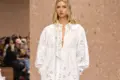
The subtle French undertones and echoes of fashion history were visible in the construction and styling. The sleeveless safari shirts and sharply cut pencil skirts, loosely and provocatively laced at the sides, bore a distinct resemblance to the high-octane glamour of Tom Ford’s celebrated era at the house Yves built. However, it was the 1940s that Davis fundamentally explored and reinterpreted throughout the presentation. This historical focus was felt most acutely in the opening look—a commanding, strong-shouldered coatdress that set a serious, authoritative tone for the afternoon—and continued through the collection’s immaculate, high-waisted tailoring.
Throughout the presentation, Davis demonstrated a characteristic lightness of hand coupled with an innate, deeply sophisticated sense of fabric behavior. He possesses a rare talent for creating spontaneous-seeming drama through simple gestures, such as scarf-like drapes tossed tightly and nonchalantly over the shoulder, or a generous swag of sheer silk that lapped fluidly at the models’ legs with every step.
The standalone pieces were uniformly strong, with his sleeveless leather safari vests and matching pencil skirts proving to be absolute masterclasses in modern leatherworking. Importantly, the menswear offerings held their own effortlessly against the womenswear on the shared runway, radiating a palpable swagger and refined chic to spare. The male models walked with an easy confidence, wearing tailored silhouettes and utility-inspired outerwear that translated the desert theme into a thoroughly wearable, masculine wardrobe.
Marking a significant milestone in his career, the designer has now officially passed his sixth anniversary at the historic Florentine house. With this confident, deeply cohesive collection, it is clear that Maximilian Davis has truly come into his own, cementing his place as one of the most compelling creative forces working in luxury fashion today.