






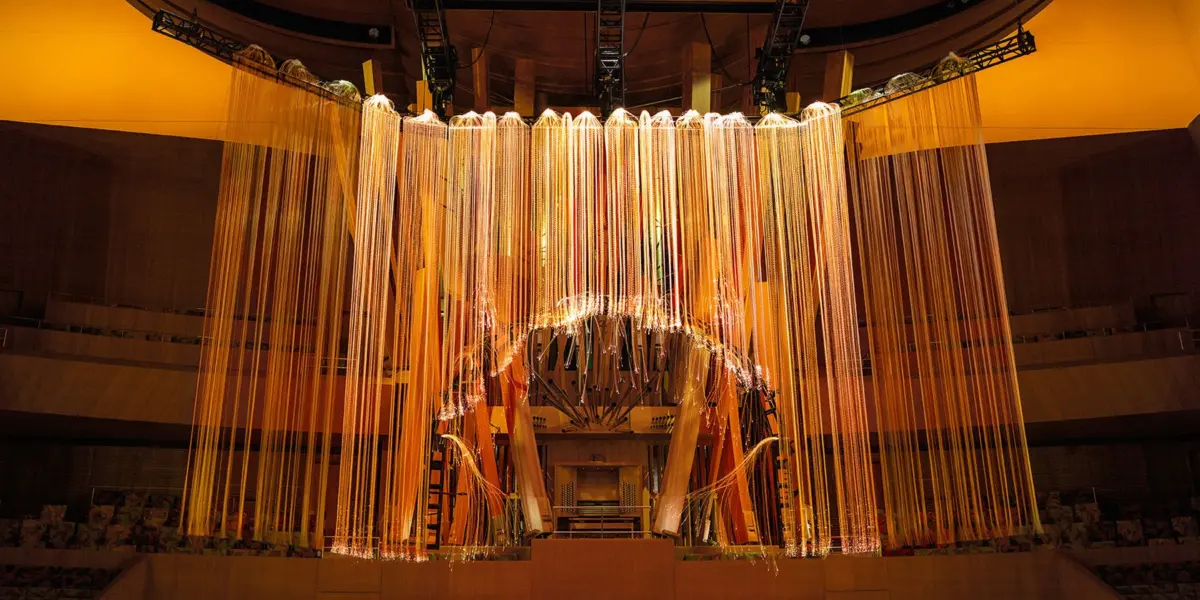
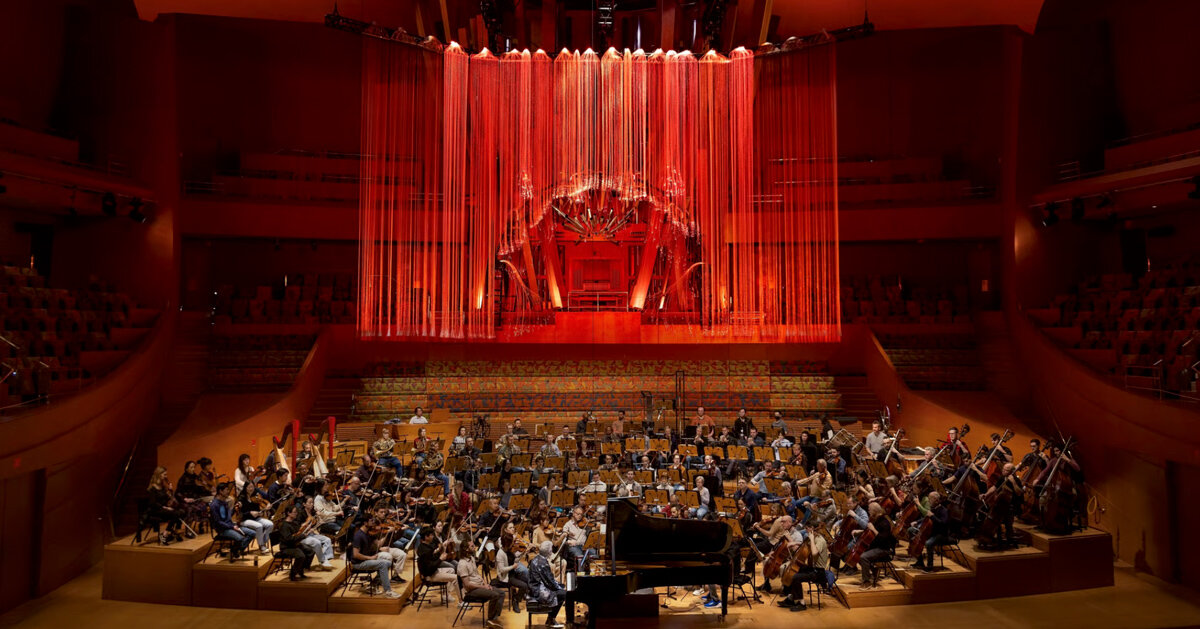
The iconic Frank Gehry-designed Walt Disney Concert Hall in downtown Los Angeles recently played host to a breathtaking synthesis of sight, sound, and architectural space through a striking new temporary intervention. Titled RADIANCE, a monumental light sculpture installation created by renowned multidisciplinary artist Grimanesa Amorós, was recently commissioned by the Los Angeles Philharmonic and presented to audiences across three consecutive performances. Conceived specifically to accompany and visually interpret Alexander Scriabin’s revolutionary 1910 orchestral masterpiece, Prometheus: The Poem of Fire, Op. 60, the ambitious work takes the primal, untamed subject of fire and translates it into a magnificent, pulsing spark suspended delicately in mid-air directly above the orchestra.
The conceptual foundation of RADIANCE is deeply rooted in profound mythological and cultural references, bridging ancient human history with contemporary technological art. The installation draws primarily from two distinct yet conceptually harmonious legends: the classic Greek myth of Prometheus, the Titan who famously stole fire from the gods and gifted it to humanity, and Viracocha, the revered creator deity of Incan mythology. Together, these powerful cultural narratives frame light not merely as a physical phenomenon, but as a profound carrier of knowledge and an enduring medium of spiritual and cultural transformation.
For Grimanesa Amorós—a Peruvian-born American artist whose celebrated career has consistently explored the intersection of sculpture, video, and lighting—this project represents a major milestone in her artistic evolution. Amorós has worked extensively with light as both a physical material and a dynamic, expressive language since 2002. With RADIANCE, she has taken this foundational approach and scaled it up to meet the immense spatial and acoustical demands of world-class architectural environments, successfully merging high-concept fine art with symphonic performance.
Programmable LED Light Sculpture Responds to the Orchestra
Spanning an impressive 60 by 35 by 5 feet (or roughly 18.29 by 10.67 by 1.52 meters), the sheer physical presence of the installation commands the volume of the auditorium. RADIANCE is meticulously constructed from a sophisticated array of reflective materials, color-shifting rope-like LED tubing, and custom-engineered electrical hardware. Hidden beneath its luminous exterior is an intricate, highly specialized lighting sequence written entirely from scratch specifically for this three-performance run, controlling the sculpture’s continuous, fluid shifts in hue, intensity, and rhythm.
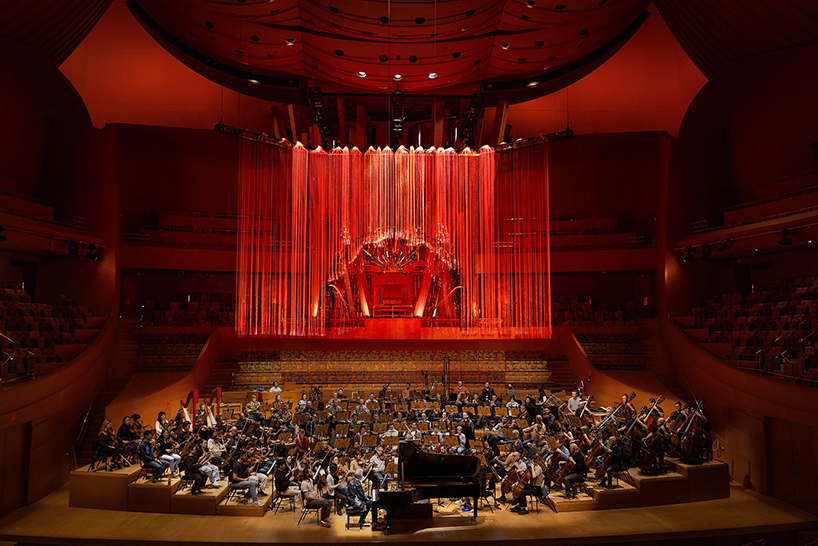
One of the most technically ambitious and defining aspects of the Los Angeles Philharmonic commission is the total integration of the sculpture with Walt Disney Concert Hall’s existing architectural house lighting. Rather than treating the suspended artwork as an isolated object floating arbitrarily within the space, Amorós approached the commission as a unified, holistic environment. The artist personally programmed both the independent light sculpture and the concert hall’s permanent house lighting systems to operate simultaneously as a single, cohesive lighting ecosystem. This deliberate curatorial and technical choice creates an immediate, visceral dialogue between the suspended artwork, the curvaceous metallic architecture of the concert hall, and the live musical performance unfolding on the stage below.
Rather than relying on random or generic patterns, the entire lighting sequence was composed second by second in meticulous relation to the score played by the orchestra. The visual narrative of RADIANCE develops organically through six major synchronized moments, mirroring the emotional and structural contours of Scriabin’s musical composition. As the orchestra moves through the movements of Prometheus, the lighting of the sculpture, the overarching concert hall, and the live performance progress in lockstep, functioning as a coordinated, multi-sensory system that envelops the audience from the first note to the final resonant chord.