



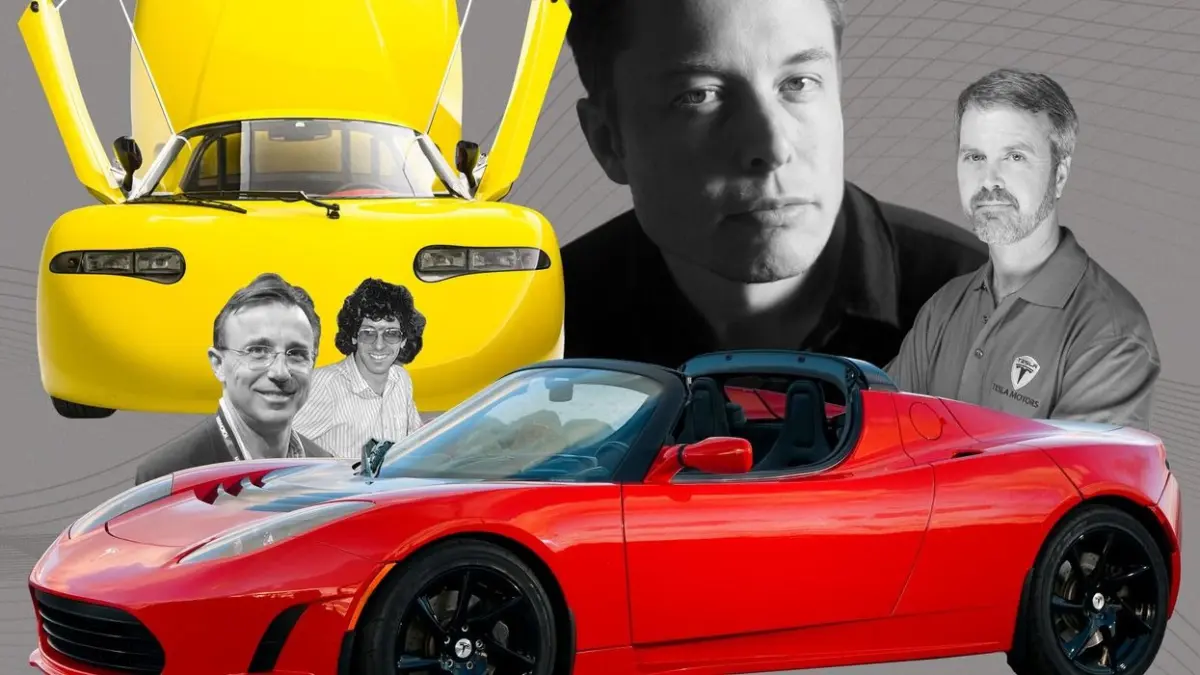
In 2003, Martin Eberhard, a cofounder of Tesla Motors, reached a critical crossroads where he needed to start convincing venture capitalists and potential investors to back his ambitious vision. To achieve this, however, he urgently needed an electric car to demonstrate the viability of the technology. He turned to Alan Cocconi, asking if he could borrow the tZero, a revolutionary, blazingly fast electric roadster that Cocconi had engineered and built at AC Propulsion.
Eberhard’s strategy was simple yet daring: he wanted to drive the tZero up and down Sand Hill Road in the heart of Silicon Valley, conducting live, high-impact demonstrations for curious entrepreneurs and venture capitalists. Eberhard was frequently accompanied by Tom Gage, Cocconi’s partner at AC Propulsion, during many of these visits. Like Tesla at the time, AC Propulsion was also actively seeking financial backing, though their commercial goal was to develop a considerably more utilitarian electric vehicle rather than an exotic sports car.
By December 2003, Eberhard proposed another high-stakes demonstration at Buck’s of Woodside, a popular restaurant famously frequented by influential tech entrepreneurs and investors. At five o’clock on any given evening, Buck’s likely harbored a higher concentration of venture capital wealth per square foot than nearly any other building in the country. Eberhard’s explicit plan was to showcase what a genuinely high-performance electric sports car could accomplish. He outlined his intentions in an email to the restaurant’s owner, Jamis MacNiven, who happily accommodated the request.

The tZero proved to be an immediate psychological and visceral hit. When a venture capitalist climbed into the passenger seat for a ride with Eberhard behind the wheel, Eberhard would instruct them to reach forward and try to touch the dashboard. As the unsuspecting passenger stretched their arm out, Eberhard would abruptly slam down on the accelerator. The resulting G-forces were so intense and immediate that the passenger was literally pinned back into their seat, unable to reach the dashboard. That raw, breathtaking power was the ultimate testament to the tZero’s electric drivetrain performance.
Many of the venture capitalists were utterly astounded by the demonstration. Some even openly questioned whether the vehicle was actually electric, suspecting a hidden gasoline engine. These were individuals who frequently owned high-end exotic vehicles like Ferraris and Lamborghinis; they understood performance sports cars inside and out, but the instantaneous torque and acceleration of the tZero defied everything they thought they knew about electric mobility.
Despite the excitement generated at Buck’s of Woodside, the event garnered surprisingly little direct investor interest—with one notable exception. Google cofounders Sergey Brin and Larry Page were both present at the restaurant that day. They pulled Tom Gage aside to mention an individual whose financial assets were highly liquid, having recently cashed out his massive stake in a successful startup. Furthermore, this mysterious investor happened to share a deep passion for fast, exotic cars.
That man was Elon Musk.

Elon Musk, Meet the tZero
In 2004, it was far from apparent to outside observers that Elon Musk would eventually leave an indelible mark on the global automotive industry. At that time, he was primarily known as the cofounder of PayPal, which he had successfully sold to eBay in 2002 for a staggering $1.5 billion. He had already set his sights on the stars by launching Space Exploration Technologies Corp., widely known as SpaceX, with the audacious long-term goal of paving the way for a sustainable human colony on Mars. Musk undeniably harbored a deep love for high-performance automobiles. His personal garage included a million-dollar silver McLaren F1—one of only 64 road-going models in existence—alongside a 400-horsepower BMW M5 and a classic 1967 Jaguar XK-E Series 1 roadster. Yet, prior to this juncture, he had never publicly expressed any serious desire to build automobiles or establish an automotive manufacturing company.
Nevertheless, Musk’s profound affinity for exceptional engineering and fast cars made it virtually impossible for him to ignore an email he received from Tom Gage on January 21, 2004. Gage wrote that Sergey Brin and JB Straubel—a young Stanford engineering graduate who would later become Tesla’s chief technology officer—had both suggested Musk might be genuinely interested in experiencing their tZero electric sports car. Gage noted that the vehicle performed remarkably well, mentioning a recent impromptu street race against a Dodge Viper where the tZero won four out of five sprints on a short track, losing only when carrying a heavily loaded, 300-pound cameraman. Gage offered to bring the car by for a personal demonstration.
Musk responded swiftly, expressing genuine enthusiasm while playfully noting that he doubted the electric car could outperform his McLaren F1, though he confirmed he would be in town during early February. Gage eagerly accepted the scheduling window, realizing that securing Musk’s attention could be a monumental turning point for their enterprise.

This digital exchange marked the true genesis of Musk’s fateful entanglement with electric vehicles and the traditional automotive sector. Gage drove the tZero down to SpaceX headquarters, situated in an expansive industrial warehouse in El Segundo, California, roughly 30 kilometers southwest of Los Angeles. Inside Musk’s modest cubicle within the open-plan office section of the facility, Gage laid out his strategic pitch.
Gage explained that a gaping void had emerged in the broader automotive market. General Motors had recently abandoned its pioneering EV1 program, while legacy manufacturers like Toyota, Honda, Ford, and Chrysler were actively winding down their respective electric vehicle initiatives. Furthermore, California’s aggressive zero-emission vehicle regulations, which mandated increasing sales percentages for tailpipe-free transport, had faced intense political and legal rollbacks. Public perception of electric vehicle technology had plummeted, but the tZero stood as definitive proof that the underlying technology was not only viable but capable of delivering jet-like acceleration. Gage and Cocconi wanted to harness that breakthrough to build a practical, everyday vehicle: the eBox, an electrified version of the utilitarian Toyota Scion.
For Musk, however, Gage’s pivot toward the eBox came as an unwelcome surprise. He had agreed to meet with Gage specifically because of his fascination with the high-performance tZero. The sports car’s raw capabilities were what captured his imagination; he held zero interest in buying or backing a boxy, converted hatchback. After taking the tZero out for a test drive, Musk immediately offered to purchase the vehicle outright.
When Gage informed him that the tZero was simply not for sale, an undeterred Musk proposed paying a quarter of a million dollars if AC Propulsion would agree to transplant its advanced lithium-ion battery pack directly into his personal Porsche. Gage politely declined once again, explaining that the company’s capital was desperately needed to fund the Toyota Scion electrification project.

Musk shook his head in disbelief, finding the business model entirely illogical. As he later recalled during an interview with Vanity Fair magazine, he could not fathom the economic sense of taking an inexpensive car, converting it, and selling it at a massive markup. He remarked that he would never want to drive such a vehicle, nor would his wife. Years later, he echoed similar sentiments to his biographer Walter Isaacson, emphasizing that no consumer would ever pay a premium price for a vehicle that appeared unappealing. Musk firmly believed that any credible attempt to launch a car company had to begin at the high end of the market with expensive, desirable vehicles, allowing the core technology to gradually trickle down to mainstream buyers over time—a classic, high-risk Silicon Valley approach.
In Musk’s view, the path forward was self-evident. He loved fast cars, recognized that the tZero had the potential to change the world, and struggled to understand why Gage was wasting time trying to pitch the eBox. Concluding that he could not win Musk over to his commercial vision, Gage suggested an alternative route. He advised Musk to reach out to Martin Eberhard, who was attempting to build a high-end electric sports car from scratch. A few weeks later, Gage formally introduced the two men via email, noting Musk’s background as a car enthusiast and head of SpaceX who would likely be intrigued by Tesla’s ongoing endeavors.
Elon Musk, Meet Tesla Motors
As it happened, Eberhard and Marc Tarpenning, his partner and cofounder at Tesla, had already been contemplating reaching out to Musk even before receiving Gage’s introduction. They were familiar with Musk’s unconventional intellect, having watched him speak a few years earlier at a Mars Society conference held at Stanford University. During that appearance, Musk had discussed the seemingly whimsical idea of sending mice to Mars, providing the Tesla founders with an early glimpse into his disruptive approach to high-tech entrepreneurism and complex problem-solving.

Eberhard and Musk quickly coordinated a meeting, prompting Eberhard to contact Gage to borrow the tZero yet again—a request Gage readily fulfilled.
By this time, Tesla Motors was approximately nine months old and operated with a skeletal staff of just three employees: Eberhard, Tarpenning, and Ian Wright, a New Zealand-born engineer who lived near Eberhard. The founders were actively negotiating the licensing fees for AC Propulsion’s proprietary drivetrain technology while concurrently laying the groundwork to build their inaugural vehicles utilizing the lightweight chassis of the Lotus Elise two-seat roadster. They calculated that they would need roughly $6.5 million in capital to advance their engineering roadmap, making Musk’s deep pockets a potentially transformative asset.
Eberhard and Wright flew down to Los Angeles on a Friday to meet Musk inside his cubicle at SpaceX. What was originally scheduled as a brief, thirty-minute introductory conversation stretched on for hours as Musk relentlessly fired off technical questions. As the discussion deepened, Musk repeatedly shouted across the open office to instruct his assistant to cancel his remaining appointments for the day.
Over the course of the following weekend, Musk initiated follow-up calls with Tarpenning to dissect Tesla’s financial projections and operational models. The Tesla founders were deeply impressed by Musk’s technical acumen and unorthodox perspective. Unlike the traditional venture capitalists they had encountered previously, Musk possessed a rigorous scientific background, having earned a bachelor’s degree in physics from the University of Pennsylvania and briefly pursued doctoral research at Stanford focusing on solid-state capacitors intended for electric vehicle applications.

Furthermore, Musk showed no hesitation when confronted with calculated risks. He thrived on tackling seemingly impossible engineering challenges. Tarpenning later observed the parallel between the two ventures, noting that presenting an electric car startup to a man who was simultaneously attempting to build commercial rocket ships naturally cultivated a mutual respect for audacity.
On the Monday following their initial meeting at SpaceX, Eberhard and Tarpenning returned to Southern California. Musk formally agreed to inject $6.35 million into the fledgling enterprise, immediately becoming Tesla’s largest shareholder and assuming the role of chairman of the board. With adequate funding secured, Tesla Motors was officially operational; its next monumental challenge was to design and manufacture a revolutionary electric vehicle.
All Electric Cars Have Sucked
Virtually nobody at AC Propulsion believed that Tesla Motors stood even a remote chance of surviving, let alone succeeding. The overarching ambition of building and selling pure electric vehicles in direct competition with entrenched automotive giants across Detroit, Japan, and Germany struck industry veterans as an impossible pipe dream. Even Toyota, which was enjoying massive commercial success with its hybrid Prius, harbored no immediate plans to develop battery-electric vehicles.

Launching any automotive startup is an extraordinarily perilous undertaking that historically spelled financial ruin for ambitious visionaries like Henry Kaiser, Preston Tucker, and John DeLorean. Such endeavors demand vast capital reserves, complex supply chains, and deep manufacturing expertise. The founders of Tesla, brilliant though they were, remained largely unprepared for the grueling realities ahead.
Reflecting on those early years, Musk later argued that the company was initially built upon two fundamentally flawed premises. The first was the belief that Tesla could simply take an existing gasoline sports car chassis and convert it to electric power. The second was the assumption that they could utilize AC Propulsion’s existing technology stack with little to no structural modification. In hindsight, Musk characterized that initial shortcut as staggeringly naive and ultimately more difficult than designing a vehicle entirely from scratch.
Compounding these strategic missteps, Eberhard and Tarpenning faced immediate technological hurdles. They harbored severe reservations regarding the reliability of the analog motor controllers and drivetrain electronics they had licensed, knowing that jittery components would doom the vehicle upon release.
An even more terrifying obstacle centered on the safety of the lithium-ion battery pack. To evaluate the thermal stability of the cells, Eberhard organized a dramatic test at his home, where the engineering team dug a pit in his backyard. They arranged a block of cells beneath a sheet of Plexiglass and used an electrical wire to intentionally overheat a single cell. As anticipated, the compromised cell ruptured into flames, igniting adjacent cells in a rapid, domino-style sequence. The backyard experiment resulted in a violent conflagration that obliterated the test pack from the inside out.

While high-end sports car buyers were known to tolerate mechanical unreliability in exchange for raw performance, a catastrophic fire hazard represented an existential threat to the company. Eberhard brought the alarming results directly to Tesla’s board of directors, imposing an immediate, day-to-day halt on development schedules until the engineering team engineered a safe containment solution.
Collaborating with engineering talent from his Stanford days, JB Straubel began designing an entirely new battery pack architecture from his home garage. The team procured 7,000 individual lithium-ion cells from LG Chem, grouped them into smaller modular bricks containing 69 cells each, and integrated sophisticated liquid-cooling networks to manage thermal loads. By October 2004, the team successfully completed a prototype battery pack and used a crane to lower it into the rear bay of a modified Lotus Elise.
By January 2005, the engineering squad had assembled a fully functional prototype of their debut vehicle. Demonstrating the working car at a subsequent board meeting prompted Musk to invest an additional $9 million, successfully closing a $13 million Series B funding round. The vehicle finally received its official moniker—the Roadster—alongside an ambitious production timeline targeting initial customer deliveries in early 2006.
Internal manufacturing struggles, however, remained largely concealed from the public when Tesla formally unveiled the Roadster prototype at the Santa Monica Airport in July 2006. By that milestone, the original yellow test mule had evolved into two polished prototypes: a red car and a black car, both prepared for demonstration drives during the launch event.

The company entered the public sphere under immense pressure. Tesla operated entirely in stealth mode up to that evening, boasting no prior media coverage, zero existing customers, no formal sales team, and not a single reservation deposit in hand. Despite these vulnerabilities, Musk orchestrated a lavish unveiling inside the airport’s cavernous Barker Hangar. His assistant dispatched invitations to roughly 350 high-profile guests, including entertainment executive Michael Eisner, movie producer Richard Donner, actor Ed Begley Jr., and California Governor Arnold Schwarzenegger. Attendees were pointedly advised to bring their checkbooks should they wish to secure a build slot with a $100,000 deposit. During the festivities, a Roadster prototype aggressively zipped around a makeshift indoor track, exited the hangar doors, sped down the tarmac runway, and roared back inside.
Taking center stage, Musk addressed the gathered crowd, declaring that they were witnessing the dawn of a transformative era in automotive engineering. Until that day, he asserted, every electric car produced had universally disappointed consumers. He emphasized that electric vehicle development aligned perfectly with the innovative ethos of Silicon Valley, noting that while traditional automotive hardware was complex, the true magic lay within proprietary battery chemistry, sophisticated software, and advanced motor controllers.
Tesla Hooks Arnold Schwarzenegger, George Clooney
Musk’s uncompromising message resonated powerfully with the attending press corps, who enthusiastically embraced the Roadster. The vehicle represented a compelling counter-narrative to Detroit: it was compact, exhilarating, emissions-free, and proudly conceived in Northern California rather than an aging Michigan assembly plant.

Financially, the launch event proved to be an immediate triumph. Tesla secured twenty $100,000 reservation checks on the spot. The sales momentum continued unabated in the days following the event. Joe Francis, creator of the Girls Gone Wild entertainment franchise, dispatched an armored transport vehicle directly to Tesla’s San Carlos office to deliver $100,000 in cash. Shortly thereafter, both Arnold Schwarzenegger and actor George Clooney committed their own funds. Within a mere two weeks, Tesla had successfully presold 127 Roadsters.
Beneath the glittering surface of public acclaim, however, severe operational and manufacturing crises threatened to derail the company. The mechanical complexities of the vehicle paled in comparison to the nightmarish logistical realities of Tesla’s global supply chain. While outside observers praised the company’s internationalized manufacturing approach—sourcing battery packs from Thailand, motors and chassis components from Europe, and managing final assembly locally—the reality was profoundly dysfunctional.
The battery packs were being assembled by a third-party contractor in Thailand whose primary business was manufacturing barbecue grills. The facility was located deep in a rural region three hours outside Bangkok, consisting of an open-air pavilion supported by steel columns beneath a truss roof, lacking exterior walls because local technicians preferred working outdoors. Due to the contractor’s lack of specialized experience, Tesla engineering personnel were forced to fly back and forth across the Pacific repeatedly to oversee the work. Engineers frequently discovered animal droppings resting directly on battery assemblies that sat exposed to the ambient jungle air day and night.
Recognizing the unsustainable nature of the arrangement, Musk voiced grave concerns to his manufacturing team. He warned that the company was doomed unless it brought battery pack production entirely in-house. Relying on an overseas barbecue manufacturer yielded a crippling six-month supply chain lag from raw cell procurement to final vehicle installation, tying up immense capital in stagnant inventory and locking in undetected design flaws across months of unusable production volume.

The foundational premise of operating as a lean, fabless Silicon Valley enterprise that outsourced heavy manufacturing was rapidly collapsing under the weight of logistical friction. Straubel and other core leaders acknowledged that their initial assumption—that outsourcing fabrication to Asia would automatically yield cheaper and superior results—had proven disastrously flawed.
Tesla’s Chances of Success: 10 Percent
From the very beginning, Musk maintained remarkably sober expectations regarding Tesla’s probability of long-term survival, frequently estimating the odds of success at roughly 10 percent. Launching any traditional automotive company in 2004 was an inherently risky proposition; attempting to build an electric car company under the same conditions, he often remarked, was foolishness squared. As supply chain bottlenecks and quality failures mounted, his early skepticism appeared increasingly prophetic.
The engineering leadership ultimately concluded that their only viable path forward required bringing the manufacturing of all critical subsystems—including battery packs, power electronics, and inverters—directly under internal control. Tesla systematically dismantled its overseas manufacturing partnerships and repatriated operations to California, starting with battery pack production. Assembly infrastructure was packed into massive shipping containers, transported back to a newly established facility on Bing Street in San Carlos, and meticulously re-established over a grueling five-and-a-half-month transition period. Simultaneously, engineers completely redesigned the battery architecture and engineered custom automated manufacturing equipment.

Musk ultimately realized that the ultimate competitive advantage did not lie solely in vehicle design, but rather in the mastery of production systems. Echoing a century-old realization by Henry Ford, Musk emphasized the vital importance of building the machine that builds the machine. While assembling a functional prototype with a small engineering team might take a few months, designing the complex manufacturing ecosystem required to mass-produce that product safely and efficiently demanded orders of magnitude more resources and operational rigor.
By bringing battery assembly into their own facilities and consolidating final integration steps in California, Tesla successfully reclaimed operational control. Eliminating trans-oceanic transit loops drastically reduced inventory lag and empowered engineers to rapidly resolve design defects on the factory floor.
With manufacturing stabilized under an increasingly vertically integrated model, Musk began articulating a broader industrial vision—one centered on massive production facilities where raw materials entered at one end and finished vehicles emerged from the other. This pursuit of total operational integration mirrored Henry Ford’s historic River Rouge plant, signaling that Tesla Motors had definitively transitioned from an experimental startup into a bonafide global automotive manufacturer.