





President Donald Trump’s diplomatic and economic mission to Asia this week has yielded a major bilateral trade breakthrough, highlighted by a sweeping agreement with Thailand designed to provide American manufacturers, corporations, and exporters with what the White House has described as “unprecedented levels of market access.”
According to official statements released by the administration, the newly minted reciprocal trade agreement is slated to eliminate duties on 99 percent of goods exported from the United States to the Southeast Asian nation. The deal represents a significant milestone in economic relations between Washington and Bangkok, reshaping trade dynamics in a vital region where the United States has historically faced notable trade deficits and market entry barriers.
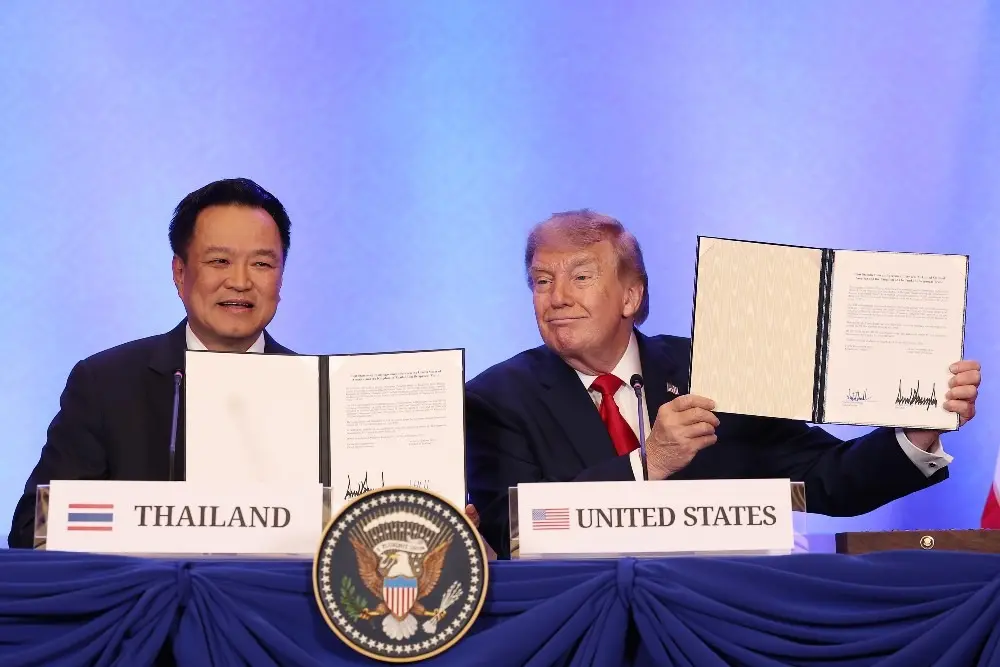
The formal economic pact was ceremoniously signed on Tuesday on the sidelines of the Association of Southeast Asian Nations (ASEAN) Summit in Manila, the Philippines. President Trump met directly with Thailand’s Prime Minister Anutin Charnvirakul to finalize the framework of the historic accord. Just one day later, Thailand’s Commerce Minister Suphajee Suthumpun formally announced the development to the public, offering further insight into the compromises and strategic calculations made by both governments during the high-stakes negotiations.
While the primary headline for American exporters focuses on the near-total elimination of tariffs on U.S. goods entering Thailand, the agreement involves a complex set of reciprocal concessions and regulatory alignments. According to statements from Thailand’s government, a key component of the compromise involves the adjustment of Section 301 forced labor tariffs. Bangkok confirmed that its Section 301 tariff rate will be reduced from 12.5 percent down to 10 percent. This reduction effectively mirrors the duty rates faced by neighboring regional competitors, including Cambodia, Malaysia, and Indonesia, thereby leveling the playing field for Thai exporters operating within the American market.
Interestingly, the initial official statements released by the White House did not explicitly feature the planned reduction of Section 301 tariffs on Thai goods. However, the American administration’s briefing emphasized that Thailand has made firm commitments to improving domestic conditions for workers. Specifically, Bangkok has pledged to amend its national labor laws to strengthen worker protections, while actively addressing violations in industrial sectors historically identified as carrying a high risk for forced labor and child labor practices.
As part of the broader tariff structure, the United States will maintain a 19 percent reciprocal tariff on certain Thai goods—a baseline established during prior framework negotiations held in October 2025. Nevertheless, the U.S. government has agreed to review last year’s product lists to identify specific items eligible for potential tariff reductions, which could eventually be lowered to as low as zero percent depending on future regulatory compliance and bilateral cooperation.
The economic stakes surrounding the agreement are substantial. The United States currently stands as Thailand’s single largest export destination. Last year alone, Thai manufacturers shipped approximately $70.2 billion worth of goods to American shores. Conversely, this robust trade volume has contributed to a persistent trade imbalance for the United States. According to White House figures, Thailand currently represents America’s 11th largest goods trade deficit, accounting for a deficit worth roughly $45 billion in 2024 alone.
By securing this new agreement, Washington has successfully pressured Bangkok into opening selective portions of its domestic market, while carefully maintaining certain import limits and regulatory safeguards to protect domestic Thai industries. In addition to drawing down duties on the vast majority of U.S. products, Thailand has committed to purchasing American-made vehicles as part of its economic concessions. Furthermore, the country has agreed to buy an additional $2.6 billion in American agricultural products, providing a substantial boost to U.S. farmers and the domestic agricultural sector.
Beyond traditional physical goods and agricultural commodities, the trade pact addresses modern economic challenges, particularly concerning digital commerce and intellectual property enforcement. Both governments announced that they would finalize commitments to remove longstanding barriers to digital trade, specifically targeting discriminatory services taxes that have previously penalized U.S. technology and digital products. Furthermore, Thailand has committed to addressing chronic intellectual property issues. This includes strengthening enforcement mechanisms against trademark counterfeiting and copyright piracy, as well as taking proactive steps to collaborate with the U.S. on countering unfair trade policies, enhancing export controls, and jointly combating duty evasion.
The path forward for the agreement involves rigorous legal review and internal legislative processes. The White House indicated that both nations will continue intensive negotiations over the coming weeks to formally “lock in” the economic benefits for U.S. businesses. Meanwhile, Thai representatives stated that legal counsel is scheduled to spend approximately two months finalizing the legal text of the agreement before it is officially submitted to the Thai cabinet for final authorization and enactment.
President Trump praised the outcome of the diplomatic talks, emphasizing the mutual benefits of the pact. “This is an incredible victory for both countries, both the people of Thailand and the American people, and I look forward to finalizing the details of our formal agreement in the coming weeks,” Trump remarked following the signing ceremony.
Prime Minister Charnvirakul echoed these sentiments during his address at the event, underscoring the enduring partnership between the two nations. “Thailand attaches great importance to its long-standing relationship with the United States,” Charnvirakul said. “Our partnership is beyond trade and investment. We remain committed to strengthening our cooperation across areas of mutual interest.”
Following the successful conclusion of the ASEAN Summit and the signing of the Thailand trade agreement, President Trump traveled onward to Shenzhen, China. There, he participated in the Asia-Pacific Economic Cooperation (APEC) forum, which set the stage for a highly anticipated diplomatic meeting on Thursday involving Chinese President Xi Jinping and Russian President Vladimir Putin.
Ahead of the gathering in Shenzhen, significant global speculation surrounded the possibility that the occasion might provide an opening for Trump and Xi to advance discussions regarding the future of bilateral U.S.-China trade relations. These discussions had previously seen a temporary reprieve when the two superpowers agreed to extend last year’s Busan trade truce for an additional three months back in September. However, little substantive headway appeared to be achieved on the core trade front during this week’s encounter. Observers characterized the conversation primarily as an in-depth exchange of views addressing the broader international situation, with both sides committing generally to maintaining strategic stability and international security.
Despite the limited progress on trade specifics during the Shenzhen meetings, diplomatic channels remain active. President Trump is already slated to hold another face-to-face meeting with President Xi in mid-December. That encounter is scheduled to take place during the upcoming G20 Leaders’ Summit, which will be hosted on December 14 and 15 at the Trump National Doral golf club in Miami.
In addition to their discussions on commerce and security, the international leaders participating in this week’s diplomatic engagements in Asia addressed several broader multilateral initiatives. They committed to pursuing institutional reforms within the United Nations to enhance the international body’s capacity to respond swiftly and effectively to emerging global challenges. Furthermore, the leaders promised to maintain an ongoing diplomatic dialogue aimed at reducing nuclear risks and preventing the dangerous proliferation of nuclear weapons. In a notable joint energy-related announcement, they also revealed concrete plans to increase the production of refined petroleum products, a move intended to stabilize global energy flows and support economic stability for nations worldwide.