





About a year ago—or perhaps it was two—I remember sitting in an Uber with Ben and some of the Hodinkee team as we drove down the Rue de Lausanne in Geneva, heading toward Watches & Wonders. We had just grabbed a quick breakfast when Michael Friedman unexpectedly joined us. Yes, that Michael Friedman. The "AP, Michael Friedman, my friend’s cooler" rap lyric guy. The person who just so happened to have previously served as a curator at the Willard House & Clock Museum and the National Watch & Clock Museum, Head of Watches at Christie’s New York, a client advisor to figures like Eric Clapton during his pièce unique Patek years, and, most recently, the Head of Complications at Audemars Piguet.
Okay, maybe you do not know Michael Friedman. But I knew him well and experienced some formative early-career moments bumping into and getting to know him. I also knew he was working on an entirely new brand, though I had absolute zero idea what it actually was. "It’s wild," said Ben—or some approximation of that. "It’s not so much a watch as a cuff, with a bunch of diamonds." What could that even mean? I had ideas in my head, but as they spiraled, they got further and further from the truth. As of a few months ago, however, we finally have the answer, and it is not at all what I had envisioned.
The B-Theory Series 1 from Friedman’s new brand, Pattern Recognition, is, as Ben noted, far from a watch in most respects, yet somehow closer than I expected. Yes, it is jewelry. There are diamonds involved. And yet, it possesses the bona fides of serious technical watchmaking and deep connections with the past without ever falling into the trap of being a mere revival or reissue. Instead, it represents an ambitious attempt at a horological reinterpretation of how we perceive time itself. Beyond its strikingly modern form, the watch requires a bit of a primer in philosophy to truly understand its underlying intent.
The A-theory and B-theory of time were foundational concepts coined back in 1966 by philosopher and professor Richard M. Gale. Philosophy was never one of my strong suits in school—Intro to Political Philosophy was, by my foggy recollection, my lowest grade during my freshman year. But if I understand the premise correctly, Gale argued that one could either assume time has tenses like past, present, and future (where things used to exist, currently exist, and will exist) and that as we move through it, the universe is actively creating new moments to experience. That is A-theory. B-theory, on the other hand, suggests that all moments equally exist at once as equally real, and it is simply our position within them that changes. Just because I am in New York and you are in your respective location does not mean that either place is less real, or that there is not something tangible connecting the space between us.
That, in a nutshell, is the philosophy behind the Pattern Recognition B-Theory. Rather than entirely recap Friedman’s explanation from his appearance on Talking Watches, it is worth breaking down the genesis of the project before diving into the practical specifications. There are a great many things that traditional watchmakers used to be able to accomplish. Three-dimensional curved movements—specifically historic watches like the Movado Polyplan—have largely gone by the wayside over the decades. Not just shaped watches in general, but actual movements built on a continuous curve. Returning to A-theory versus B-theory, in the latter framework, it is not that these are old ideas that were done once and abandoned; rather, they are ideas that permanently exist, just as this new creation does. This watch is not strictly modern, and the Polyplan is not merely vintage. They simply are.

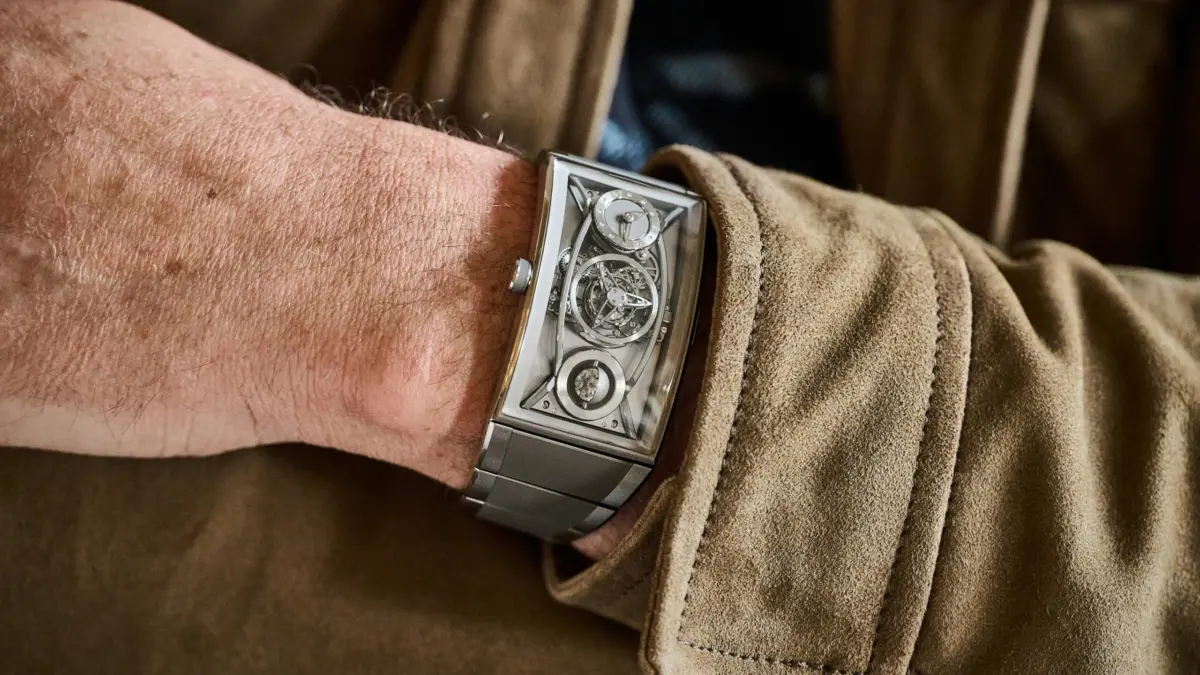
The case and movement of the B-Theory are realized as a unified, curved form, closely following the architectural curve established by the historic Polyplan. Crafted from Grade 5 titanium, the case measures 32mm wide but features a very long 52mm span, maintaining a consistent 9.6mm total thickness throughout its gentle 18-degree curve. The entirety of the watch focuses heavily on intricate hand-finishing rather than relying on material coatings or exterior treatments. Some surfaces are satin-polished and appear lighter to the eye, while others are darker and meticulously sandblasted. Two distinct versions are available, allowing collectors to choose their preferred dominant aesthetic.
The dial display is laid out consciously from top to bottom. At the very top sits a moon phase complication represented by a 6mm "moon-cut" diamond, grown in a lab in Switzerland. This lab-grown origin allows for strict control over quality and cutting parameters, ensuring the entire watch can proudly claim Swiss-made status from top to bottom. Friedman explains that this celestial feature represents astronomy and serves as the fundamental basis of time as we perceive it. Instead of a traditional rotating display disk, a specialized shroud rotates smoothly around the diamond, and it can be advanced easily via a side-mounted pusher. Positioned directly below is the tourbillon, metaphorically harvesting that energy—though functionally, this remains a hand-wound caliber—and below that sits a standard time display representing time as we collectively understand it, complete with diamonds marking the hours.
I will be completely honest: I rarely turn to watches to satisfy my philosophical appetite. In fact, I actively try to avoid thinking too philosophically, though perhaps that is something for another time and place. But if you are like me and believe that high-end watchmaking—where the sky could and should be the limit at least sometimes—has occasionally become too confined to a traditional box, there is no denying that the B-Theory accomplishes something striking. It delivers an impactful form and an entirely fresh view of what watchmaking can look like, whether viewed as modern, current, or historic depending on your philosophical stance on time.
The finishing on the B-Theory can be somewhat difficult to fully comprehend at first glance. It is rare to see titanium components finished to the same high level that traditional brass, gold, or steel can be polished and chamfered. The visual contrast is achieved through varied areas of delicate graining, sandblasting, and sharply defined, high-polished surfaces along edges featuring tight, angular chamfers. The movement operates at a steady 3Hz frequency and is protected by 30 meters of water resistance. While Friedman was still awaiting final official specifications for the power reserve during our discussions, he noted that prototype testing consistently yields upwards of 60 hours of running time.
The movement itself was conceived in the abstract by Friedman and brought into physical reality with the crucial assistance of Fabrice Deschanel, the former head of R&D at Audemars Piguet, who now leads a new enterprise known as Artime. The design process was further refined with input from Claude Emmenegger, also at Artime, who famously designed the AP Concept. The movement was co-developed, constructed, and finished by the specialized team at Vanguart. Looking at the watch from the front, you see only what is presented on the dial side, with the remainder tucked neatly behind the caseback. When viewed from the rear, however, it becomes immediately apparent how tightly integrated the bracelet is to the case, featuring a clever quick-change mechanism built directly into the back.

The bracelet and strap system is remarkably user-friendly. Unlike most brands that leave articulation largely to the bracelet itself—typically utilizing a hook that loops over a bar or locks securely into the case—the articulation here is directly integrated into the core structure of the case. Without using overly gendered terms, the case essentially features male ends that slot precisely into the female receivers of the bracelet or strap. It is also worth noting that the watch ships on either a strap or a bracelet, though owners of the bracelet version can swap over to the strap later if desired.
Let us attempt a bit of geometry—a topic I certainly did not cover in college, meaning I am really sticking my neck out here. Friedman informs me that the watch measures 52mm as a curved object. It did not feel overly long when strapped to the wrist, so I sat down to do the math to find the equivalent lug-to-lug distance across a flat surface, what mathematically inclined minds refer to as the chord. Factoring in the 18-degree curve, I calculated the radius using the arc length formula, arriving at approximately 165.52 mm, and from there calculated the chord length, revealing a flat span of approximately 51.79 mm. That math also revealed an interesting detail: if the watch strictly followed that 18-degree curve, the ideal wrist size would be roughly 16.5 centimeters, or about 6.5 inches. Yet on my own 7.25-inch wrist, the watch never felt like it was riding too high, and the flexibility of the bracelet certainly assists with that comfortable wearability.
Unfortunately, I did not have the alternative straps or the secondary bracelet version on hand when I was photographing the timepiece. The bracelet—and the entire physical package—that I did have in front of me provided a striking and thoroughly unusual experience. I am a self-avowed lover of watches on bracelets, and I deeply appreciate curved designs; a platinum Cartier Tank Cintrée on a bracelet ranks firmly in my personal top five dream watches. And yet, the B-Theory wears nothing like that. Nor does it wear like a Royal Oak, a Nautilus, or any other iconic integrated-bracelet watch I can readily recall. The bracelet does not feature traditional links where alternating rows connect in a conventional manner. It functions simultaneously as a rigid cuff and a surprisingly thin, lightweight piece of architecture.
What is undeniably heavy—though thoroughly justified by the horological bona fides, the industry heavyweights behind the project, the technical complexity, and the obsessive attention to detail—is the price tag. The Pattern Recognition B-Theory Series 1 is priced at CHF 150,000 when fitted on a strap and CHF 120,000 on a bracelet. Production of the Series 1 is strictly limited to 25 commercial pieces alongside five prototypes. Given Friedman’s deep roster of industry connections and high-end collectors, it comes as little surprise that all of the Series 1 allocation has already been spoken for. From prominent celebrities and musicians to dedicated collectors of deep-cut independent watchmaking, I already know quite a few of the buyers. As Friedman mentioned during his Talking Watches appearance, he plans to return with a two-tone variant and several other iterations in the future. Or perhaps it is in the past? Or maybe they already exist. You get the drift.