




As the digital landscape expands with millions of new content creators launching channels for gaming, podcasting, and home music recording, the era of relying on cheap, built-in laptop microphones has firmly come to an end. Today’s audiences demand pristine audio fidelity, and achieving that professional sound no longer requires a complex studio full of expensive analog gear, mixing boards, and separate interfaces. Modern USB microphones have revolutionized home audio by offering studio-quality capture through a single, straightforward plug-and-play connection to a computer or mobile device.
After rigorous testing of models ranging from $30 budget finds to $250 professional studio setups, audio experts and reviewers have identified the top hardware options for creators looking to elevate their sound. Leading the pack as the best all-purpose choice is the Sennheiser Profile, a versatile, solidly built microphone that delivers exceptional audio clarity for a wide variety of recording tasks.
Why You Should Trust Our Evaluation
The extensive testing behind these recommendations was conducted by industry professionals with deep roots in audio engineering, performance, and recording technology. Freddy Gerngross, a graduate of NYU Steinhardt’s Music Technology Program, professional musician, and recording engineer, handled the testing for home-studio recording and gaming applications. Joining him was writer Brent Butterworth, who brings more than three decades of experience testing and measuring audio equipment, co-hosts a biweekly podcast, and has charted nationally with his own self-produced musical projects.
Together, the testing team evaluated microphones across multiple categories, ensuring that performance was measured objectively through blind listening panels and standardized testing apparatuses. Rather than relying solely on brand reputation or price tags, the reviewers utilized rigorous testing methods—including artificial mouth simulators and controlled acoustic environments—to determine how well each microphone handled human speech, musical instruments, and background noise.
Understanding Who Needs an Upgrade
This comprehensive review is specifically tailored for individuals who spend substantial time recording music, streaming video games, producing podcasts, or generating content for platforms like YouTube and TikTok. For these creators, upgrading from a subpar internal microphone to a dedicated USB device is the most cost-effective way to dramatically improve production value without purchasing an array of external audio interfaces.
While more ambitious, complex studio projects might still benefit from traditional analog setups utilizing USB audio interfaces and specialized mixing hardware, the current crop of advanced USB microphones bridges the gap remarkably well, offering high-end audio performance with a fraction of the setup complexity.
Rigorous Testing Methodology
To evaluate each microphone thoroughly, experts scoured the market for recent releases spanning a wide price range. Sound quality for spoken word was tested by recording male and female voices reading standardized Harvard Sentences into high-end measurement microphones. These recordings were then played back through a Brüel & Kjær Type 4227 Mouth Simulator, ensuring that every USB microphone tested received the exact same audio signal under identical conditions.
The microphones were tested at multiple distances: close-up at two inches for optimal quality, one foot away to evaluate room echo rejection, and one foot away with ambient air conditioner noise playing from a nearby speaker to test background noise suppression. To eliminate bias, all test recordings were anonymized with letter labels and ranked blindly by multiple Wirecutter staffers alongside industry-standard reference microphones like the Shure SM57 and Electro-Voice RE20.

For musical performance testing, reviewers recorded acoustic guitar, vocals, and double bass within a furnished residential bedroom, repeating performances meticulously for each model. Gaming performance was evaluated by playing cooperative online multiplayer games to test both push-to-talk functionality and open-mic clarity, noting whether any devices clipped the beginnings of words or picked up excessive keyboard clatter.
Top Picks for Every Creator
Top Pick: Sennheiser Profile
The Sennheiser Profile emerged as the definitive best all-purpose USB microphone because it successfully combines excellent sound quality, solid physical construction, and intuitive operation. Unlike many podcast-focused microphones that utilize dynamic elements, the Profile employs a condenser element, allowing it to capture finer treble details and acoustic instrument nuances with remarkable clarity.
Featuring front-mounted controls for microphone gain, headphone volume, and monitoring mix, the Profile makes adjusting levels effortless. It also includes a convenient mute button and a sturdy desktop stand, making it immediately ready for action out of the box. While its sound can lean slightly thin compared to bulkier broadcast mics, its overall performance makes it the most adaptable choice for general use.
Budget Pick: Mackie EM-91CU
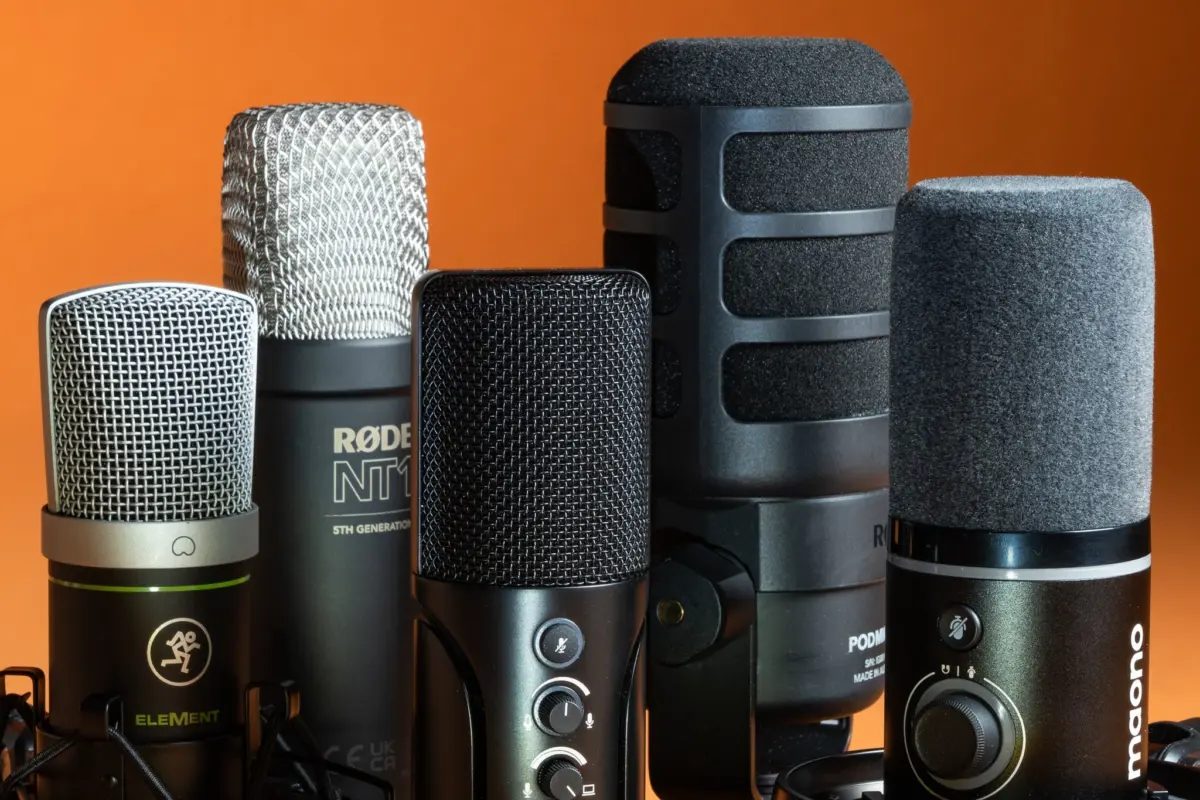
For creators working with tighter budgets or focusing primarily on music production, the Mackie EM-91CU stands out as a dependable workhorse. Offering transparent sound reproduction with minimal coloration, this microphone excels at capturing instruments cleanly. It features a durable, lightweight build that handles regular use well, though it lacks onboard physical controls, a headphone jack, and modern USB-C connectivity, relying instead on an older USB-B port. Paired with an affordable desktop stand and a pop filter, it serves as an exceptional entry-level tool.
Upgrade Pick: Røde NT1 5th Generation
Creators seeking professional-grade studio fidelity without the hassle of a separate audio interface will find the Røde NT1 5th Generation to be the premier upgrade option. As a USB adaptation of a legendary studio classic, the NT1 delivers exceptionally clear treble, detailed midrange, and a robust bass response. It also features a rare 32-bit float recording capability, which prevents digital clipping if a performance suddenly gets too loud. Bundled with a heavy-duty shock mount, pop filter, and both USB and XLR cables, it offers true professional versatility, though its heavy build is less suited for casual desktop setups.
Best for Podcasters: Maono PD200W
Designed specifically with podcasters in mind, the Maono PD200W offers fantastic voice clarity and unmatched connectivity options, including USB-C, analog XLR, and wireless operation via an included USB-C dongle. Its standout feature is an adjustable noise-cancelling system that effectively subdues heavy background noises like air conditioning units and room reverb, making it ideal for less-than-ideal recording spaces.
Best Upgrade for Podcasters: Røde PodMic USB
For podcasters and streamers who prioritize top-tier vocal reproduction and prefer a broadcast-style swing-arm setup, the Røde PodMic USB is the ultimate choice. It produces a full, warm, and natural vocal tone while effectively rejecting keyboard clicks and room reflections. Complete with an internal pop filter, a headphone jack with volume control, and dual USB-C and XLR outputs, it is built to handle professional long-form recording sessions effortlessly.
As the creator economy continues to mature, investing in a reliable USB microphone remains the single most impactful upgrade a content producer can make. Whether opting for the versatile Sennheiser Profile, the budget-friendly Mackie, or the professional-grade Røde models, creators now have unprecedented access to studio-quality sound right from their desks.