





When Carlo Crocco stood inside a modest exhibition booth at Baselworld in 1980, the horological landscape was facing a turbulent transformation. Armed with little more than a single window displaying a lone gold-cased watch suspended from a black rubber strap, the young founder waited. For the first two days, almost nobody came to see us, and we were very anxious, Crocco recalls, casting his mind back to the quiet launch of what would become a revolutionary concept. But the tide turned swiftly. On the third day, we realised that everyone was speaking about us, because it was really something different from all the other watches.

That bold juxtaposition of precious yellow gold and utilitarian rubber—branded under the name MDM—shattered conventional luxury codes of the era. Decades later, Hublot is formally returning to those foundational roots with the launch of the Classic Fusion Tributo. Gathered in Milan on the eve of the release, enthusiasts and industry observers are examining a piece that Hublot presents as a direct lineage to Crocco’s original design. Yet, after spending hands-on time with the watch in the metal, the most compelling aspect of the Tributo is how firmly it refuses to be a simple reissue. At a time when luxury watch brands frequently reproduce their historical archives down to exact 3D-scanned specifications, Hublot has chosen a different path. The brand has delivered an evolved expression of its inaugural timepiece, seamlessly blending its original DNA with a design language that has matured over four decades of watchmaking history.
This strategic decision comes into sharper focus when examining where Hublot stands today under contemporary leadership. Since Julien Tornare stepped into the role of CEO in late 2024, the Swiss manufacture has been executing a deliberate, multi-faceted reset. The brand has heavily invested in its Nyon campus, refined its internal movement strategy, and completely reworked its flagship Big Bang line twice within a single year. Tornare signaled early in his tenure that a revival of the Classic Fusion—built around the distinctive Italian elegance championed by its founder—would inevitably follow.

The Classic Fusion Tributo preserves the two critical elements that immediately evoke the original 1980 aesthetic at a glance: the iconic twelve bezel screws and the supple black rubber strap. However, examining the watch on the wrist reveals that the case is where the most striking evolution has taken place. Grown modestly from 36mm to 38mm, the case feels remarkably bolder and more commanding than those two additional millimeters might suggest. This visual presence is achieved through a sophisticated, layered, stepped construction that creates genuine depth and play of shadow.
Despite its visual impact, the watch maintains a slender 9.5-millimeter profile, wearing as a complete and remarkably compact package that sits well clear of the aggressive proportions associated with the larger Big Bang line. Thanks to shorter, downturned lugs, the Tributo hugs a standard seven-inch wrist with remarkable comfort. Perhaps the most surprising achievement is how the design has been distilled down to the absolute essence of the original MDM philosophy. The distinctive bezel screws are pushed forward to serve as a primary visual focal point, the signature ears on the flanks of the case are faithfully retained, and the metal surrounding the lugs is left intentionally exposed to highlight the meticulous construction of the case components.

In the physical realm, the two available metal references possess distinct personalities, though both strictly adhere to the logic of evolution rather than direct replication. The yellow gold reference immediately invokes the familiar design codes of modern Hublot, featuring a gleaming yellow gold case paired with a deeply contrasting matte black dial that echoes the spirit of 1980. Its restrained overall design allows the impressive lines of the Tributo case to feel strikingly brazen on the wrist. In softer lighting environments, the yellow gold reads with a muted, classic elegance, but under bright light, the uncompromised modernity and visual impact of the precious metal become impossible to ignore. It is undeniably a loud watch, but that loudness is entirely fitting for a true successor to the original, disruptive MDM creation.
Alongside the yellow gold model sits the white gold reference, which Hublot positions as its ultimate black-tie option. This variant incorporates black-plated bezel screws and a deep, polished black onyx dial. In person, this onyx dial possesses a depth and high-gloss finish that the original matte black iteration could never match. The result is a more formal, understated timepiece that offers exceptional versatility, featuring a high-polish finish that maintains its visual consistency regardless of ambient light conditions. For traditional collectors who lean toward yellow gold, the execution of the white gold model offers a compelling alternative. The core theme of the Tributo relies heavily on contrast—the juxtaposition of rubber and precious metal, historical cues and modern engineering, bright white elements and deep black tones—and that dynamic contrast arguably lands with maximum effect on the white gold canvas.

Across both references, practical design choices have been carefully balanced. The date window remains positioned faithfully at the three o’clock mark where Crocco originally placed it, though it is now subtly color-matched to the dial so that it practically disappears under casual observation. The signature MDM branding returns prominently at six o’clock as a direct nod to the company under which Crocco first presented the watch to the world. Furthermore, the handset has been updated with larger, highly polished hands that inject surprising vitality into a dial layout that otherwise remains refreshingly uncluttered.
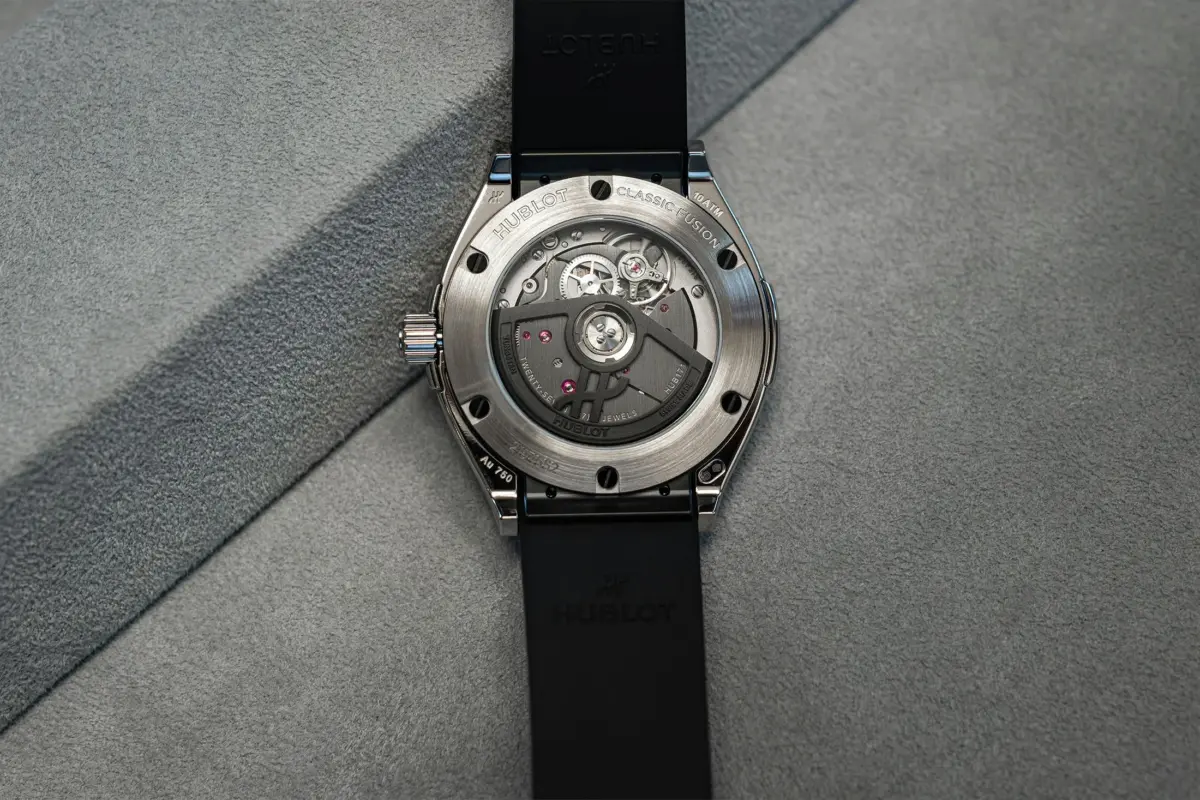
Perhaps the most significant mechanical upgrade rests hidden behind the solid caseback. The original 1980 reference ran exclusively on a quartz movement—a decision driven entirely by Crocco’s aesthetic focus at the time. Reflecting on that choice today, Crocco is remarkably candid. Personally, I was wrong, he admits. The Tributo rectifies that historical limitation by outfitting the watch with Hublot’s automatic HUB1711 caliber. Based on a Zenith architecture and beating at a frequency of 4Hz, the movement offers a robust 60-hour power reserve, visible through an open-worked rotor shaped like the letter H, crafted from either 22-karat gold or black tungsten.

The decision to utilize the HUB1711, rather than relying on Hublot’s more common Sellita-derived calibers, represents a tangible benefit for the watch, its future owners, and the broader perception of the brand. It delivers a significantly longer power reserve than the roughly 42-hour duration of the Sellita-based HUB1110, alongside a movement pedigree that commands respect in this price tier. While dedicated horological purists will always push Hublot to advance further in proprietary movement development, the HUB1711 serves as an ideal match for a watch whose primary appeal lies in its historical form and legendary lineage.
Within the broader context of the contemporary Hublot catalog, the Tributo occupies a fascinating space because it stands quite far removed from the watches that immediately come to mind for the general public. For most enthusiasts, names like the Big Bang, high-profile celebrity collaborations with figures like Usain Bolt and Novak Djokovic, advanced sapphire crystal cases, and heavily skeletonized dials define the modern identity of the brand. Meanwhile, the standard Classic Fusion family has long functioned as the more restrained pillar of the catalog, spanning diverse sizes and materials utilizing a modern case architecture. Hublot has previously looked back to its founding year, notably releasing three limited 45mm reissues to celebrate its 40th anniversary in 2020, followed by the Classic Fusion Original in 2023.

However, the Tributo returns to the original proportions and micro-details with far greater intentionality than any predecessor in the modern Classic Fusion lineup. Standard production models of the Classic Fusion can often present a somewhat heavy physical presence on the wrist, characterized by thick lugs, broader case dimensions, and prominent bezels. After wearing both Tributo editions extensively, it is clear that the new model successfully avoids this bulkiness.
Evaluating the design philosophy behind the watch brings to mind a familiar automotive analogy: parking an early 1990s Porsche 964 next to a modern 911. While almost every individual panel and mechanical component differs between the two generations, no observer would ever mistake either vehicle for anything other than a genuine 911. Achieving that level of continuity is vastly more difficult than simply copying the past, as it requires designers to intuitively understand which specific lines define the soul of a product and which merely belong to the era of its creation.

Sadegh Keiser, Hublot’s Chief Product Officer and the executive responsible for shaping the Tributo alongside Crocco, explains the creative process by imagining the original MDM watch pressed firmly into a bed of sand. Everything you see is the minimum that you need to keep, leaving behind only what is essential, while everything else belongs strictly to its temporal moment, whether that is 1980 or today. Our challenge was being sure that we understood those lines, Keiser notes. Handling the final product confirms that this rigorous level of design consideration has been successfully realized.
Priced at $30,900, the Tributo enters a fiercely competitive market segment populated by serious gold dress-sports watches. For comparison, Hublot’s standard 38mm Classic Fusion in King Gold retails for $21,100, featuring the modern case geometry and the Sellita-based HUB1110 caliber. The substantial premium commanded by the Tributo pays for an extensive rethinking of proportions, case construction, and movement pedigree. When viewed against wider luxury market alternatives—such as Piaget’s rose gold Polo Date at $37,700, Parmigiani’s rose gold Tonda PF Sport Automatic at approximately $46,000, or Vacheron Constantin’s pink gold Overseas 4520V at $71,500—the positioning of the watch shifts. Set against such respected company, a solid precious metal watch equipped with a Zenith-derived caliber from a premier LVMH manufacture, paired with an authentic claim to originating the gold-and-rubber conversation, appears less like an aggressive price point and more like a fair valuation.

Finding flaws in Hublot’s latest releases proves surprisingly challenging. In a modern watch market saturated with near-constant daily novelties, the criteria for a timepiece to earn a coveted spot on a collector’s wrist grow increasingly strict, yet the white gold Tributo easily clears that hurdle. While minor stylistic debates could be raised—such as wishing for a date-free dial or seeking even closer alignment with 1980 dimensions—the watch wears with exceptional comfort and visual cohesion. The most prominent barrier for prospective buyers will likely be the retail price, particularly in a consumer market that has grown more sensitive to pricing corrections than at any point in recent memory. Collectors evaluating whether a nearly $10,000 premium over a standard King Gold model is justified will scrutinize the piece closely, but that level of scrutiny only highlights the self-aware, proactive engineering Hublot has invested into the project, from historical archival research to directly involving Carlo Crocco in the developmental journey.
Ultimately, the Tributo is a timepiece designed for two distinct audiences: the seasoned collector who has long admired elements of the Hublot narrative without finding a modern release that captured its essence, and the newcomer seeking a watch defined by tangible heritage and a timeless design language. Both groups are responding, whether consciously or not, to that exact spark Carlo Crocco first ignited at Baselworld in over four decades ago. The success of the Tributo proves that the original vision still resonates just as clearly today.