




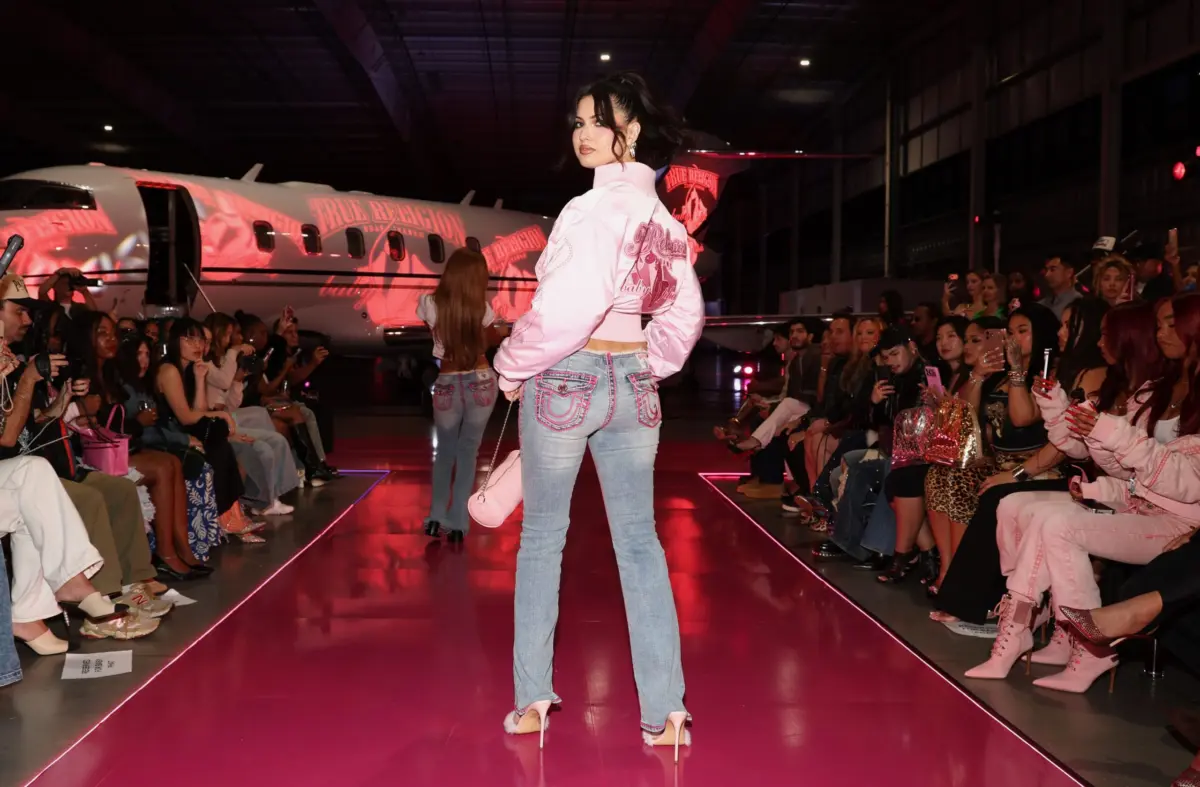
On Tuesday evening at Los Angeles’s Van Nuys Airport, inside the gleaming confines of a Silver Air hangar, two of the most defining names in early-aughts streetwear made it abundantly clear that the Y2K revival is no longer just a subtle undercurrent in fashion—it is a full-throttle celebration. True Religion and Baby Phat, whose respective horseshoe and slinky cat logos once dominated the wardrobes of an entire generation, gathered a crowd of industry insiders, nostalgic millennials, and curious Gen Zers to debut their first-ever co-branded collection. Naturally, the event was anchored by a private jet, setting the exact tone of unapologetic opulence that both brands built their empires on.
Inside the hangar, the audience reflected the strange, cyclical nature of modern fashion. It was an eclectic mix of Y2K survivors who lived through the era the first time around, wearing sensible denim that stayed safely away from the hips, alongside Gen Z trendsetters experiencing the aesthetics secondhand. Entertainment added to the high-energy atmosphere, with performances by Yume and professional "It-friend" Justine Skye, while Jaleel White—forever immortalized as Steve Urkel from Family Matters—served as an unlikely elder statesman of pop culture.
The main attraction, however, was Kimora Lee, the larger-than-life model, entrepreneur, and Baby Phat founder. Holding court from inside the sleek aircraft, surrounded by plush seats piled high with pieces from the new collaboration, Lee reflected on the ethos that defined her career.
"It was always about aspiration," Lee explained from the plane. "If you can’t have that huge pink diamond… you can have those jeans." Her own rosy ring was enormous and, much like her enduring career in fashion, roughly 30 years old.
Subtlety has never had a place in this aesthetic world, then or now. True Religion’s aggressively topstitched denim, complete with its unmistakable flap pockets, and Baby Phat’s crystal-encrusted sportswear, faux-fur-trimmed minis, and velour tracksuits offered a conspicuous approximation of turn-of-the-century luxury. The underlying message of the clothes remained the same: you do not need to own a private plane or sign autographs outside your hotel to dress like someone who might. The garments were designed to do the talking, and they preferred to do it at considerable volume.
The newly unveiled collection leans entirely into that unrestrained spirit. Every bottom is low-rise, ranging from classic bootcut and baggy jeans to a ten-inch micro skirt. The assortment also features shrunken baby tees, satin bombers, and enough crystals to warrant sunglasses worn after dark. It is cheeky, heavily accessorized, and occasionally flirts with millennium cosplay, but moderation was never the point of the aesthetic.

Lee originally launched Baby Phat in 1999 as an offshoot of her then-husband Russell Simmons’s Phat Farm. The brand quickly became a cultural touchstone, dressing everyone from Aaliyah and Lil’ Kim to Missy Elliott and Alicia Keys. True Religion, meanwhile, became an undeniable staple in the rap world, with artists like Chief Keef dedicating entire songs to the brand and 2 Chainz naming an entire mixtape after them. Both labels owe a massive debt to Black culture, whose profound influence on mainstream fashion has frequently outpaced the traditional industry’s willingness to properly acknowledge it.
Lee, who famously modeled for Karl Lagerfeld at Chanel as a teenager and wore gifted tweed jackets paired with jeans to high school, successfully brought European Parisian fashion codes into the unapologetic glamour of hip-hop. In doing so, she helped fundamentally redefine who luxury could speak to and what it could look like.
"I am a Chanel girl, through and through," Lee told Vogue. "And I brought that very much to Baby Phat all of my life."
With Chanel currently enjoying a wave of renewed attention under Matthieu Blazy, Lee’s unique place in its history feels remarkably relevant today. In September, she released Kimora Lee: On Her Own, a Lifetime documentary that revisits her expansive career, public relationships, and personal struggles. Having successfully reacquired Baby Phat in 2019, she also stands as one of the very rare fashion founders to regain total control of a company after selling it.
"Normally, you don’t sell a brand and then come back," she noted. Her advice to younger entrepreneurs hoping to reclaim their creative output is characteristically unsentimental: "If you made it once, you can make it again."
While Baby Phat’s comeback is deeply personal for its founder, True Religion’s resurgence is increasingly commercial. Having successfully navigated two separate bankruptcies, the denim label expects its sales to reach $550 million this year, according to CEO Michael Buckley, with an ambitious target of $1 billion within the next five years. Meanwhile, its owners are reportedly exploring a potential sale or minority investment that could value the business at close to $1 billion. Nostalgia, it turns out, is remarkably bankable. It is little wonder that Lee was eager to embroider the brand’s jeans with her beloved kitten insignia—a symbol she holds so dear that she has it permanently tattooed on her lower back.

"When people say to us, ‘Oh, back in the heyday of True Religion,’ well, the heyday is now," chief marketing officer Kristen D’Arcy told Vogue. She added that the company is currently "the largest in sales we’ve ever been, plus the most profitable we’ve ever been."
Beyond its core denim offerings, True Religion has courted a younger demographic through musicians like Meghan Thee Stallion, a steady stream of digital influencers, and strategic collaborations. D’Arcy pointed to organic appearances by Timothée Chalamet, Kylie Jenner, and Alix Earle as clear evidence of the brand’s ongoing cultural relevancy, noting that early consumer access to the Baby Phat offering had already generated exceptionally strong app sales.
The phenomenon raises a compelling question: does it matter that the generation currently buying into the aesthetic has no firsthand memory of the socio-cultural world that originally produced it?
For content creator and Love Island USA: Aftersun co-host Tefi Pessoa, the answer is refreshingly uncomplicated. "What True Religion is so good at is ass, and we have lost ass in fashion," she declared, praising the jeans for their famously flattering rear view. She also recalled the vanished ecosystem of early-2000s malls—home to Baby Phat, Wet Seal, Charlotte Russe, and dELiA*s—with profound affection, crediting Lee as a visionary who paved the way for modern lifestyle brands like Juicy Couture.
For younger customers entering stores or browsing apps today, the attraction is less about remembering the past and more about discovering it. The promotional campaign for the collaboration stars Love Island personalities and event attendees Aniya Harvey and Kayda Bosse in a knowing homage to MTV’s Making the Video, a pop-culture series that originally premiered before either of them was born.
Lee sees this generational divide reflected within her own family as well. Her daughters, Ming, 26, and Aoki, 24, have both inherited pieces from her extensive fashion archive, though their personal tastes diverge: Ming tends to prefer classic, understated dressing, while Aoki enthusiastically embraces low-slung denim. Lee also recalled Rihanna recently sending her stylist out on a hunt for vintage Baby Phat—serving as enduring proof that the clothes continue to resonate at the highest levels of pop culture.

At 51, having successfully navigated professional upheavals, public scrutiny, and the complicated business of corporate ownership, Lee is no longer merely selling the transient fantasy of being young, glittering, and rich. Instead, she is actively demonstrating what it means to build a distinct design language, lose control of it, and then reclaim it entirely on one’s own terms.
"I want my girls to see powerful women, beautiful women, women of all ages, who keep going and growing," she said. "I don’t feel like I’m done with anything."
Ultimately, that may be the more compelling American Dream offered by the partnership between True Religion and Baby Phat—not the private jet parked on the tarmac or the oversized pink diamond on display, but the profound agency to reclaim your name, your work, and your future. The low-rise jean may be back, but Kimora Lee is still firmly focused on moving forward.