I am not usually someone who looks for self-actualization through my travels, but the truth is, I found myself at a point in my life where a wellness retreat in Costa Rica sounded like a genuinely good idea. I was dealing with impending loss, a recent breakup, and an overarching anxiety about getting older. Some might call what I was going through a classic quarter-life crisis; others might attribute it to a turbulent Saturn return. Surely, I thought, whatever was clouding my mind about turning 30 would clear with the vibrations rippling through The Vessyl’s "Frequency Dome."
It was this seemingly new category of wellness that initially piqued my interest in The Vessyl, marketed as the "world’s first 4D sound resort," which officially opened its doors in August. On the one hand, the resort followed the naming conventions of a modern tech company playing fast and loose with its vowels, and I was fully prepared to talk consciousness with the Burning Man set. But feeling fatigued by the repetitive sauna-and-cold-plunge narrative that has dominated the wellness conversation among many of my peers, I was excited to see what genuinely set this New-New Age retreat apart. Set on 118 acres of pristine rainforest nestled directly beneath the Arenal Volcano, The Vessyl welcomes just 32 guests at a time, offering an intimate opportunity to connect with the natural surroundings alongside the high-tech experiences housed inside the Dome. Hosting everything from vibrational yoga sessions and fractal projections to energy alignments and live performances, the resort’s immersive showpiece is engineered to help guests physically feel sound, rather than merely hear it.

Yet, as wonderfully experimental as all of this might have seemed on paper, I struggled in the weeks leading up to the trip to decide whether leaving New York was truly the right decision. As my departure date grew closer, my 11-year-old French Bulldog, Cooper, had begun breaking through his medication amid an alarming uptick in seizures, and I knew deep down that he was reaching his final days. It had been a devastating few months, watching a brain tumor control his little body in unpredictable and heartbreaking ways. Cooper had come into my life at age 18, right before I left for college. My dad had agreed to get the French Bulldog as a graduation present with a somewhat manipulative yet ultimately harmless scheme in mind: that I would always come back to New Jersey to visit. And just as planned, Cooper bore witness to the entirety of my twenties playing out from the comfort of my parents’ home—the long standstills of the COVID-19 pandemic, two bouts of unemployment, and a series of boyfriends followed by inevitable breakups. Through it all, he was always there to stare up at me with a cocked head, seemingly wondering why I was crying.
There was at least some comfort in knowing he would be exceptionally well-taken care of by my parents while I was away, and I departed with the fragile hope that this wellness retreat would provide the physical and mental space needed to confront my anticipatory grief. That was how I found myself on a misty afternoon in August, winding through lush, rain-slicked roads on a three-hour drive from San José to the northern highlands of La Fortuna. It is not difficult to untangle why so many people in desperate need of a little soul-searching flock to Costa Rica, a country gushing with waterfalls carrying names like "La Paz," which translates to peace in Spanish. Its rapidly growing wellness industry—boasting a 58 percent market increase since 2019, according to data from the Global Wellness Institute—aligns harmoniously with the ubiquitous "pura vida" tagline that pervades local souvenir shops just as strongly as it shapes daily life.
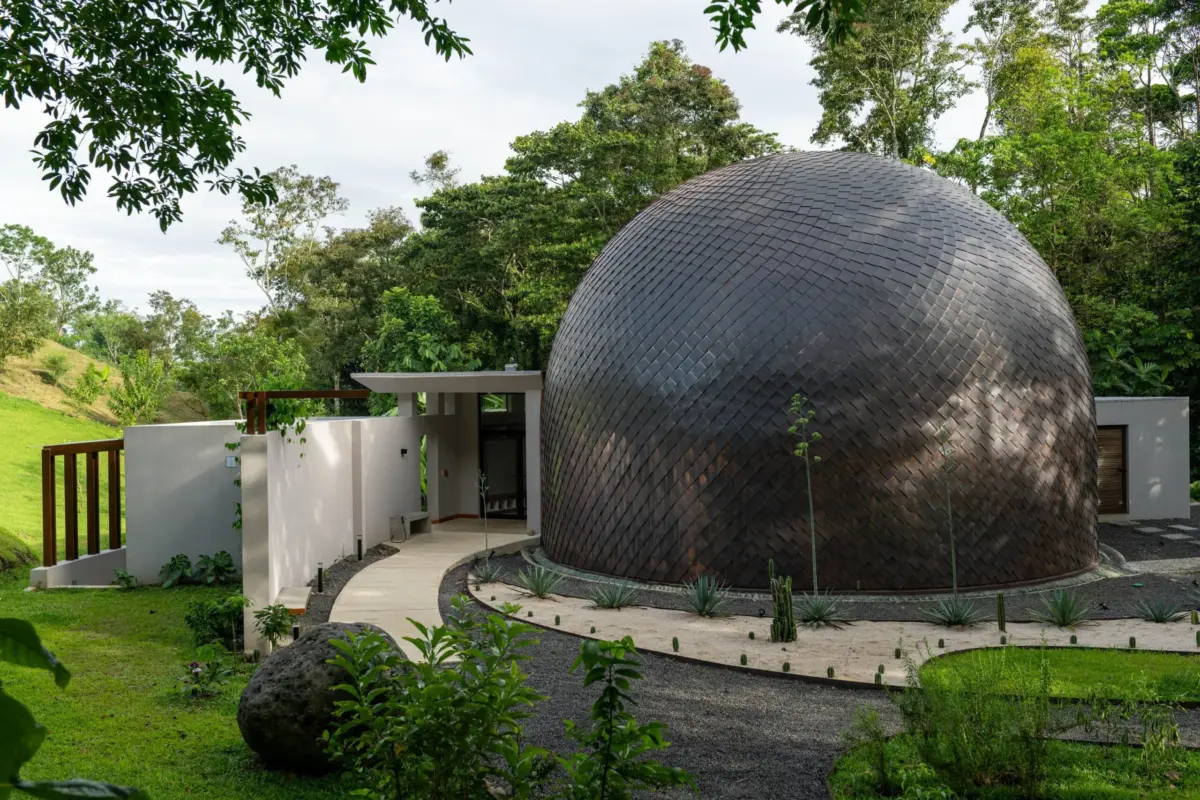
When I finally arrived at The Vessyl’s open-air lobby and restaurant, I was instantly taken aback by the striking outline of the Arenal Volcano peeking out behind a sea of clouds, perfectly positioned to meet your eyes right at the edge of a sleek infinity pool. From there, I made my way to my accommodation at the Sky Tree House, a wooden retreat elevated entirely on stilts. From its panoramic terrace, I caught my first glimpse of the copper-scaled Dome, gleaming in sharp, futuristic contrast to the wild, untamed jungle surrounding it. In just a few minutes, I would be heading inside to experience what it was like to undergo a "Bio-Well" scan. Just before leaving the room, I followed a spiral staircase that punctured the living room floor, finding myself tucked inside a dark burrow that looked as though it had been custom-designed for an animal. This, I was told, was where I could retreat to meditate throughout my stay, though I wasn’t entirely sure how much meditating I would manage on my own—quieting my mind has never been my strong suit.

Upon arriving at the Dome, Chad Wittman, the resort’s chief operating officer, began by giving me an extensive tour of the futuristic space, which was developed in collaboration with Grammy Award-winning acoustician George Augspurger over the course of eleven and a half years. The custom floating floor, he explained, is embedded with 24 transducers—the exact kind found in motion-based rides at theme parks like Disney and Universal—which allow sound frequencies to flow physically through vibration as well as audio. These transducers, combined with cutting-edge spatial audio and immersive visual projections, work collectively to support a comprehensive nervous system reset. As our voices echoed softly off the curved, acoustic walls, Wittman led me into an adjacent recording studio, which remains available for visiting musicians, artists, and scientific researchers interested in exploring frequencies.
Next, I met a facilitator named Ashley Marie, who guided me through the Bio-Well scan in the Dome’s lobby. Developed by Russian physicist Konstantin Korotkov, the Bio-Well is a compact, cube-like scanner that utilizes Gas Discharge Visualization (GDV) imaging technology to reflect patterns of stress, balance, energy distribution, and overall autonomic regulation. Essentially, it provides a digital snapshot of your current energetic state, captured entirely from the readings of your fingertips.
"You guys aren’t going to clone me, are you?" I asked Wittman, half-jokingly.

"Oh, we don’t have the technology for that," he responded with a smile.
It was a humorous exchange in a space specifically engineered to dissolve anxiety, but I surrendered my fingerprint anyway. The machine subsequently generated roughly a dozen graphs marked by human anatomical figures and brilliant bursts of color denoting energy fields, broken down by individual organs and even specific teeth. I could also track my "biorhythms"—fluctuating waves charting my physical, emotional, and intellectual levels over the preceding weeks. When I cross-referenced the dates, it was remarkable to realize that my lowest energetic levels directly corresponded to the intensely stressful days I had spent sitting in waiting rooms with Cooper at the neurologist earlier that month.
Following the examination, Wittman outlined the itinerary for the coming days, which would inevitably involve a lot of introspection. I had already been doing plenty of that, acutely aware that the impending end of Cooper’s life also signaled the definitive closing of a major chapter for myself. I am not where I once suspected I would be at this age—not only physically here in Costa Rica, traversing the many places I had visited prior to this trip, but also personally detached from the traditional marriage-and-kids life track. I am increasingly aware that my body is changing: I have noticed two stubborn gray hairs, an emerging lower back pain that could easily turn into something serious if I fail to address it, and a lingering fear that the decisions I make from here on out will carry significantly more weight than they used to.

Later that night at a family-style dinner served under a canopy of stars, I met the founder of The Vessyl, Josh Stanley. Over shared plates of yuca gnocchi, pejibaye croquettes, and octopus ceviche, Stanley explained how he is no stranger to the challenge of helping people understand unconventional concepts that have not yet entered the cultural mainstream. He referenced the time he and his brothers helped save the life of a five-year-old girl named Charlotte Figi using a specific high-CBD hemp strain they were cultivating at home back in 2013, long before cannabis lost its heavy social stigma. That early effort eventually sparked the nationwide CBD movement through Charlotte’s Web.
During the meal, I also began hearing hushed conversations surrounding "human design," which I initially dismissed as just a fancy, modern buzzword for personality typing. However, after chatting extensively with lead facilitator Svetlana Parmar, I learned it is actually a deeply intricate personal mapping system, functioning much like a postmodern astrological chart that draws on a synthesis of disciplines, including the Kabbalah, the I Ching, numerology, the chakra system, and quantum physics. Developed in 1987 by Alan Robert Krakower—who later changed his name to Ra Uru Hu—the system utilizes a person’s exact birth date, time, and geographical location to generate a unique visual "bodygraph." It also happens to be a rapidly trending practice across social media platforms like TikTok.
It was inside the Dome the following day that I first became acquainted with my own human design. Along with my fellow guests, I was handed a pair of headphones and a warm blanket, instructed to get comfortable on the vibrating floor. Lying flat on our backs, we stared up at the towering spherical ceiling, which featured a continuous, hypnotic projection of a black-and-white spiral. A calming female voice began delivering a personalized message directly into my headphones: "Hello Jessica, I’m your higher self… the eternal, quiet presence that has walked beside you through every shadow and every spark of light… I’m the part of your soul that exists beyond the world’s confusion… living in absolute, loving calm."

What followed was a detailed narration of behavioral patterns I had allegedly exhibited throughout my life. It felt essentially like a form of guided hypnosis, and I could not shake the lingering sensation that I was being gently inducted into a wellness cult. While the words certainly resonated at times—such as noting my persistent urge to turn life’s mysteries into intellectual certainty, or my tendency to constantly worry about what comes next—they ultimately remained somewhat vague. I found myself wondering how much of this was truly any different from standard self-optimization tools. Even wrapped in spiritual language, a "road map" to my inner self still sounded inherently data-driven. It certainly did not help to learn later that an artificial intelligence program had actually crafted my specific messaging after digesting the data from my bodygraph.
Eventually, resort leadership explained, these self-knowledge sessions will be fully synced with a mobile app so guests can continue their introspective journey long after returning home. The experience forced me to reflect deeply on how much self-awareness is actually too much self-awareness, and the extreme lengths we are willing to go to biohack our way to psychological success. There has arguably never been a stronger cultural desire to dissect the inner workings of our physical being, to obsess over our individual metrics with the assistance of wearable devices, ranging from advanced medical scans to Oura Rings. Taken to an extreme, this relentless tracking can make us overly obsessed with numbers and, counterproductively, a little less human. The irony was certainly not lost on me that I left the session doing the exact opposite of what I was supposed to be doing: heavily intellectualizing the experience.
I was genuinely looking forward to getting out of the Dome and stepping directly into the rainforest the following day, where I had scheduled a one-on-one reading with Parmar. We sat together on an open-air patio with a flickering citronella candle burning between us, the palpable threat of a sudden tropical downpour looming overhead. As she displayed my complex bodygraph on an iPad, tracing its nine distinct geometric shapes and a web of intersecting channels, I tried my absolute best to surrender to the information. Yet, after an hour flew by, I realized that all the technical details did not actually matter. Here we were, two human women sitting together and talking openly about relationships, aging, personal fears, and future excitements. Yes, Parmar revealed various insights about my personality with oracle-like accuracy, but even more powerful was the realization that I already instinctively knew most of it—that I am deeply inquisitive by nature, for instance, but have a tendency to take myself far too seriously, and that part of the quiet joy of getting older is realizing you have finally accumulated enough trial and error to etch your traits in permanent ink.

However, I never want to harbor fixed ideas about what psychological buttons will or will not push me, and I was delightfully proven wrong during a somatic breathwork session held later in the Dome—an activity we were explicitly warned could prove overwhelming. As someone who has historically never cried during a yoga Savasana, and whose perennial personal resolution is invariably "less thinking, more feeling," I was not overly concerned about my ability to keep a lid on my emotions. So when our facilitator, Dylan Baird, casually revealed to the group that what we were about to experience might be the closest thing one could get to a psychedelic experience without actually consuming illicit substances, I thought to myself, Yeah, right.
Alongside my fellow guests, I lay flat on my back in a wide circle, with Baird and Marie managing a live sound bath from the center of the room. We pulled dark eye masks over our faces to minimize observational distractions, and quickly settled into a collective, somewhat accelerated rhythm of breathing—inhaling for three seconds, exhaling for three seconds, maintained continuously for 40 minutes straight. As we breathed, the two facilitators gently moved around the room, placing hands on our shoulders to help release physical tension or lightly tapping our cheeks to relax our tight jaws. As I maintained this relentless flow of oxygen, my hands slowly grew completely numb, and a deep chill settled over my body.
Then, the pace slowed dramatically, transitioning into a 20-minute integration period. I was struck by a profound sense of physical heaviness, followed by a sudden ripple running along my entire body that resulted in what felt—whether real or imagined—like a distinct lift in my chest. I began experiencing brief visual flashes, nothing particularly profound, merely fragmented scenes involving some of the other guests at the resort. It felt akin to that twilight state just before falling asleep when you are still partially awake. And then, without warning, I began to cry—tears that seemed entirely untriggered by any specific sad thought, but rather born out of a strange, total nothingness. When I finally opened my eyes, I had never felt so physically and mentally relaxed, a sensation that felt entirely foreign to me.

So what actually happens physiologically during such an experience? "During active, connected breathing, carbon dioxide levels fall, temporarily raising blood pH, reducing cerebral blood flow, and activating the sympathetic nervous system," explains Dr. Diva Nagula, co-founder and chief medical officer at The Vessyl. "This produces the tingling, buzzing, muscle tightening, and involuntary contractions that some people experience as energy moving through the body." The regions of the brain responsible for controlling emotion and memory, such as the amygdala and hippocampus, also function quite differently during this altered state. Once normal breathing patterns resume, parasympathetic nervous system influence increases, allowing the body to relax deeply. The Dome, with its specialized spatial sound and constant vibrations, appeared to create the ideal environmental conditions for turning my frantic attention inward.
When we returned to the open-air restaurant for lunch that afternoon, we were greeted by the sight of the imposing Arenal Volcano completely free of cloud cover for the very first time. It felt like an impromptu cause for celebration among the guests, though I could not help thinking the landscape was just as magnificent when it was shrouded and shy.
It is difficult to say whether I ultimately preferred the natural, outdoor experiences over the high-tech offerings of the Dome, or if the Dome simply helped sharpen my overall awareness of the surrounding environment. But undoubtedly, one of the true highlights of the trip was our group visit to a nearby local stable, where we watched a line of Criollo horses quietly filing into their wooden stalls after a long afternoon of grazing. A horse whisperer named Enrique Molina led us and his four-legged team down a dusty road toward a wide, circular sandy training ring. He systematically paired each of us with a specific steed based on our individual temperaments—a process that involved testing how we reacted when he physically leaned his body weight into our sides—and explained that how a horse interacts with a human is never personal. Instead, their reactions are based entirely on what is visibly presented before them at that exact moment, whether that happens to be hesitation, underlying fear, or quiet confidence. I offered my trust to a gentle white horse named Rosa, and together we rode out into the jungle, with Molina pointing out venomous poison dart frogs and colorful toucans perched high in the canopy along the way. Had it not been for the heavy rains that poured overnight, we would have taken our horses straight into the neighboring Arenal River for a refreshing dip, but learning to gracefully accept nature’s unpredictable fate was very much part of the lesson.

Just before we departed for the trail ride, I broke away from the group to use the restroom near the training area and noticed that a small, pointy-eared Doberman belonging to Molina’s son, Steven, was quietly trailing behind me. When I stepped out of the stall, she was still waiting there, playfully bowing before me to invite a game of chase. We whirled around the circular patch of sand together, our bond feeling entirely instantaneous—the difference between horses and dogs, I thought to myself. Suddenly, I started to tear up again, this time triggered purely by memory, and I made no effort to hold the tears back. I was instantly transported back in time to the very day we first brought Cooper home as a clumsy puppy, tracking behind me with only one of his ears remaining floppy and folded over. Now, more than ever, I desperately wished he could still follow me forward as I stumble through my mistakes at 30, 40, and beyond.