



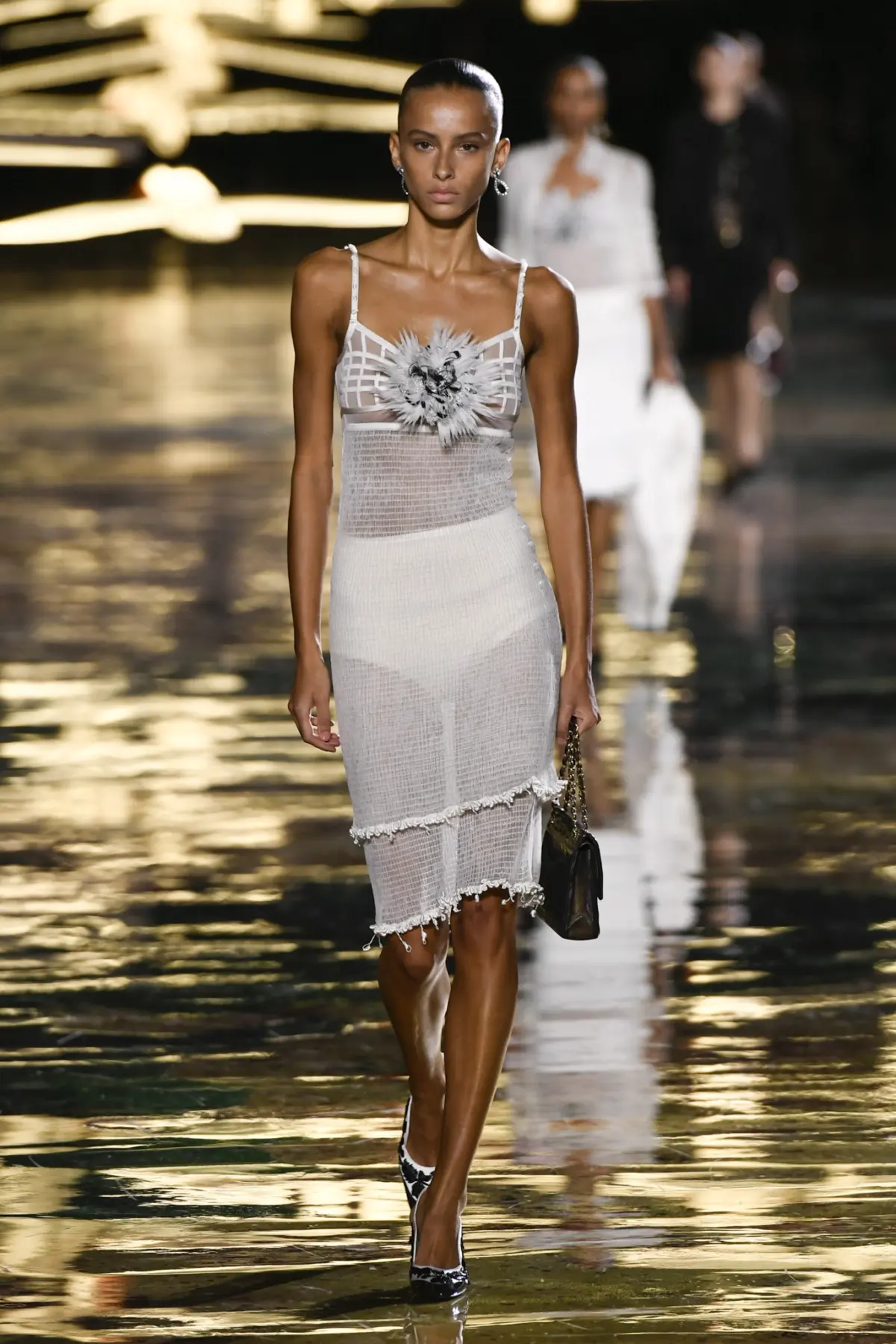
Exactly one year ago, Matthieu Blazy stood on the precipice of a daunting new era as he prepared to unveil his inaugural collection for the storied house of Chanel. On Monday night, he returned to the majestic expanse of the Grand Palais not as an anxious newcomer, but as a conquering hero. He walked the runway floor with the fashion industry’s most successful and critically acclaimed brand revival of the year firmly under his belt, having redefined the codes of a legendary institution while capturing the collective imagination of the global fashion community.
As guests milled about the vast, soaring steel-and-glass structure of the Parisian landmark, taking in an arresting visual installation of 95 birds suspended in midflight, a keen observer could practically tick off Blazy’s various collections by scanning the attire worn by the attendees. Look number eight from his celebrated Métiers d’Art show, in particular, seemed exceptionally popular among the front-row crowd, highlighting just how deeply and quickly his new vision has penetrated the wardrobes of fashion’s elite.
The spring 2027 collection served as a brilliant digest of the design codes established over the course of his fast-paced, high-stakes first twelve months at the helm, while simultaneously acting as a clear signal of where the brand is heading next. At its core, the collection was deeply rooted in an ongoing, intimate dialogue with the house’s pioneering founder, Gabrielle "Coco" Chanel. Photographs of the iconic designer were plastered all over Blazy’s mood board in the studio, tracing her remarkable personal and professional evolution from the stiff, restrictive tailoring of the Edwardian era to the rebellious act of cross-dressing in her lovers’ suits—and, ultimately, to the invention of her own revolutionary tweed suit, which went on to become one of the most defining garments of the entire 20th century.
"They are very interesting because you see a side of Chanel that is not known, which is the funny side, the joyful side, the fact that she loved to play music, the fact that she was obsessed with wearing costumes," Blazy reflected backstage after the show, illuminating the human spirit behind the legendary monicker.
This foundational philosophy—the idea that a modern woman contains multitudes and defies simple categorization—translated effortlessly into what is arguably Blazy’s most versatile collection to date. Comprising an ambitious 83 distinct looks, the presentation covered a tremendous amount of aesthetic ground, proving that the Chanel wardrobe can stretch far beyond traditional boundaries without ever losing its essential identity.
"Since I started at Chanel a year ago, we’ve tried with the team and the atelier to expand on the idea of women—so not just one woman, but the many women that could enter or belong to the world of Chanel," he explained, emphasizing the collaborative and inclusive spirit that has driven his atelier over the past year.
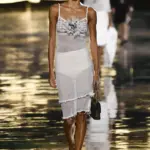
During the early stages of his tenure, Blazy’s propensity for boxy silhouettes occasionally proved to be a source of debate or even frustration for traditional Chanelophiles who pined for softer, more traditional lines. In response, the designer appeared to directly address those critiques with a plethora of brilliantly executed formfitting silhouettes. These ranged from clingy, semisheer knits that hugged the body to a striking pearl-embroidered corset top paired sleekly with masculine black pants, striking a delicate balance between structure and fluidity.
The iconic Chanel jacket, a cornerstone of the house’s heritage, naturally took on multiple incarnations under Blazy’s direction. While jackets arrived in his signature wide, cropped styles—many finished with bold graphic motifs—he also introduced intriguing variations. There were patchwork jackets finished with corset-inspired ribbon trims, suiting jackets cut with unexpected sloping hems, and sleeveless iterations, such as a standout zebra-patterned gilet sculpted with a dramatic hourglass waist.
For minimalists seeking a clean, unadorned aesthetic, the collection offered a crisp ivory coatdress with sharp slits outlined tastefully in mismatched gold buttons. Moving toward the opposite end of the spectrum, Blazy demonstrated his mastery of pattern mixing with a look that featured a top, skirt, and boots all rendered in three clashing yet strangely harmonious patterns.
Throughout the presentation, Blazy sprinkled in moments of pure whimsy and theatricality. A couple of dancer silhouettes floated down the runway in frothy, ethereal tutus, while parachute dresses were printed dynamically with sweeping clouds or a sparkling night sky, reminding the audience of the playful costumes that Coco Chanel herself so deeply adored.
Perhaps most significantly for the commercial and cultural future of the brand, Blazy introduced the next-generation Chanel suit. Crafted from a newly developed stretch fabric that ingeniously blends the classic, tactile look of traditional tweed with the effortless, high-performance ease of modern athleticwear, the garment signals a new chapter in luxury comfort. "I like this idea of the future of Chanel, because every design house is obsessed with the future, the sportswear. We all look at Nike," he remarked, acknowledging the pervasive influence of athletic apparel on contemporary high fashion.
The show was rich in symbolic gestures and emotional resonance. It opened and closed with model Dyanira Hurbuscher carrying Gabrielle Chanel’s very own personal 2.55 handbag retrieved directly from the archives, creating a poignant, full-circle moment that bridged the house’s storied past with its vibrant present.
Meanwhile, the runway soundtrack provided an immersive literary and auditory experience, featuring brand ambassador Nicole Kidman—who sat front row, taking in every look—reading evocative extracts from Virginia Woolf’s novels "Orlando" and "To the Lighthouse." The reading served as a touching echo of Kidman’s own Oscar-winning cinematic turn portraying the celebrated feminist author.
The set design itself was deeply personal to the designer, drawing direct inspiration from the quiet village in southern Italy where Blazy spends his vacations. That specific landscape is home to a tranquil river that serves as a vital sanctuary for migrating birds, tying neatly into overarching themes of freedom—a principle deeply embedded in the house’s history that feels especially resonant in the modern sociopolitical climate, according to the designer.
"We open the same phone every day to watch our news, and not to get too philosophical, but I think there is a space for poetry, beauty, joy, and it’s a good remedy to the dark times," Blazy noted, offering a philosophical perspective on the uplifting role that fashion can and should play in society today.
Fittingly capping off an evening defined by joyous discovery and boundary-pushing design, Blazy ended the show with Britney Spears’s infectious pop anthem "Gimme More." Reflecting on his journey as he stood backstage, exactly one year into a job that has revitalized one of France’s most revered luxury houses, the designer seemed to be truly spreading his wings with confidence. "It’s a good start," he said with a wide grin.