





The world of fine antique jewelry and mineralogy holds countless optical wonders, but few phenomena capture the imagination quite like adularescence, an ethereal optical effect more commonly known as the "moonstone" effect. This captivating visual characteristic, deeply prized by gemologists and collectors alike, defines some of history’s most exquisite adornments, including the magnificent Victorian Moonstone Fringe Necklace. As experts in historical jewelry and mineral sciences continue to study these pieces, the interplay between light, structure, and human artistry remains a subject of enduring fascination.
At its core, adularescence is an optical phenomenon predominantly observed in specific varieties of feldspar, most notably orthoclase. When these stones are meticulously shaped and polished into smooth, rounded cabochons rather than faceted gems, they reveal a striking transformation. As the stone is turned in the light, a floating, billowy bluish or white radiance seems to emanate from within the depths of the mineral, gliding across its surface like a wisp of vapor captured in solid stone. This mesmerizing visual display has earned the phenomenon its poetic association with Earth’s lunar satellite, mirroring the soft, glowing illumination of the moon against a dark night sky.
Within the formal nomenclature of mineralogy, this distinct internal sheen is officially referred to as schiller. The term describes the lustrous reflection or metallic glitter arising from inclusions or structural variations within a mineral. In the case of moonstone and related feldspars, this schiller effect is produced by microscopic structural intergrowths of different feldspar types—specifically, alternating layers of orthoclase and albite. As light penetrates the stone, it scatters between these ultra-thin layers, creating the characteristic diffused, billowy glow that appears to shift and dance as the viewing angle changes.
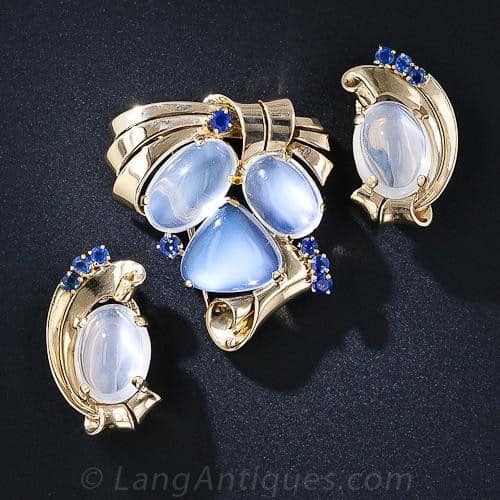
Historically, this optical behavior reached new heights of popularity during the Victorian era, a period renowned for its romantic sentimentality, reverence for nature, and innovative approaches to jewelry design. Master artisans of the 19th century recognized the unique aesthetic value of orthoclase feldspar exhibiting strong adularescence and sought out the finest specimens to incorporate into elaborate, high-status pieces. Among these, the Victorian Moonstone Fringe Necklace stands out as a quintessential example of the period’s lapidary and goldsmithing achievements.
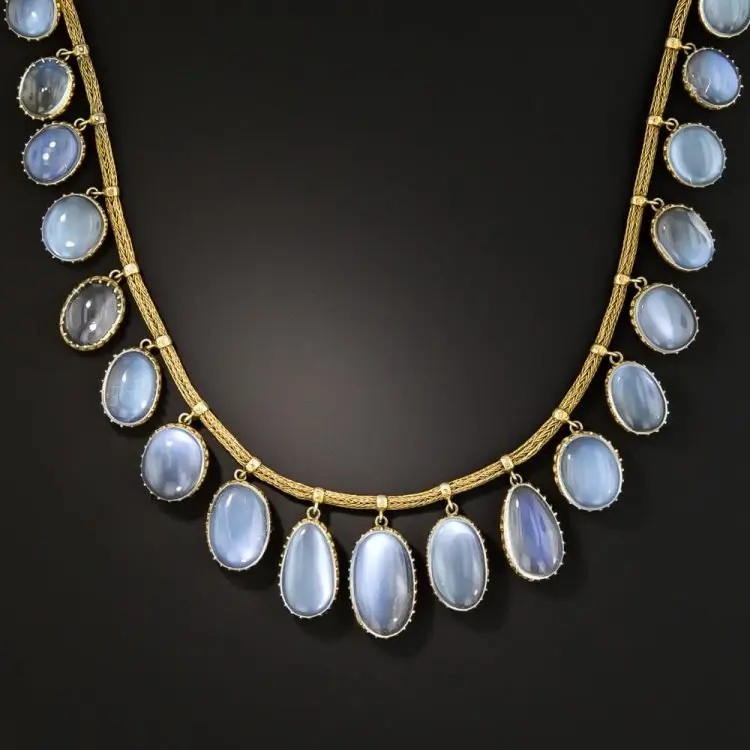
In a classic fringe necklace from the Victorian epoch, multiple graduated drops or pendants—often referred to as fringes—are suspended fluidly from a central chain or collar. When crafted using moonstones cut into matching cabochons, each individual drop catches the light from a slightly different angle. As the wearer moves, the necklace comes alive with a dynamic interplay of shifting blue and white luminescence, perfectly showcasing the mesmerizing capabilities of schiller. The careful selection and matching of these stones required immense skill, as gem-cutters had to orient each cabochon precisely to maximize the floating optical effect.
The enduring appeal of the Victorian Moonstone Fringe Necklace lies not only in its exquisite craftsmanship and the romance of its design, but also in the rare physical properties of the materials that compose it. Adularescence transforms a simple piece of orthoclase feldspar into a dynamic work of art, bridging the gap between the rigid sciences of mineralogy and the fluid grace of historical fine jewelry. Today, these remarkable antique pieces continue to be studied and admired by historians, gemologists, and collectors worldwide, serving as a timeless testament to the natural wonders captured within the Earth’s crust and the human appreciation for beauty driven by light.