





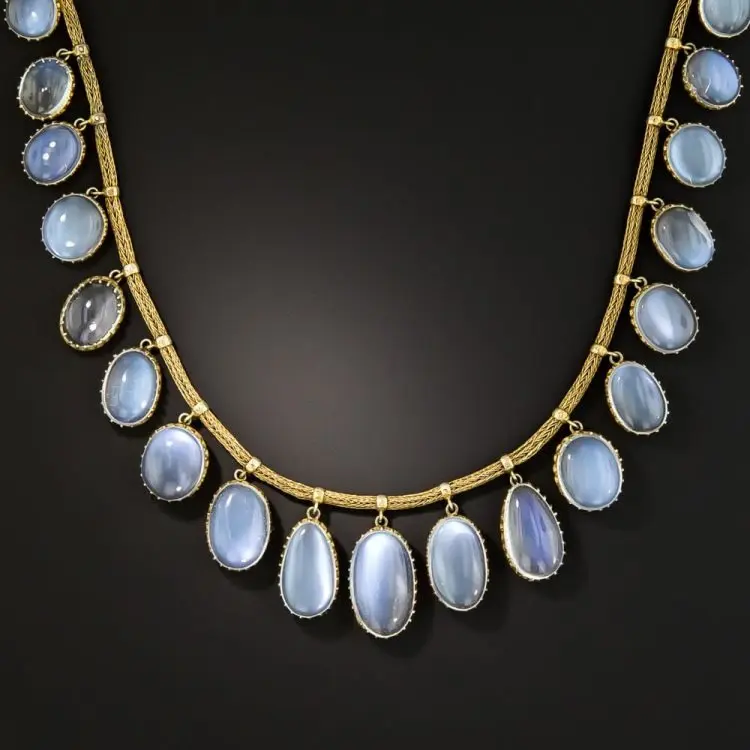
In the realm of gemology and antique jewelry appreciation, few visual phenomena command the quiet fascination and enduring mystique of adularescence. Commonly referred to in the trade and among collectors as the "moonstone effect," this distinctive optical property has captivated artisans, gem enthusiasts, and historians for centuries. Most frequently observed in specific varieties of feldspar—particularly orthoclase—adularescence transforms a polished gemstone into a dynamic canvas of shifting light, casting a soft, ethereal glow that seems to emanate from deep within the stone itself.
The phenomenon becomes visible when a qualifying mineral is shaped and polished into a cabochon, a traditional cutting style characterized by a smooth, rounded, and convex surface rather than faceted planes. As the viewer rotates the stone under a light source, a billowy, cloud-like sheen of bluish or white illumination appears to float across the surface. This fluid movement of light creates the illusion of a living, breathing internal flame, a quality that has historically linked the stone to lunar symbolism and mystical folklore across various cultures.
While the term "moonstone effect" remains popular among antique dealers, jewelry historians, and the general public, professional mineralogists and gemological institutions identify the characteristic optical behavior by a different technical term: schiller. Derived from a German word historically used to describe a metallic or pearlescent luster or play of colors within minerals, schiller encompasses the internal light-scattering mechanisms that give feldspar and related stones their characteristic visual depth.
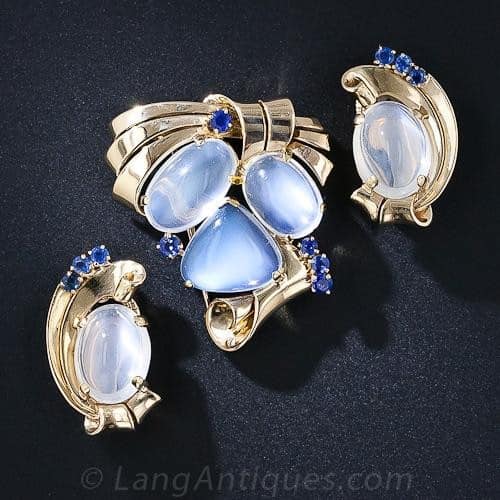
The physical mechanics behind adularescence lie in the microscopic internal structure of the gemstone. Feldspar minerals possessing this quality are composed of alternating, microscopic layers of different feldspar compositions—typically orthoclase and albite. When light enters the stone, it penetrates these ultra-thin, alternating lamellae and is scattered in various directions. This interference and scattering of light waves produce the characteristic milky, bluish luminescence that appears to glide across the cabochon as the viewing angle shifts.
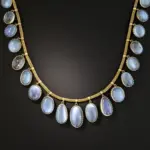
Throughout the history of decorative arts and jewelry design, this optical behavior has been prized by master craftsmen seeking to create pieces with organic movement and subtle dimensionality. During the Victorian era, particularly within the later romantic and aesthetic periods, moonstones featuring strong adularescence were frequently incorporated into elaborate fringe necklaces, brooches, and rings. Pieces such as the classic Victorian moonstone fringe necklace highlight how lapidaries utilized the cabochon cut to maximize the floating light effect, arranging graduated stones so that their individual schiller properties played off one another when worn.
The appreciation for adularescence extends far beyond historical antique collections, remaining a cornerstone of gemological study. Gemologists evaluate moonstones and related orthoclase feldspars primarily on the basis of this optical phenomenon, assessing the intensity, color, and centering of the floating light, alongside the overall clarity and transparency of the host material. Stones that exhibit a vivid, centered blue adularescence against a clear or nearly transparent body are traditionally regarded as the most desirable among connoisseurs of antique and period jewelry.
As contemporary collectors and historians continue to examine the materials and techniques of past eras, the fascination with adularescence endures. Whether described poetically as the moonstone effect or categorized technically as schiller by mineralogists, the phenomenon remains a striking reminder of the complex internal physics that give natural gemstones their unique visual character, bridging the gap between rigorous scientific classification and timeless aesthetic wonder.