



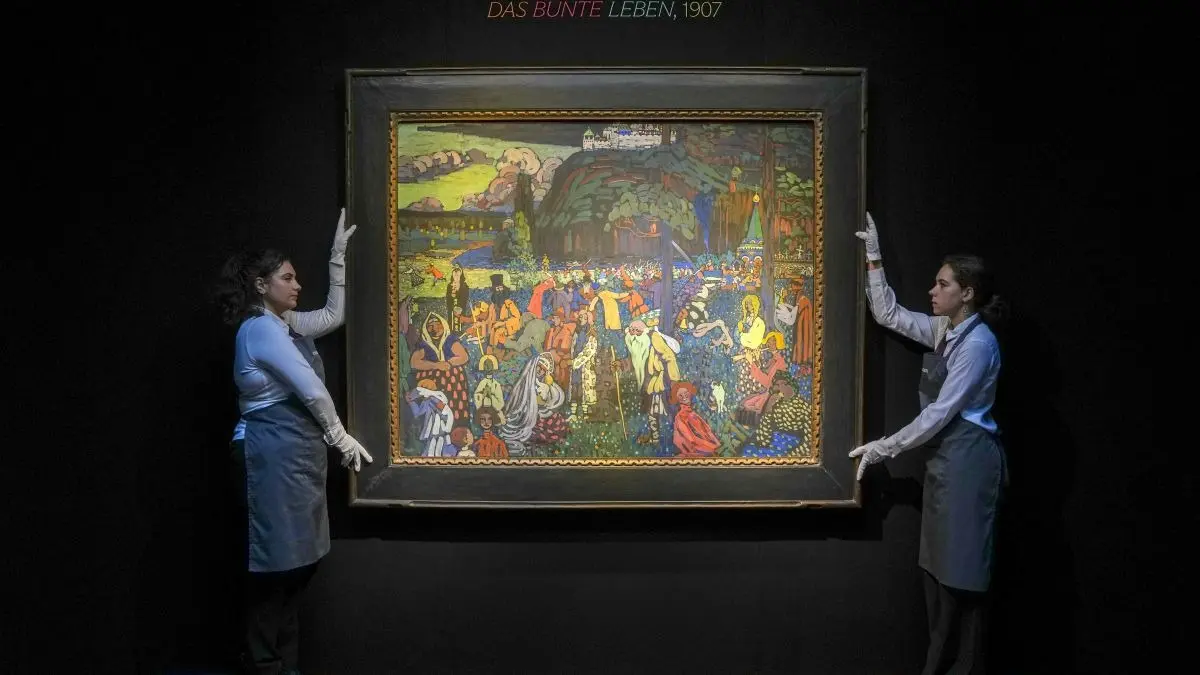
October 15, 2026 – A vibrant, historically significant painting by Russian modernist pioneer Wassily Kandinsky, which was unlawfully seized from a Jewish family in Amsterdam during the dark days of Nazi persecution, has been successfully sold at Christie’s auction house in London for £27 million, equivalent to approximately €32 million.
The high-profile sale of the 1907 masterpiece, titled Das bunte Leben—translated into English as The Colourful Life—marks another major chapter in the ongoing, complex global reckoning over Nazi-looted art. The artwork had spent decades hanging in a prominent German museum before exhaustive provenance research exposed its painful history of displacement, eventually leading to its triumphant return to the rightful heirs of its original owners.
According to reports from Dutch broadcaster NOS, the painting represents a crucial transitional period in Kandinsky’s artistic evolution, capturing the brilliant chromatic experimentation that would eventually help birth abstract art. Kandinsky painted Das bunte Leben in Paris in 1907, a time when the artist was deeply influenced by Russian folk art, fairy tales, and pointillism, resulting in a composition teeming with vibrant figures, traditional clothing, and symbolic motifs rendered in a dazzling array of primary and secondary colors.
Two decades after its creation, the painting found its way into the hands of a prominent Amsterdam-based collecting couple, Emanuel and Hedwig Lewenstein. The Lewensteins were successful entrepreneurs who ran a thriving sewing machine factory located on the Dam, a central hub of Dutch commercial life. Their sophisticated art collection was not limited to Kandinsky’s vibrant vision; it also encompassed remarkable works by other esteemed masters of the era, including Dutch artists Jan Toorop and Jozef Israëls, as well as the French Cubist painter Jean Metzinger.
However, the catastrophic events of World War II shattered the Lewenstein family’s peaceful existence and dispersed their treasured collection. Following the German military occupation of the Netherlands in May 1940, the Nazi regime implemented systematic measures to plunder Jewish-owned property, stripping families of their financial assets, personal belongings, and cultural treasures.
Historical records and recent provenance investigations revealed that the fateful journey of Das bunte Leben out of the Lewenstein family’s possession began shortly after the occupation commenced. In 1940, an employee of an Amsterdam museum—acting on behalf of an unidentified individual whose true identity remains obscured by history—arranged for the priceless Kandinsky painting to be transported by courier to a local auction house. Subsequent historical research established that there were overwhelming indications the Nazis had directly or indirectly seized the artwork under duress, transforming a legitimate transaction into an act of state-sponsored theft.
At the wartime auction, the painting was acquired by Sal Slijper, a prominent Jewish art collector who managed to survive the war years. Slijper’s acquisition of the painting during a time of extreme peril for the Jewish community added yet another layer of complexity to the artwork’s troubled history. Years later, Slijper’s family parted with the painting, selling it to the Bayerische Landesbank, a major German public-sector bank.
Following its acquisition by the financial institution, the painting entered a long period of public visibility, albeit under a cloud of unresolved historical ownership. The bank loaned Das bunte Leben on a permanent basis to the Lenbachhaus museum in Munich, a cultural institution renowned for its extensive holding of Kandinsky and Blue Rider group artworks. For decades, the painting hung peacefully on the museum’s walls, viewed by hundreds of thousands of visitors who remained entirely unaware of the trauma and injustice embedded in its provenance.
The tide began to turn in recent years as international pressure mounted on museums, financial institutions, and governments to rigorously investigate the origins of works acquired during the Nazi era. Thorough archival research undertaken by experts ultimately dismantled the illusion of the painting’s clean postwar history. In 2023, the German public prosecution department officially classified Das bunte Leben as looted art, acknowledging the coercive circumstances under which it had been torn from the Lewenstein family during the dark shadow of the occupation.
Armed with this definitive legal and historical determination, the Bayerische Landesbank acted to rectify the historic wrong. The bank returned the painting to the surviving heirs of Emanuel and Hedwig Lewenstein, closing a decades-long chapter of loss and initiating a new phase of justice for the family.
The restitution of Das bunte Leben in 2023 was not an isolated triumph for the Lewenstein descendants. Earlier that very same year, the family achieved another monumental victory when the Amsterdam city council returned a different, highly valuable Kandinsky work titled Bild mit Häusern (Picture with Houses). That restitution followed a protracted, years-long legal and administrative dispute between the heirs and municipal authorities. Before its return in February 2022, Bild mit Häusern had been prominently displayed for decades inside the Stedelijk Museum, Amsterdam’s renowned museum of modern art.
The successful recovery of Bild mit Häusern set a powerful precedent, leading directly to the re-examination and eventual restitution of Das bunte Leben. Following its return by the German bank, the heirs swiftly moved to offer Bild mit Häusern at the international art market, where it commanded a staggering sum of more than €60 million in 2023.
Now, with the successful sale of Das bunte Leben for £27 million at Christie’s London evening sale, the Lewenstein family’s legacy has once again reverberated through the upper echelons of the global art market. The transaction underscores both the enduring astronomical value of Kandinsky’s early modernist masterpieces and the relentless, decades-long pursuit of justice by the descendants of collectors whose lives and property were devastated by the Nazi regime.