





Atelier de Chronométrie, the Barcelona-based independent watchmaker celebrated for its painstaking craftsmanship and vintage-inspired creations, has introduced its latest masterpiece: the ADC16. Marking the brand’s first dual-register chronograph, this unique timepiece follows up on its previously lauded three-register rattrapantes. Built upon a heavily upgraded and reimagined historical Valjoux 23 movement, the debut commission features a striking gilt dial and embodies the pinnacle of bespoke watchmaking, where almost every aesthetic and mechanical detail can be tailored to the collector’s exact preferences.

Initial Thoughts
Specializing in bespoke, vintage-inspired watches that are as visually captivating as they are substantively hand-made, Atelier de Chronométrie (AdC) has carved out a unique space in modern independent watchmaking. The brand’s debut chronograph, the AdC8 Split-Seconds Chronograph launched in 2020, received widespread acclaim for its ambition, and this new simple chronograph proves nearly as ambitious in its execution.
The practice of sourcing, restoring, and refinishing decades-old chronograph movements is far from a novel concept in the contemporary watch landscape. At times, the market seems to feature an almost endless supply of new-old-stock Valjoux and Venus chronograph calibres waiting for a second life. However, Atelier de Chronométrie goes far beyond standard restoration. The independent workshop substantially transforms the historical architecture to a degree that is genuinely uncommon in the industry, crafting its own redesigned bridges, manufacturing a proprietary balance wheel, and replacing the stock semi-instantaneous minutes counter with an advanced instantaneous mechanism.

Naturally, these extensive, labor-intensive upgrades come at a significant cost. With a starting price of approximately €140,000, AdC’s dual-register chronograph commands a price tag substantially higher than comparable production pieces from established high-end maisons such as Patek Philippe and A. Lange & Söhne, both of which frequently offer calibres featuring more modern, ground-up technological innovations.
Yet, neither of those luxury powerhouses accommodates individualized custom programming or bespoke exterior commissions to the degree offered by AdC. This dynamic forms the core of the brand’s value proposition: providing discerning collectors with the rare opportunity to commission a truly one-of-a-kind, vintage-inspired dual-register chronograph that has been finished to the absolute highest contemporary expectations.

Movement Glow-Up
While Atelier de Chronométrie has lavished the movement with exquisite decoration, the brand understands that hand-finishing alone does not make a movement truly great—much in the way that frosting alone does not make a good cake. Frivolous decoration, no matter how finely executed, remains merely superficial if the underlying mechanical design is flawed.
Fortunately, the Valjoux 23 is a historically celebrated construction, and AdC has implemented several clever engineering upgrades for its proprietary Calibre S440 that elevate the base architecture to new heights. One notable improvement addresses the friction-fit chronograph driving wheel that historically detracted from the reliability and smooth operation of many vintage chronographs.

Historically, legendary watchmaker Patek Philippe addressed this mechanical challenge on its own Valjoux-based movements by splitting the combined escape and fourth wheel bridge into two separate components, neatly tucking the chronograph driving wheel underneath the newly separated fourth wheel bridge. Following a similar philosophy, AdC split the Valjoux 23’s combined escape and fourth wheel bridge into two distinct elements, though it stops short of the full bridge architecture found in Patek Philippe’s modern manually wound chronographs. AdC also meticulously reshaped several other critical components throughout the mechanism, including the gracefully sculpted clutch bridge.
The inclusion of an instantaneous minutes counter represents another major upgrade over the original Valjoux 23 architecture. According to renowned horological writer François LeCoultre in A Guide to Complicated Watches, historical watchmakers often regarded this specific mechanical approach with skepticism due to the high parasitic friction it introduces if the components are not impeccably designed and fabricated. This mechanical complexity is precisely why true instantaneous counters largely faded away from wristwatches with the decline of the pocket watch era.

That trajectory changed fundamentally when A. Lange & Söhne successfully resurrected the complication with the introduction of the Datograph in 1999. The secret to a reliable instantaneous jump lies in a delicate touch, with Patek Philippe pioneering the use of a dedicated hairspring for this purpose while actively minimizing the physical contact area between components. Since then, the instantaneous minutes counter has become a darling of the ultra-high-end segment, and even briefly seemed poised to break into the more accessible market segment during past industry projects.
Movement finishing across the Calibre S440 is as lavish as anything seen on the brand’s past creations. Thick, lustrous anglage with sharp internal angles outlines the frosted palladium-plated bridges, many of which are entirely new manufactures. The divided chronograph seconds and minutes totaliser bridges represent the most obvious visual departures from the donor movement. While this design modification successfully obscures the traditional architecture of the base caliber, it also thoughtfully reveals the friction spring for the sweep seconds hand that is typically hidden beneath a classic horseshoe-shaped bridge.

Further elevating the movement is a balance wheel entirely designed and produced in-house by AdC. Fabricated from beryllium copper (BeCu) and fitted with 18k rose gold weights along with platinum inertia screws, the assembly is supplemented by a meticulously black-polished micrometric regulator. A blued overcoil hairspring and the integration of modern shock-protection systems round out a decidedly high-end assortment that distinguishes Atelier de Chronométrie’s interpretation of the Valjoux 23 from any other historical adaptation on the market.
Calatrava-Inspired Case Design
True to the brand’s established design language, the case takes its primary aesthetic cues from the classic Calatrava style. In this specific two-tone configuration, the watch features a robust stainless steel midcase paired harmoniously with a bezel, chronograph pushers, crown, and case back crafted from warm 18k yellow gold.

If this model follows the standards set by AdC’s previous timepieces, the exterior polishing will be nothing short of radiant. Interestingly, while Calatrava-esque lug geometries offer a timeless elegance, they do not showcase the intricate mirror-polishing quite as dramatically as the teardrop-shaped lugs chosen for some of the brand’s earlier chronographs. Nevertheless, the same unwavering attention to detail is clearly evident in the two-tone beads-of-rice bracelet, which is meticulously constructed by hand within the workshop.
Watches like the ADC16 offer collectors much of the undeniable charm and romanticism that draws them to vintage horology in the first place, but they eliminate the traditional risks by integrating modern conveniences such as a scratch-resistant sapphire crystal and improved water resistance. Furthermore, a newly manufactured bespoke timepiece naturally delivers a pristine condition that is virtually impossible to unearth within the fragile world of vintage collecting. Contemporary independent workshops like Atelier de Chronométrie also provide an astonishing level of movement finishing and mechanical execution that was entirely unheard of when the original Valjoux calibre first left the factory decades ago.

A Traditional Gilt Dial
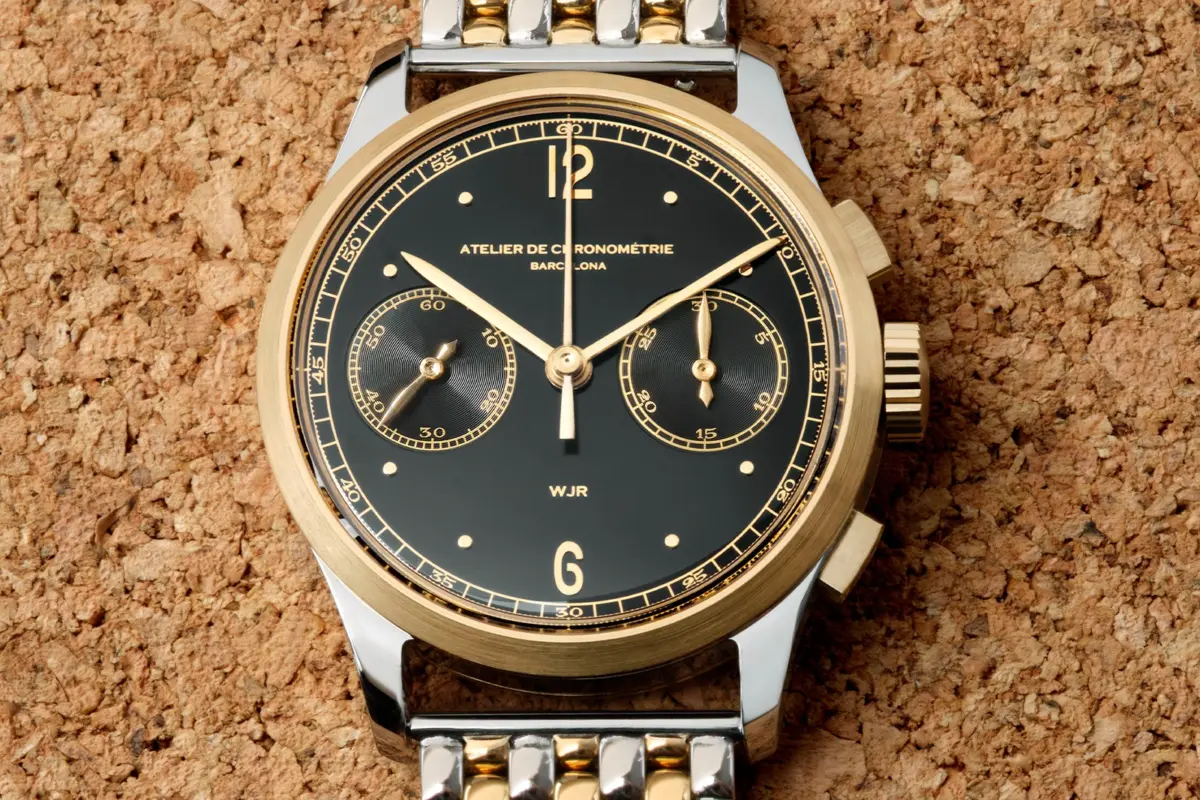
Unambiguously vintage-inspired—with the dial layout taking clear cues from one of the classic configurations of the Vacheron Constantin reference 4072—Atelier de Chronométrie produces its gilt dials using entirely traditional, old-fashioned methods. The process begins by printing the desired markings onto the gilt dial base to serve as a protective mask. The entire base is then galvanised black. Afterward, the mask is meticulously removed, exposing the warm, gleaming gold underneath.
This artisanal technique mirrors the historical approach recently utilized on contemporary high-end releases like the Daniel Roth Extra Plat Gilt. When viewed up close, the resulting aesthetic differs dramatically from modern gilt dials, which are typically produced via simple pad-printing using gold-tone ink.

All five hands on the ADC16 are crafted in-house from solid 18k yellow gold, including the sweep seconds hand—a component that many manufacturers choose to fabricate from lightweight steel for weight-saving reasons. The hands are substantial, featuring a noticeable three-dimensional depth, though they are styled slightly differently from the elegant leaf hands found on the brand’s time-only models.
None of these aesthetic or functional details are permanently fixed, as Atelier de Chronométrie collaborates closely with individual collectors to finalize the design of the dial, hands, and case according to their personal vision. Two additional unique commissions based on this new platform are expected to be unveiled soon, with several more currently in active development within the Barcelona atelier.