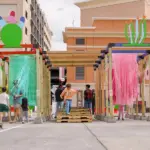



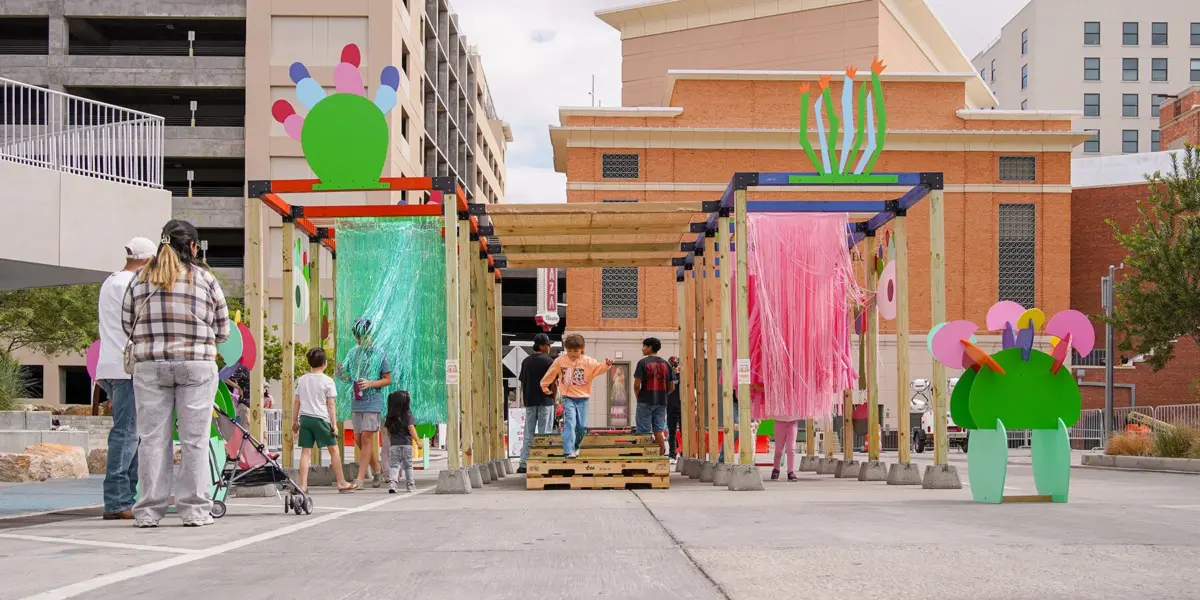
What does a bustling modern city actually look and feel like from just 95 centimeters above the ground? This is the central, thought-provoking question explored by Nómada Estudio Urbano in downtown El Paso through Desert Playgola, a temporary public pavilion that reimagines a traditional architectural pergola as an immersive, highly interactive playscape. Designed by architect Miguel Mendoza specifically for the annual Chalkthe Block public art festival, the installation brings together a vibrant mix of recycled timber, shimmering iridescent curtains, and desert-inspired sculptures. Commissioned by the City of El Paso through its Museums and Cultural Affairs Department (MCAD), the project occupies a prominent pedestrian corridor along West Main Drive, seamlessly turning an ordinary urban thoroughfare into an imaginative destination for unexpected encounters and joyful discovery.
The conceptual foundation of the project draws heavy inspiration from Urban95, a prominent global initiative spearheaded by the Van Leer Foundation. This progressive urban planning framework actively encourages architects, designers, and city officials to experience the built environment from the physical perspective of a three-year-old child—standing roughly 95 centimeters tall. Rather than treating children as miniature adults or relegating play exclusively to fenced-in, standardized zones, this human-centric approach carefully evaluates how scale, sensory engagement, textural variety, and physical accessibility profoundly influence how young minds form a relationship with public space. For Nómada Estudio Urbano, adopting this unique vantage point served as the primary catalyst for designing an open-ended environment completely devoid of predetermined routes, mandatory rules, or scripted activities. Cleverly combining the concepts of play and pergola, the name Desert Playgola reflects a protective structural framework that offers welcome shelter while deliberately leaving vast room for unbridled curiosity, boundless imagination, and spontaneous improvisation.
A Playful Landscape Built from Timber, Recycled Materials, and Desert Sculptures
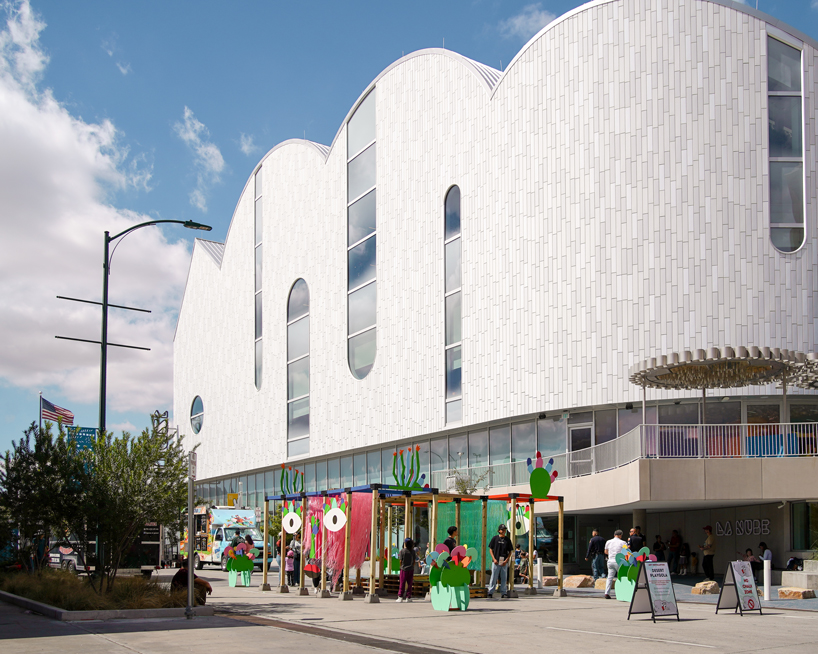
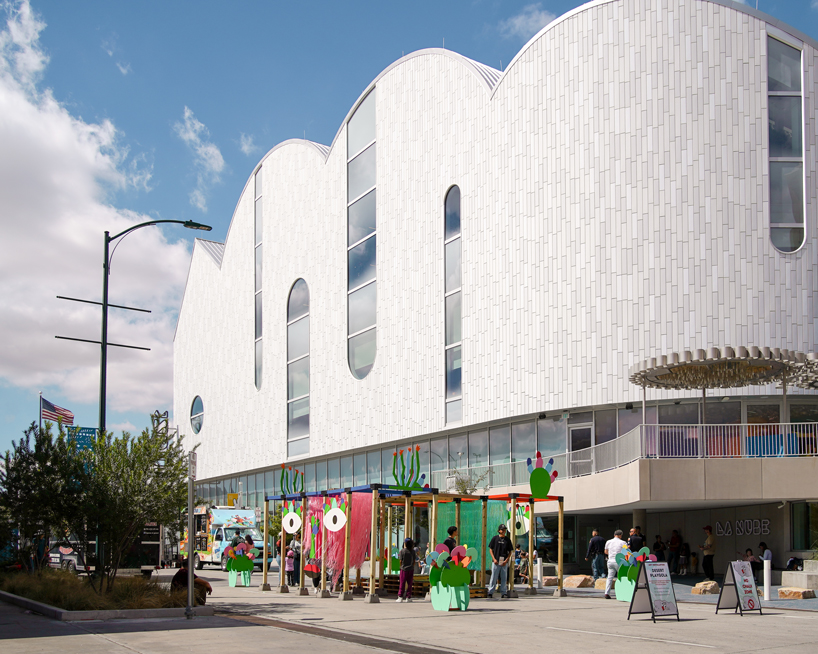
Physically, the pavilion is anchored by a sturdy timber framework securely supported by robust concrete block bases. Hanging dynamically from this overhead structure are translucent iridescent curtains alongside a series of colorful, precisely cut figures fabricated from medium-density fiberboard (MDF). Beneath this protective canopy, a collection of recycled wooden pallets has been meticulously arranged to form a series of raised platforms covered in soft artificial turf. These clever elevations introduce subtle yet engaging changes in height, topography, and tactile texture across the footprint of the installation. Furthermore, a series of freestanding sculptures resembling stylized prickly pear cacti are assembled from interlocking MDF pieces, bringing familiar organic elements of the regional landscape down to a scale where children can comfortably reach, touch, and explore them. Together, these thoughtfully curated components transform a familiar architectural typology into a miniature terrain filled with hidden passages, varied surfaces, and tactile objects that invite visitors to actively navigate rather than merely pass by.
The rich visual vocabulary of the installation is deeply rooted in the distinctive ecology of the Chihuahuan Desert. The design incorporates distinct artistic references to native flora such as prickly pears and ocotillo plants, as well as the sweeping topography of the surrounding region. In certain areas of the pavilion, the hanging curtains and structural elements subtly converge to form a generalized face, giving Desert Playgola an endearing, character-like presence along the active streetscape. From a distance, the temporary structure presents itself as a dynamic, colorful sculpture animating the urban fabric. Up close, however, those same visual elements transform into tangible objects designed for physical interaction. This clever duality allows the pavilion to operate simultaneously on multiple levels: as a striking piece of contemporary public art, a welcoming sheltered gathering spot for the community, and an informal, highly engaging playground.
Sensory Play and the Urban Experience from 95 Centimeters
Throughout the festival, movement, light, and touch played an equally vital role in shaping the overall visitor experience. Natural wind gently animates the flowing iridescent curtains, creating a soft rustling sound while casting shifting, kaleidoscopic shadows across the artificial turf below. As daylight transitions into evening, integrated architectural lighting dramatically alters the pavilion’s appearance, giving the structure a glowing, ethereal presence after dark. Children are encouraged to weave between the hanging fabric elements, climb confidently onto the low-slung wooden platforms, examine contrasting textures, or simply find a quiet place to pause and observe the bustling festival around them. Because the installation establishes no prescribed sequence of movement, it comfortably accommodates a wide variety of behaviors and interpretations, allowing its youngest visitors to take complete ownership of their environment and decide what happens next.
Strategically positioned directly beside La Nube, El Paso’s renowned interactive children’s museum, Desert Playgola effectively extends the philosophy of playful, experiential learning out into the surrounding public realm. Its vibrant temporary presence during the Chalk the Block festival successfully injected a refreshing rhythm into the established pedestrian route, encouraging festival-goers of all generations to slow down, explore together, and share the same public domain. For Nómada Estudio Urbano, the project highlights a broader, ongoing commitment to making contemporary cities significantly more responsive to the lived experiences of children without segregating them from everyday urban life. The studio encapsulates this guiding design ethos with a simple yet powerful premise: a city that plays is a city that genuinely cares, and meaningful urban care often begins by bringing the city just a little closer to the ground.