



The contemporary fashion landscape has spent the better part of the past year pushing the boundaries of footwear, continuously questioning how far the "naked shoe" trend can actually go. From sole-less sandals to split-toe designs, the industry’s current obsession centers squarely on feet, prioritizing subversion over conventional utility. Designers are increasingly drawn to items that challenge traditional notions of what is wearable, transforming impractical concepts into coveted runway statements.
At the center of this movement is Evelina, a 23-year-old Polimoda graduate and native of Ukraine, whose design philosophy embraces this spirit of subversion. Having just completed her formal education, Evelina has quickly captured the attention of the global fashion community with a footwear creation that bridges the gap between intimacy and structural design.
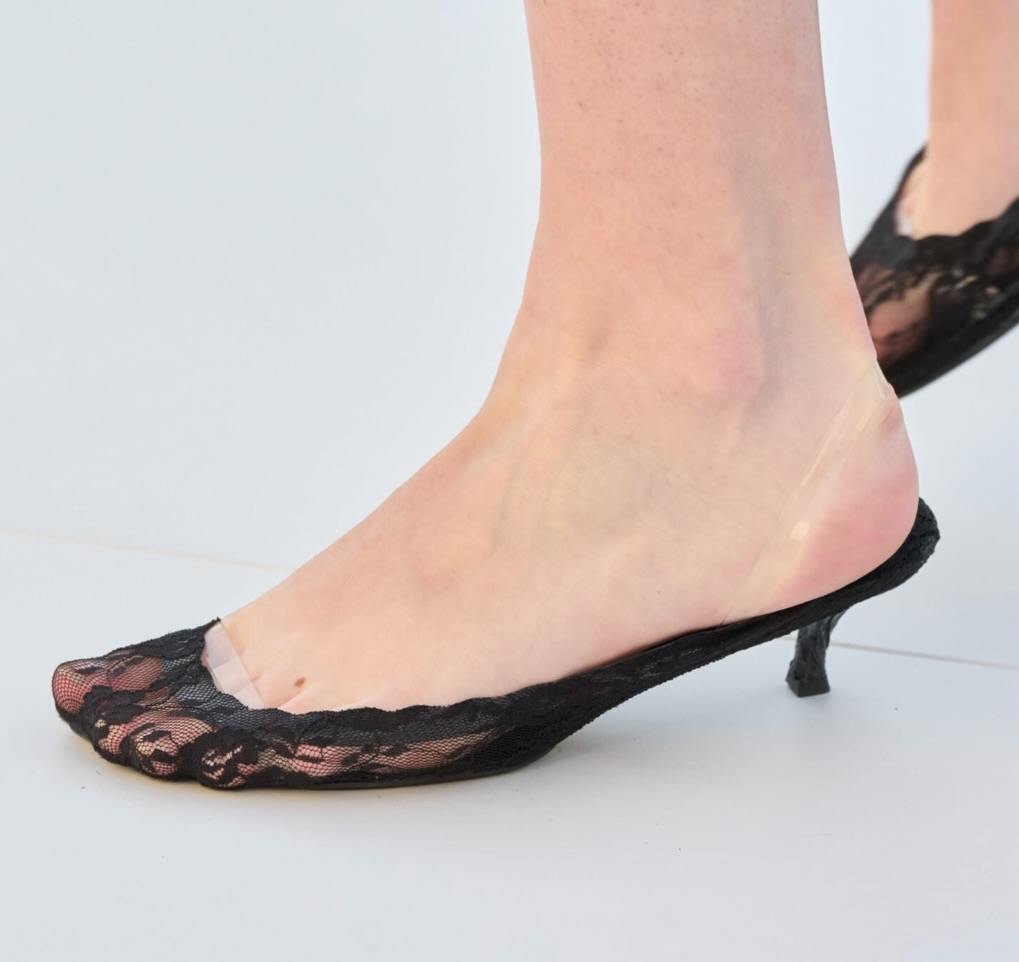
The young designer went viral across social media earlier this summer following the debut of her graduate collection, which featured a distinctive take on the naked shoe. Her creation—a lace sockette paired with a transparent slingback and a minimal kitten heel—sparked an immediate online frenzy. Instagram proved to be a powerful catalyst for her burgeoning career; within weeks of posting her prototypes, she caught the eye of the industry and secured an unexpected collaboration with designer Nicholas Aburn for AREA’s Spring/Summer 2027 collection.
Just as fashion insiders made their way to the AREA show, Evelina released a strictly limited run of 100 pairs of the footwear, aptly dubbed the "barely there shoe." Moments later, those exact kitten heels stepped down the runway, completing nearly every look in the collection.
Reflecting on her rapid rise, the designer admits that her trajectory has been nothing short of a whirlwind. Fresh out of university, Evelina never anticipated that her initial foray into footwear would eclipse her clothing designs and capture the spotlight on such a massive international scale.
Developing a Practice From Scratch
"I just freshly finished university, so I’m quite surprised that my stuff became so viral because every time someone has asked me about stuff, I’m like, ‘Oh my God, I just started,’" Evelina shares. "I’m not at the point where I can say ‘this is my practice, this is exactly what I do’ because I’m still exploring a lot of stuff."
For the young designer, her final university collection served as an accidental launchpad into footwear. Having never worked with shoes prior to her graduate collection, she approached the medium entirely from scratch. Without previous constraints or rigid industry expectations, she was able to experiment freely, treating the design process as an open laboratory.
"Everything happened super quick, everything’s super random, but quite natural," she notes. "I’m quite happy with how it’s going. I’m still at the point where I’m taking my time to explore stuff and learn new skills. I want to take my time and experiment with stuff that I’m not sure I will like."
While many designers spend years refining a specific category before achieving commercial recognition, Evelina’s path proved entirely unconventional. She admits she initially underestimated her interest in footwear, assuming her garments would generate the primary response. Instead, her innovative shoes took on a life of their own, captivating audiences and paving the way for high-profile industry partnerships.
Deconstructing the Naked Shoe
The conceptual foundation of the viral shoe stems from a rare luxury afforded to design students: the freedom to prioritize aesthetic experimentation over immediate commercial constraints. Commercial footwear typically demands rigorous testing, multi-year durability, and complex internal construction to ensure everyday wearability. Evelina, however, was unbound by these rules during her initial prototyping phase.
"I had the privilege to start the shoes while I was a student because usually when you have to do something more commercial, you think a lot about the construction," Evelina explains. "You have to think about the fact that they have to be functional, they have to be worn for months or years. And of course, if you’re selling something, that should be something that you’ve thought about."
Instead of starting with traditional shoelasts and soles, her design process originated from a conceptual inquiry into visibility and concealment. She explored the liminal space between what is physically seen and what remains hidden beneath a garment—specifically focusing on the underlayer of socks or tights. By treating these foundational garments as the primary material for the shoe itself, she bypassed conventional upper construction, minimizing the shoe down to its barest essentials before integrating structural support.
The AREA Collaboration
The leap from an academic graduate collection to a prominent New York runway happened organically. Roughly one to two weeks before her university presentation, Evelina began sharing digital mockups and physical prototypes of her designs online. The response was immediate, quickly propelling her Instagram following past the 5,000 mark.
Among those watching was Nicholas Aburn of AREA. Recognizing the versatility and distinct visual language of her work, Aburn reached out directly via Instagram.
"He texted me on Instagram and he said, ‘Oh my God, I love your shoes. I think they would work so well for the new collection of AREA,’" Evelina recalls. "So it was super natural. I think because of the nature of the shoes, they’re quite ambiguous and quite simple—they work with a lot of different concepts and styling. So he felt like it was the right shoe for his collection."
Transitioning from a student showcase to an established luxury brand required refining the original prototypes. While Evelina’s graduate presentation featured delicate, unreinforced slingbacks, the collaboration with AREA called for engineering adjustments to meet runway demands. Together, they refined the construction, introducing reinforced backs while preserving the ethereal, minimal aesthetic that initially drew viral acclaim.
Balancing Exclusivity and Future Collections
Following the buzz of Fashion Week and the sudden commercial release of her debut footwear, the designer is deliberately slowing down her pace. Rather than immediately rushing to establish a permanent footwear brand or mass-produce subsequent runs, Evelina is opting for a measured approach.
"I’m taking it more easy actually," she says. "I just felt like it was the right moment because I saw a huge interest of people and I thought that it would be kind of stupid not to use it. I don’t even have a brand name. I just decided to release this pair of shoes."
True to her independent spirit, she remains uncommitted to continuous drops. She notes that the initial run of one hundred pairs may remain a standalone moment of exclusivity, preferring to keep the release rare rather than over-saturating the market. Moving forward, her focus will expand back toward garment design alongside future footwear experimentation, treating this milestone as a moment of reflection and appreciation.
Conservative Ambiguity and Cinematic Inspiration
The tension that defines Evelina’s work—juxtaposing delicate, intimate undergarments with polished, conservative silhouettes—is far from accidental. It stems from a deeply considered conceptual framework she developed during her studies, drawing heavily from literature, cinema, and fine art.
"It all came from the whole idea of the collection, because the main concept that I had in my head was the concept of conservative ambiguity—which is usually not even used in clothes, and comes from literature," she explains.
To build this aesthetic vocabulary, she turned to specific cultural touchstones, including the unsettling psychological dynamics present in Michael Haneke’s film The Piano Teacher and the provocative self-portraits of artist Pierre Molinier. By combining these references, she sought to investigate the fine line between visibility and concealment, exploring what lies beneath the surface versus what is presented to the world.
"I wanted to explore stuff that you look at and it feels familiar, but then you look at it closer and it feels quite disturbing," Evelina notes. "So for me, the most familiar stuff is the looks that are quite polished and simple, and then this little twist of perversion that is also in the movie. So it was coming all from that type of reference."
This multidisciplinary approach extends directly into her personal wardrobe and day-to-day design methods. Often beginning her fittings on herself, she analyzes how garments drape and how she would naturally style them in real life. By synthesizing references from cinema, literature, and personal taste into comprehensive mood boards, she creates a dense narrative layer that informs every piece she brings to life.