




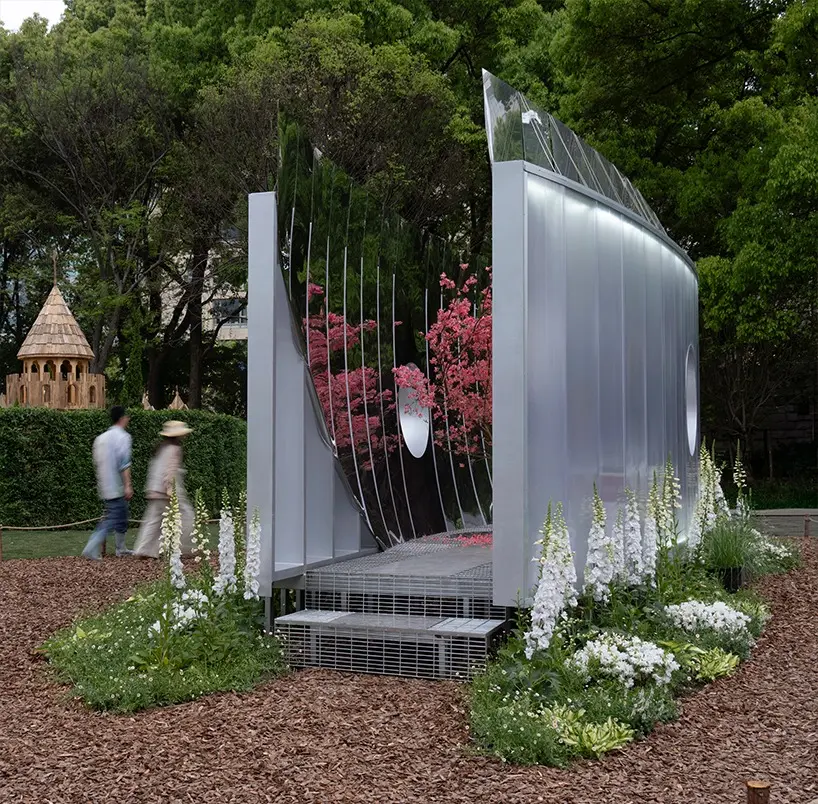
In the heart of Shanghai’s bustling urban landscape, a striking temporary pavilion is turning a single living tree into an endless, boundless forest. Created by Chang Hao Studio, the installation—aptly titled Infinite Grove—relies on clever geometry, highly polished materials, and deep-rooted architectural traditions to create an immersive optical illusion. By positioning two curved, mirrored-steel walls around a lone tree, the design generates a mesmerizing visual expanse where the boundaries of the physical structure dissolve into infinity.
First unveiled to the public in the spring of 2026 as part of the Shanghai International Flower Festival, the pavilion quickly captured the public imagination. Since its debut, the mobile installation has embarked on a journey across China’s largest metropolis, pairing its identical structural framework with different seasonal trees to continuously redefine its internal atmosphere. Within a dense city environment characterized by concrete, glass, and constant motion, Infinite Grove offers a serene, meditative sanctuary that challenges human perception and reinterprets the relationship between nature and the built environment.
One Tree, Multiplied, Shapes a Forest Within Two Walls
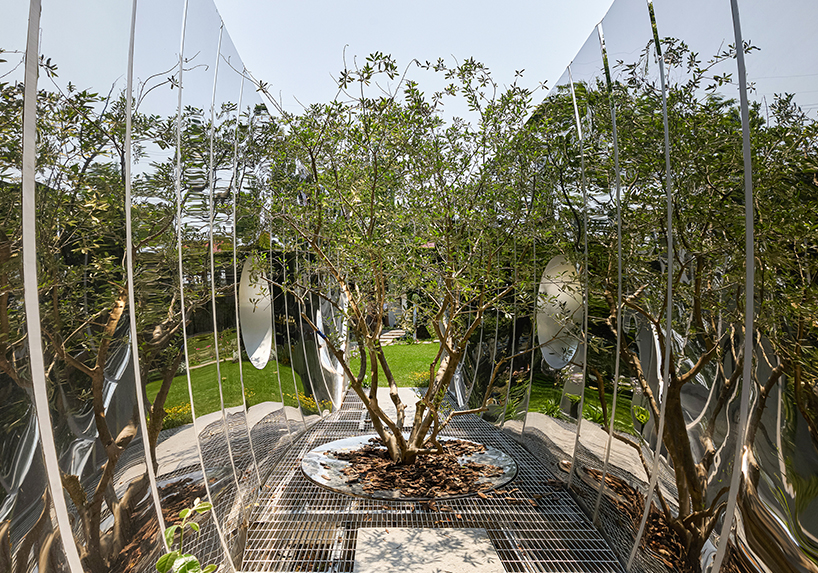
At its core, Infinite Grove is an exercise in minimalist architecture yielding maximal experiential impact. Chang Hao Studio designed the pop-up pavilion around a solitary living tree, enclosing it within two meticulously curved walls lined with polished, mirrored steel. As light enters the structure, these reflective surfaces bounce the image of the tree back and forth in an unbroken sequence, effectively multiplying a single trunk and canopy into a vast, unending woodland with no visible edges.
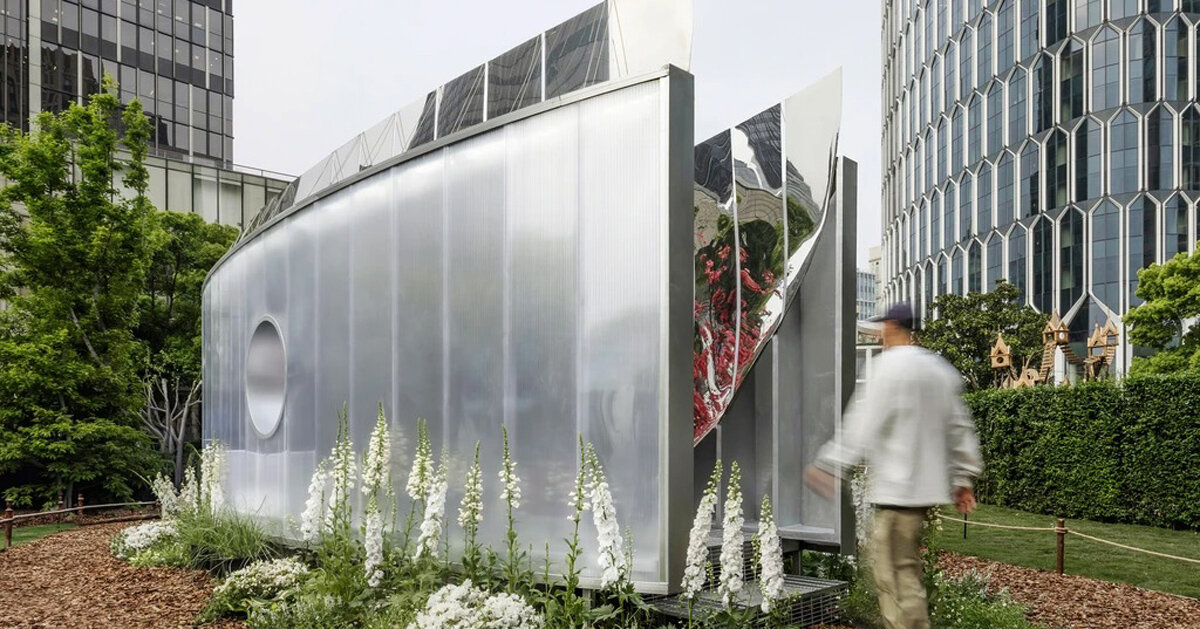
The journey into this optical labyrinth is carefully choreographed. Visitors approach a circular entrance that intentionally restricts the field of vision, revealing only a tantalizing fragment of the interior space. Overhead, frosted panels diffuse natural daylight, casting a soft, hazy glow throughout the enclosure. This atmospheric diffusion plays a crucial role in the illusion, softening harsh shadows and making it remarkably difficult for the human eye to distinguish between the actual living tree and its endless digital-like reflections.
As visitors step further inside, the spatial dynamics shift dramatically. The real tree appears suspended above while its repeated reflections envelop the spectator on all sides, cleverly incorporating the human figure into the mirrored landscape. The experience unfolds in distinct phases: first, the initial partial view through the narrow circular opening; second, the sudden, striking glimpse of the reflected forest; and finally, the quiet realization that this entire sprawling ecosystem originates from one solitary plant.
The Traveling Pavilion Forms a Garden for the City
The genesis of Infinite Grove dates back to its selection by Xiaohongshu (RED) Design Week for the 2026 Shanghai International Flower Festival, which ran from April 18th to May 10th, 2026. This year’s festival broke from tradition by expanding beyond conventional exhibition grounds, spilling directly into commercial shopping districts, public parks, and busy urban streets across two main venues and ten sub-venues throughout the city.
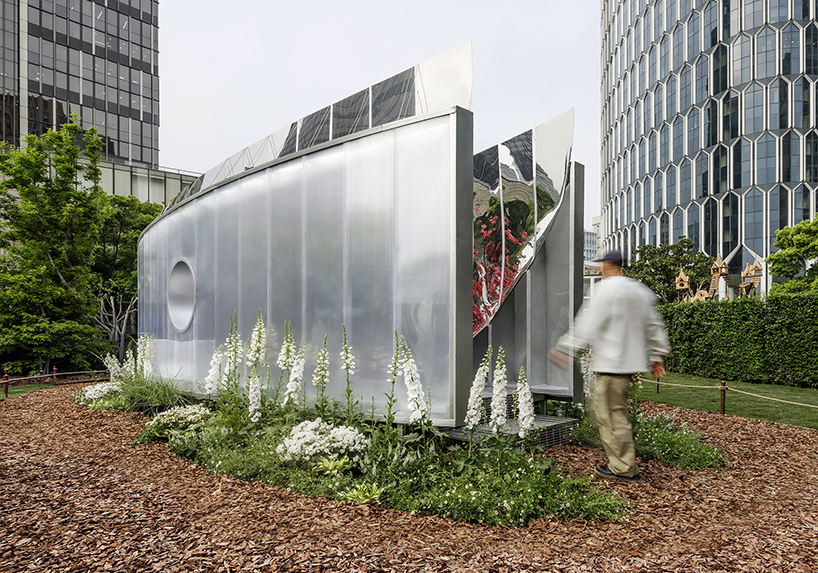
The pavilion found its inaugural home at the Huangpu main venue in Xintiandi, standing proudly among a collection of more than forty themed gardens. During its run at the festival, the event drew an astounding 29.5 million visits, cementing its status as a major cultural draw. In such a dense, high-traffic urban setting, Infinite Grove demonstrated the power of smart, compact architecture. Despite occupying a remarkably small physical footprint, its interior creates a psychological and visual depth that feels exponentially larger than its actual dimensions.
Rather than competing with the surrounding concrete architecture, the pavilion integrates with the city’s rhythm while offering a quiet counterpoint to it. Its temporary nature allows it to puncture the urban fabric lightly, turning unexpected corners of the metropolis into moments of unexpected wonder.
A Chinese Garden of Framed Views and Borrowed Scenery
While the materials and execution of Infinite Grove feel thoroughly contemporary, the conceptual framework driving the design is deeply rooted in classical Chinese garden theory. Chang Hao Studio drew inspiration from two traditional spatial strategies: framed views, known as kuangjing, and borrowed scenery, known as jiejing. Rather than serving as historical replicas or direct stylistic quotations, these principles are deployed as active, modern spatial tools.
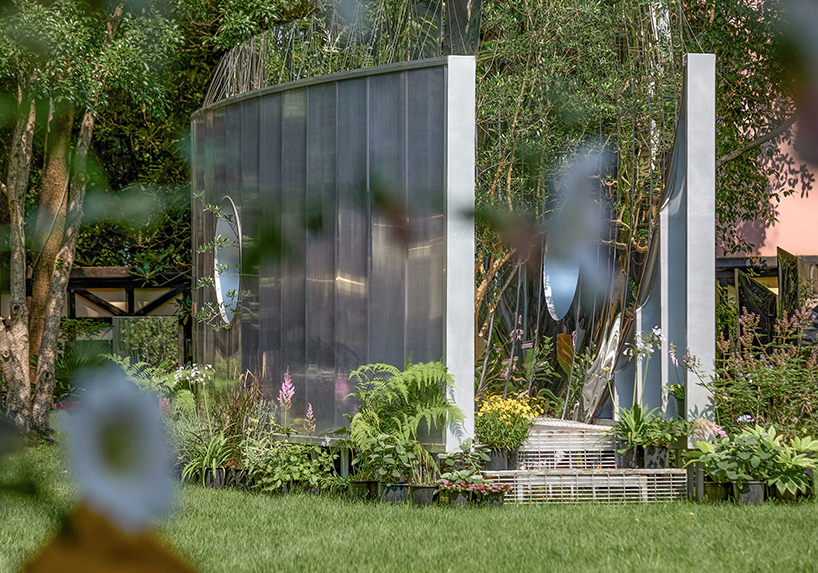
In classical Chinese landscape design, architects frequently utilized small doorways, moon gates, or perforated windows to frame a picturesque view beyond the immediate enclosure, exaggerating or manipulating the perceived scale of the environment. Infinite Grove adapts this exact methodology through its circular entrance, which deliberately withholds the full grandeur of the interior until the visitor crosses the threshold.
Similarly, the concept of "borrowed scenery" traditionally involves incorporating distant mountains, neighboring pagodas, or adjacent landscapes into a garden’s composition. In this pavilion, the borrowed scenery is the tree itself, though it is multiplied and expanded exponentially by the reflective walls. Through this clever inversion, a pavilion measuring only a few paces across successfully mimics the vast, immersive atmosphere of an ancient forest.
Curved Mirrored Steel, Frosted Panels, and a Living Tree
The architectural integrity of Infinite Grove relies on an exceptionally disciplined material palette: curved mirrored steel, frosted diffusion panels, and a single, living tree. Every element serves a distinct, functional purpose in producing the optical illusion. The highly reflective steel walls act as the engine of the installation, bouncing light and imagery indefinitely, while the frosted panels temper the sun, bathing the interior in an even, ethereal light that eliminates distracting glares.
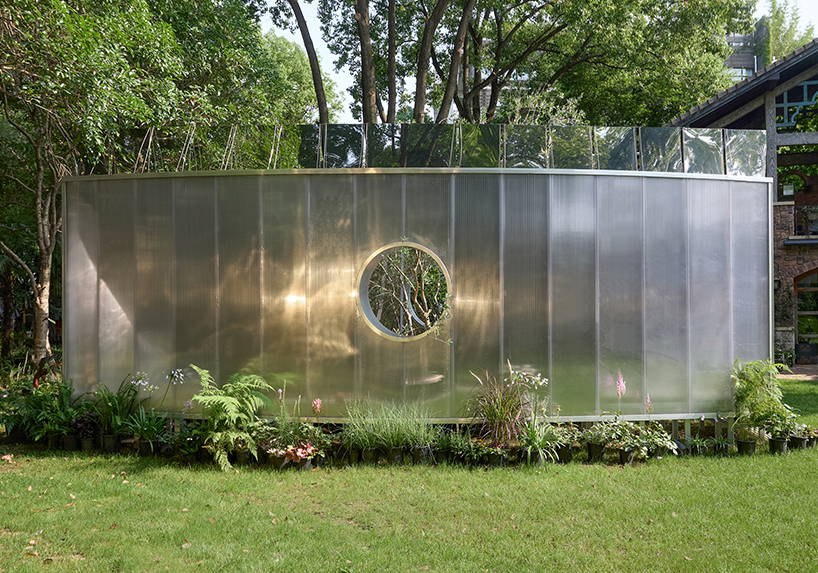
Constructibility and ecological sensitivity were also paramount in the design process. The entire pavilion is prefabricated in a factory setting, ensuring precision engineering and minimizing waste. Crucially, the structure requires no permanent foundations. When installed on-site, it is simply positioned directly onto the ground, leaving virtually no permanent impact on the landscape once removed.
Furthermore, the entire pavilion is engineered for logistical efficiency. The modular structure can be packed up and transported entirely on a single truck. This high degree of mobility is what enables the installation to travel fluidly across Shanghai, adapting to new neighborhoods and outdoor plazas with minimal disruption.
Chang Hao Studio Composes a Pavilion That Travels
Because Infinite Grove was conceived as a mobile installation, its central living element is intentionally fluid, changing to reflect the shift in seasons and locations. This dynamic approach ensures that no two visits to the pavilion are ever truly identical, as the natural world dictates the changing character of the interior architecture.
During its spring debut at the flower festival, a vibrant flowering azalea stood at the center of the enclosure. Its rich blossoms multiplied endlessly across the polished steel walls, transforming the compact space into a brilliant, kaleidoscope-like forest of vivid color.
As the seasons transitioned and the pavilion moved to its second site for the summer, the azalea was replaced by an olive tree. Featuring delicate silver-green foliage and a twisting, sculptural trunk, the olive tree lent the reflected landscape a completely different mood—one that felt lighter, more restrained, and subtly Mediterranean. While the physical structure remained entirely unchanged, the substitution of a single living organism successfully generated a brand-new spatial, visual, and emotional environment.
As Infinite Grove continues its journey across Shanghai as a nomadic public installation, it demonstrates how architecture can remain light on the earth while delivering profound spatial experiences. With each new tree it shelters, the pavilion rewrites its own narrative, proving that infinite depth can be achieved within the simplest of boundaries.