






J.C. Penney navigated a challenging second quarter, trailing behind several key competitors in the department store sector as retail landscapes shift and consumer spending habits evolve. While rival chains managed to stabilize their top-line results or limit declines during the period, J.C. Penney experienced a more pronounced downturn, highlighting ongoing hurdles in its multi-year turnaround effort.
Data covering the first half of the year indicates that J.C. Penney’s total net sales dropped by 6.5%. Industry analysts point out that this downward trajectory stands out unfavorably within the broader retail sector, especially during a quarter that saw overall market growth—even within the department store category specifically. Consequently, the company’s recent sales dip translates into a notable loss of market share at a time when competitors are finding pockets of stability.
The persistent revenue pressures come despite creative marketing campaigns and visible, positive enhancements made inside the brick-and-mortar locations. According to the retailer, the struggles in apparel sales were largely driven by lower unit inventory levels, gaps in product availability, and softer consumer demand across seasonal categories.
Retail experts note that maintaining momentum remains an uphill battle when core inventory constraints interfere with customer demand. Neil Saunders, managing director at GlobalData, emphasized that the year-over-year sales decline positions J.C. Penney near the bottom tier of current retail performance metrics. Because the wider market expanded during the quarter, JCPenney’s contraction signals that competitors captured ground that J.C. Penney was unable to secure.
Despite these broader top-line challenges, J.C. Penney’s second-quarter performance was not without notable bright spots. Several key categories posted impressive growth figures, demonstrating that targeted merchandising and strategic shifts are resonating with shoppers in specific areas of the store.
Active apparel emerged as a major growth driver, surging about 12% year over year. This increase was propelled by strong performances from Nike, team sports merchandise, and select Adidas footwear lines. GlobalData specifically highlighted the retailer’s effective merchandising surrounding the World Cup as a key catalyst for this success.
Other departments also delivered solid gains during the quarter. Furniture sales climbed 41%, jewelry increased by 9%, and the salon business grew by approximately 7%, benefiting from a healthy combination of both product retail sales and core services.
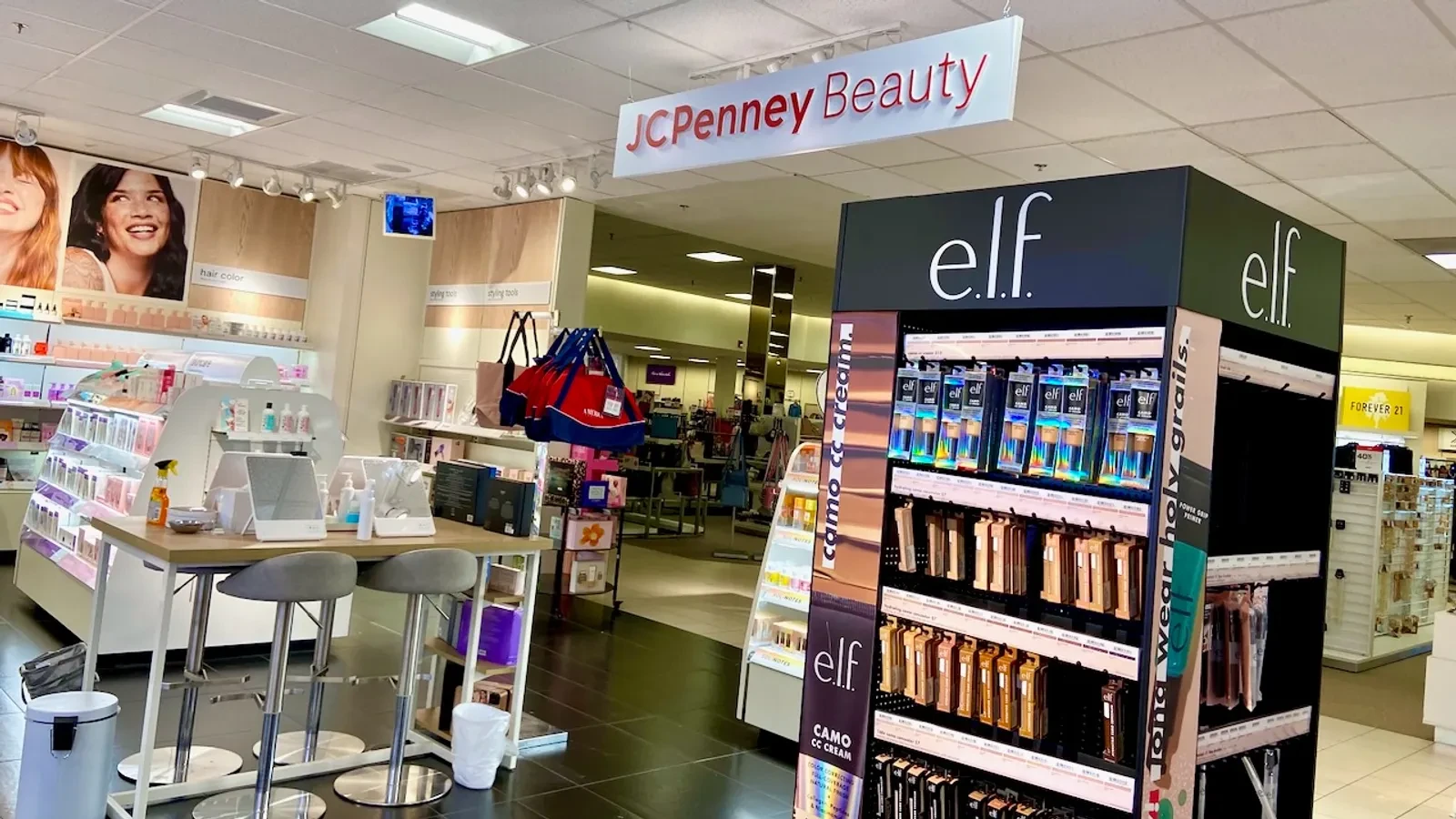
Furthermore, J.C. Penney appears to have successfully moved past the major operational disruption caused by the termination of its long-standing Sephora partnership nearly four years ago. When Sephora ended its relationship with J.C. Penney and relocated its shop-in-shops to Kohl’s—where the beauty brand has occasionally acted as a sales drag in recent quarters—J.C. Penney was forced to rethink its entire beauty strategy.
During the second quarter, J.C. Penney reported that its beauty sales received a welcome boost from skincare products and new color cosmetic launches, including lines from Milani and various K-beauty brands. Industry observers have credited the department store with developing a thoughtful, modern proposition to replace the revenue and foot traffic previously generated by Sephora.
Yet, retail analysts caution that individual category successes are not yet enough to offset broader weaknesses. A traditional department store model relies heavily on the collective strength of nearly all its departments operating efficiently at the same time. Because J.C. Penney is not firing on all cylinders across every department, the business remains under considerable financial and operational pressure.
Unlike other struggling chains that might respond to prolonged sales drops by aggressively closing underperforming store locations, J.C. Penney faces a different structural reality. Such drastic footprint reductions are considered less likely because two of the retailer’s primary landlords are also its corporate owners, tying real estate strategy closely to ownership interests.
To bolster its long-term e-commerce prospects and expand its product offerings, J.C. Penney launched a digital marketplace late in the second quarter. Early performance metrics indicate that the J.C. Penney Marketplace is outperforming expectations and is projected to contribute incremental growth to online sales moving forward.
Looking ahead to the critical upcoming holiday shopping season, J.C. Penney management outlined plans to lean into value-focused pricing strategies. Holiday presentations and marketing campaigns will center tightly on clear value propositions and family-oriented moments. Additionally, the company intends to closely monitor the evolving consumer environment and customer response, allowing leadership to make strategic adjustments as necessary.
On a broader operational level, J.C. Penney benefits significantly from its affiliation with Catalyst Brands, the entity formed when the retailer joined forces with the operator of Brooks Brothers, the Sparc Group. This partnership provides vital financial and operational backing, maintaining a focus on sustainable, long-term development rather than short-term fixes.
Industry analysts reinforce that despite the headwinds, J.C. Penney retains financial stability. With the backing of Catalyst Brands and its associated investors, the retailer has secure footing and is positioned to endure current market pressures. Observers note that unlike the historical decline and ultimate liquidation of other once-dominant department store names like Sears, J.C. Penney is actively supported by investment and ongoing organizational efforts designed to rebuild and modernize its operations for the future.