





While total solar eclipses captivate millions with the dramatic spectacle of the Moon casting its shadow across the face of Earth, a quieter yet equally fascinating celestial phenomenon unfolds nightly across the cosmos. Known as an asteroid occultation, this event occurs when an asteroid orbiting within our solar system passes directly in front of a distant star, temporarily blocking its light from the perspective of an observer on Earth. Much like the Moon during a solar eclipse, the moving asteroid projects a predictable, high-speed shadow across a narrow corridor of the Earth’s surface, creating a fleeting silhouette against the background glow of a solitary star.
When this rare geometric alignment takes place, amateur astronomers gain a unique scientific advantage. They can discern physical characteristics about an asteroid that even professional astronomers using giant telescopes perched high on remote mountain peaks cannot easily measure. The secret lies in agility. While major observatories have fixed locations, amateur stargazers can mobilize and position themselves precisely along the projected path of an asteroid’s shadow. Because these shadows can be just a few hundred meters wide and hurtle across the planet at tens of kilometers per second, a coordinated network of mobile observers can collectively map the shadow’s trajectory. By combining these observations, researchers can accurately reconstruct the three-dimensional shape of the passing space rock.
Crucially, participating in this branch of observational astronomy does not require a massive financial investment. Unlike traditional deep-space imaging, where the capacity to resolve faint objects scales directly with the aperture of the instrument, measuring an asteroid occultation depends primarily on the brightness of the target star. If the occulted star shines brightly enough, observers can capture the event using modest, highly portable equipment.

How Do You Catch an Asteroid Occultation?
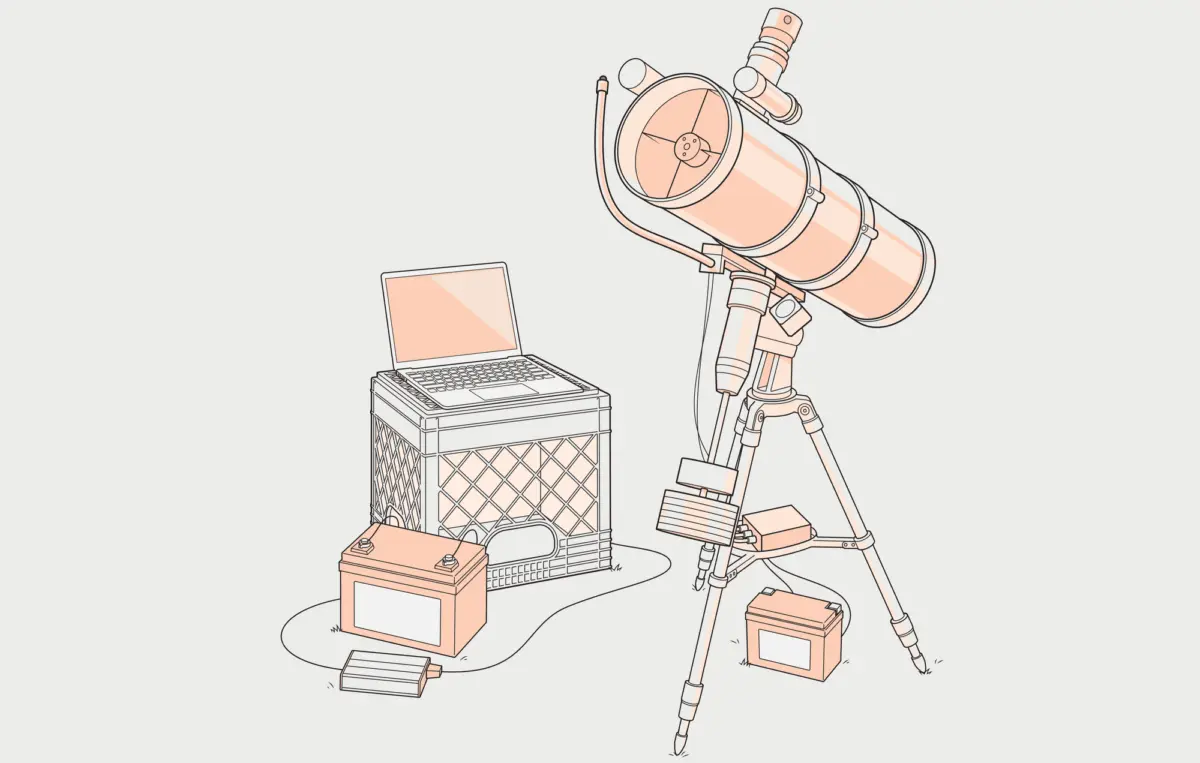
For many practitioners in the amateur astronomy community, building a functional occultation rig requires only standard off-the-shelf components and budget-friendly hardware. A typical setup might feature a modest 5.1-inch-aperture Newtonian telescope, which can be acquired for around three hundred dollars. Mounted on a small equatorial system equipped with stepper motors driven by an open-source controller like OnStep, the rig smoothly tracks the sidereal movement of the night sky. Alternatively, pre-assembled motorized mounts are available commercially for comparable prices, removing the need for custom hardware modifications.
Capturing the rapid drop in starlight requires specialized imaging gear capable of high-framerate video capture. Affordable color astronomy cameras equipped with relatively large sensors, such as the Sony IMX585, offer a wide field of view that simplifies the process of locating and keeping the target star centered. While monochrome sensors typically deliver higher sensitivity—making them theoretically superior for capturing dim astronomical events—color alternatives provide a practical, widely accessible entry point for enthusiasts operating on a budget.
Knowing precisely where and when an occultation will sweep across a given geographic region is a critical first step, calculated using specialized prediction software provided by organizations like the International Occultation Timing Association (IOTA). However, contributing valid scientific data to professional research bodies requires rigorous time calibration. Standard computer time stamps associated with video recordings are often insufficiently accurate for scientific analysis, sometimes drifting by significant margins.

To overcome this hurdle, many experienced observers employ a specialized device known as a flasher. Positioned in the optical path in front of the telescope, a flasher typically consists of a red light-emitting diode driven by the high-accuracy pulse-per-second signal generated by a GPS receiver. By pulsing the LED within the camera’s field of view at precisely known intervals, observers can calibrate their video frames against an absolute time standard. With careful setup, the margin of uncertainty in timing measurements can be reduced to just a few milliseconds.
Constructing a reliable telescope flasher typically involves combining a GPS module with a microcontroller such as an Arduino Nano, along with a few basic electronic components like transistors, resistors, and switches. Because an unmanaged flasher would blink continuously and potentially obscure the faint starlight signal of the occultation itself, the microcontroller is programmed to gate the LED. This allows the device to generate calibration pulses exclusively during the prelude and conclusion of a recording session, while remaining dark during the critical moments when the target star disappears and reappears.
How Do You Make a Telescope Flasher?
Field experience demonstrates that these DIY rigs can successfully capture genuine scientific data. Numerous occultations occur within reasonable driving distance for observers anywhere in the world each month, offering a steady stream of targets. For instance, observations of passing asteroids vary widely depending on the scale of the bodies involved. A minor asteroid measuring only a few kilometers across might block a remarkably dim star, requiring close scrutiny of laptop displays to catch the momentary blink. Conversely, brighter stars occluded by larger bodies produce stark, unmistakable drops in luminosity that require no guesswork to identify.

Challenging targets push the physical limits of small-aperture telescopes, sometimes necessitating longer exposure times per video frame when dealing with exceptionally faint background stars. Yet when a substantial asteroid crosses the path of a bright star, the resulting event produces distinct, high-resolution light curves that clearly mark the exact duration of the transit.
For example, tracking main-belt asteroids orbiting between Mars and Jupiter reveals the sheer velocity of these cosmic encounters. An asteroid a dozen kilometers wide can cast a shadow moving at roughly twenty-four kilometers per second, completing an occultation in a fraction of a second. When the occulted star possesses sufficient brightness, digital cameras recording at standard video rates can capture the event with exceptional temporal clarity, yielding data points that feed directly into broader planetary defense and asteroid characterization efforts.
Asteroid occultations represent a remarkable intersection of citizen science and modern astronomy, offering a dynamic natural experiment that unfolds in the night sky on a regular basis. Armed with fundamental astronomical knowledge, modest hardware, and precise timing calibration tools, observers around the globe can contribute meaningful data to our understanding of the solar system. All it requires is patience, preparation, and the alignment of distant stars and wandering rocks.