






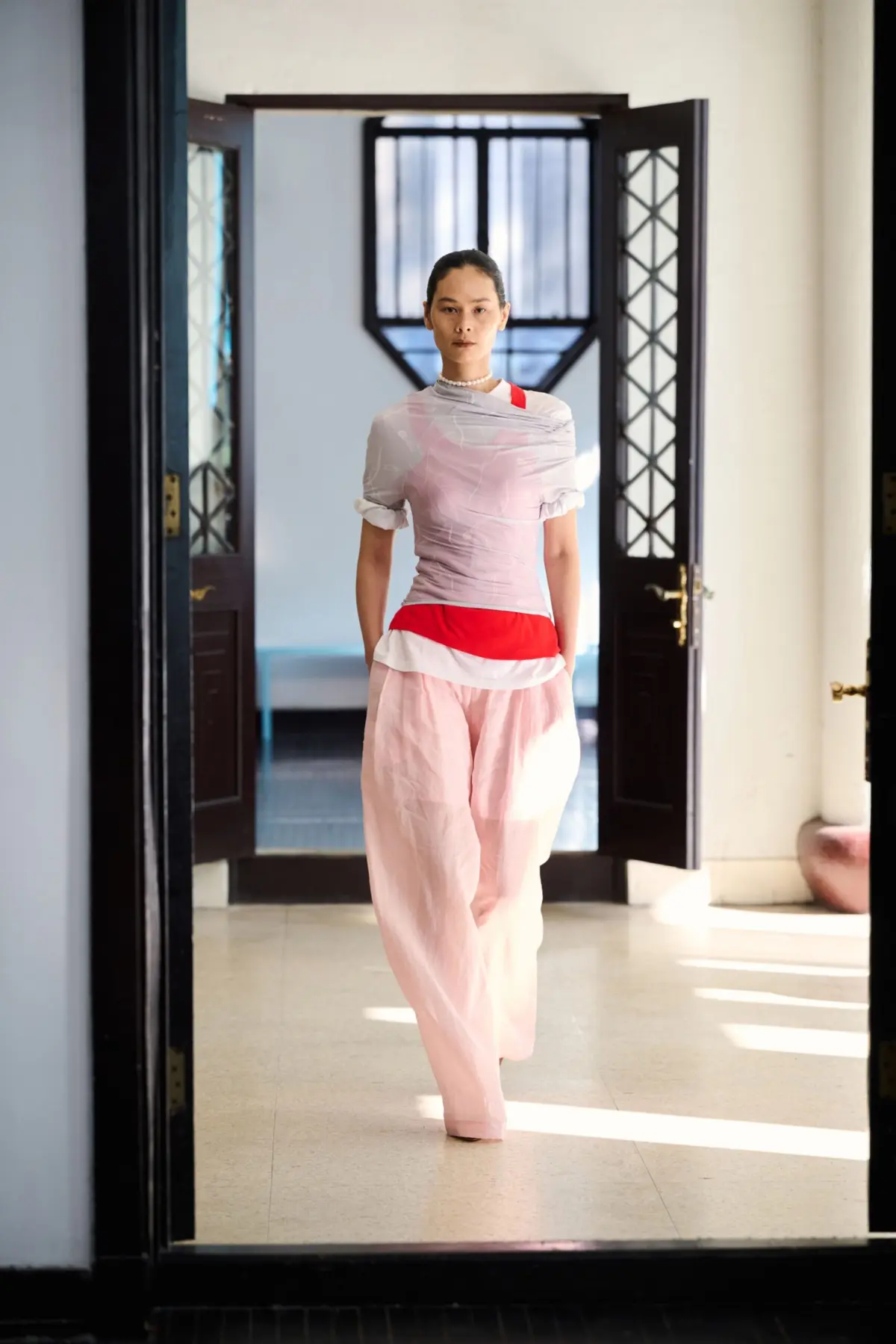
Fashion insiders have long prided themselves on tracking the industry’s next big thing, yet they are frequently less adept at looking for it anywhere outside the familiar coordinates of Paris, Milan, New York, and London. For a first-timer experiencing Shanghai Fashion Week, however, China’s dynamic economic and cultural capital offers a remarkably persuasive argument for widening that geographic and intellectual search. This is true not merely because the Chinese domestic market represents a commercial scale too massive for any global brand to ignore, but because the local creative ecosystem itself has evolved into something entirely distinct from its Western counterparts.
In Shanghai, the contemporary fashion scene feels distinctly young, deeply interconnected, and unusually close to the actual people who purchase and wear the clothes. This intimacy is particularly evident at Labelhood, the independent platform that has firmly established itself as one of the week’s most compelling showcases for emerging and avant-garde talent. Here, the traditional wall separating industry insiders—such as critics, editors, and major international buyers—from the general public is refreshingly porous. An audience of accredited professionals fills the front rows, to be sure, but they are quickly followed by a second show welcoming an equally enthusiastic public audience that shares the same genuine excitement for whatever fresh vision comes down the runway.

For Blake Abbie, the Canadian-born editor-in-chief of A Magazine Curated By, who has spent considerable time observing and participating in the Chinese fashion scene over the years, this unique proximity stands as one of Shanghai’s defining structural assets. In this bustling metropolis, he argues, designers are acutely and constructively conscious of the domestic market. In traditional Western fashion capitals, that commercial awareness is often quarantined within corporate marketing departments, leaving the creative directors free to operate in a vacuum. In Shanghai, by contrast, the designers themselves appear to possess an innate, unmediated understanding of what people actually want to wear and how they want to live.
Abbie notes that this dynamic is rarely replicated in Europe or New York, where designers frequently create collections based on an authoritative assertion of what they believe people should wear. The fundamental difference, he suggests, stems from the fact that local designers and their customers belong to the exact same youthful demographic and cultural community. Their relationship is characterized by a lack of traditional hierarchy, functioning instead as a continuous, organic exchange. Consumers actively support homegrown independent labels, designers listen and respond to that feedback, and the resulting loop actively fosters bold creativity rather than simply dictating what will easily sell at retail.

Tasha Liu, the visionary founder behind Labelhood, shares this perspective, viewing direct consumer engagement as one of Shanghai’s greatest structural advantages. She points out that Shanghai operates effectively on multiple fronts simultaneously, seamlessly blending runway presentations, high-end showrooms, direct-to-consumer retail, and a sophisticated digital ecosystem that allows consumers to follow new labels almost the exact moment they emerge. Domestic buyers turn out in substantial numbers each season, transforming the city into a genuine, high-volume trading hub alongside its well-established role as a purely creative showcase. While Paris undeniably remains the premier destination for international buyers placing massive global orders, Shanghai commands an unmistakable and formidable commercial momentum of its own.
That momentum is far from accidental. Landon Du, projects director for Shanghai Fashion Week, explains that the city’s governing bodies and organizers have spent years meticulously building an ecosystem since 2015. This deliberate framework successfully bridges runway presentations, commercial showrooms, and vital business networking opportunities. The main official venue generally requires participating designers to demonstrate at least two years of operational experience, with applications rigorously evaluated by a specialized committee comprising industry veterans, media figures, showroom owners, and experienced buyers. Labelhood, operating in parallel, offers a more open, daring platform specifically tailored for raw, emerging names.

Staging a runway collection remains an extraordinarily expensive undertaking anywhere in the world. Expenses encompassing production, model casting, specialized styling, lighting design, and public relations must all be accounted for, and corporate sponsorships rarely cover the totality of the bill. Consequently, many of the independent designers featured on the Shanghai calendar have already established functioning retail businesses within China, with a notable portion successfully breaking into multibrand stores on an international scale.
What makes this financial reality particularly interesting is that the local business infrastructure actively supports creative independence rather than crushing it under commercial demands. Liu highlights China’s unmatched manufacturing capabilities and deeply developed e-commerce channels as critical advantages that empower young labels to reach eager consumers directly, bypassing the need to first construct an elaborate, capital-intensive international distribution network. Designers can steadily grow their enterprises through online sales platforms and independent multibrand retail partnerships before ever contemplating the immense expense of opening their own flagship brick-and-mortar stores. In other global fashion markets, that entrepreneurial journey can be considerably more arduous and financially punishing.

This acute commercial awareness does not imply, however, that the garments themselves are merely cynical exercises in consumer appeasement or commercial dilution. On the contrary, both Liu and Du emphasize that one of the most intellectually compelling developments in recent seasons is the industry’s growing, sophisticated engagement with Chinese heritage, traditional craftsmanship, and age-old regional techniques. Designers are increasingly looking far beyond familiar, superficial cultural clichés to explore intricate processes preserved for generations by specific families and rural communities, including specialized textile dyeing and hand-embroidery. The ongoing challenge, which these young creators navigate with remarkable skill, is bringing these ancient practices into a modern context without reducing them to static museum artifacts.
Liu points to labels like Kinyan Lam, which collaborates directly with traditional dyeing artisans in the rural regions of southwestern China, and Samuel Gui Yang, whose work approaches historic Chinese aesthetics with a sharp, contemporary sensibility. For Blake Abbie, the true appeal lies in the seamless way this high-level craftsmanship is integrated into wearable everyday garments. He recounts observing designers devote months of painstaking labor to intricate embroidery—often operating at a technical level comparable to European haute couture—while ensuring the final pieces remain entirely suited for the realities of modern daily life. This distinction is paramount: these are not fragile, precious museum objects designed solely to be admired from a safe distance, but rather living expressions of craft that remain thoroughly accessible to younger, style-conscious consumers.

A profound psychological and cultural shift underpins this creative exploration. Abbie observed that in the wake of the global pandemic, a growing number of young Chinese designers returned home after completing their formal studies at prestigious institutions abroad, beginning to evaluate their own cultural inheritance with a renewed sense of curiosity and respect. While earlier generations of designers also explored Chinese tradition, they often did so through an external lens, lacking the integrated everyday sensibility visible today. Currently, there is a much stronger, unforced sense of pride in where these creators come from, coupled with an explicit desire to weave that identity into the fabric of contemporary life rather than treating it as a superficial decorative motif.
The relationship between this burgeoning domestic market and established international luxury houses is similarly nuanced, moving well past a simplistic narrative of local brands merely displacing foreign giants. Liu argues that the major European luxury conglomerates have historically played a vital role in educating Chinese consumers, introducing them to the foundational importance of design pedigree, narrative storytelling, and distinct brand identity. Those very same educated consumers are now applying that critical eye to develop their own distinct tastes, leading them to discover and champion homegrown Chinese labels. A modern consumer can genuinely appreciate the heritage of houses like Hermès or Louis Vuitton while simultaneously choosing to invest in a local independent designer for reasons that extend far beyond a simple price comparison.

This distinction holds profound weight in a domestic market where consumers have grown increasingly selective. As Abbie noted, the broader economic slowdown has inevitably impacted discretionary spending, but it has paradoxically created unique opportunities for younger labels that offer a compelling alternative to international luxury houses, whose retail prices in China can frequently be heavily inflated. While local independent designers may share the exact same clientele with established global luxury conglomerates, they are not necessarily competing for the exact same desires. The core question for the consumer is no longer simply which globally recognized logo to purchase, but rather what specific design identity feels genuinely meaningful and worthy of financial investment.
Looking toward the future, Du points to another notable trend worth monitoring: the increasing integration of independent Chinese designers into the creative teams and central hubs of major domestic fashion conglomerates. Rather than restricting collaborations to fleeting, one-off capsule collections, several major corporate groups are actively bringing independent designers into their corporate structures on a more sustained, long-term basis. International partnerships are likewise expanding rapidly, as clearly demonstrated by Feng Chen Wang’s ongoing creative work with athletic giant Under Armour, alongside various high-profile collaborations linking Chinese outerwear designers with brands like Moncler. The persistent question of whether homegrown Chinese creative talent will eventually ascend to lead major historic international fashion houses in Paris or Milan thus appears significantly less fanciful than it might have seemed even a few years ago.

Several standout names frequently emerge as natural candidates for such global roles. Samuel Gui Yang has successfully cultivated an impressive creative team and a fiercely distinctive brand identity split between Shanghai and London. Feng Chen Wang has consistently proven her unique capacity to operate at a massive global scale through extensive, high-profile corporate collaborations. Meanwhile, the delicate artisanal intricacy and distinct handwork championed by Kinyan Lam, the Hong Kong-based designer, possess a refined sensibility that could easily translate to a storied European house like Chloé. While these creators maintain distinctly different profiles, they share an advanced understanding of how to build and maintain a coherent, resilient creative identity around their work.
Ultimately, however, the most resounding argument for Shanghai’s rising prominence may have less to do with exporting individual Chinese designers to helm traditional European luxury houses, and everything to do with allowing a vibrant, indigenous fashion culture to flourish completely on its own terms. Abbie expressed genuine astonishment at how consistently local designers attend one another’s runway shows and presentations. This visible display of mutual support and solidarity feels remarkably organic rather than performative or driven by public relations. Industry participants understand on a fundamental level that a thriving creative market cannot be built through isolated individual ambition alone; it demands a collaborative, interconnected network of designers, stylists, photographers, retailers, and dedicated customers who consistently show up for one another. "It’s about people," Liu emphasized.

That palpable sense of community remains Shanghai’s most valuable and distinctive resource. Its designers are remarkably young, its consumers are deeply engaged, and its localized business infrastructure offers viable, accelerated routes to growth that are frequently unavailable in legacy fashion capitals. Not every emerging independent label will transform into an international household name, nor does every promising designer need to assume control of a historic Paris atelier to validate their artistic talent. The more immediate and profound achievement is that an entire generation of designers is successfully building sustainable businesses while simultaneously articulating fresh, contemporary points of view.
For decades, the global fashion conversation has been conducted almost exclusively from a relatively small, entrenched cluster of familiar Western addresses. Shanghai is forcefully making the case that there are other vibrant creative centers well worth listening to, and that the most exciting development happening on the ground may not be who gets discovered next by the international press, but rather how the local system is successfully enabling so many diverse designers to develop consistently and independently in the first place.