For most of its modern history, the nightclub was built on a simple, uncompromising premise: you had to be there. Unlike a concert hall or a theater, where a passive audience sat facing a clear stage, the traditional nightclub was an immersive, enclosed world designed to erase hierarchies, dissolve boundaries, and turn the crowd itself into the primary spectacle.
John Leo Gillen knows this architecture intimately. Born and raised inside a nightclub in the west of Ireland—where he literally slept as an infant while his parents worked and later spent his teenage years collecting glasses, working the bar, and eventually managing the family business—Gillen came of age precisely as the traditional nightclub began to disappear from the cultural landscape.
Outside of the family enterprise, he began throwing illegal raves, an experience that eventually led him to study architecture so he could build temporary club spaces. This dual background formed the foundation of Temporary Pleasure, the design practice he founded. The studio merges the physical rigor and spatial specificity of nightclub architecture with the raw emotional urgency of a rave, giving rise to a singular concept: the ephemeral nightclub.
Gillen’s high-profile spatial interventions include Choreomania at Horst Arts & Music, Joyride at the Barbican, and The Superclub at WeCanDance. He is also the author of Temporary Pleasure: Nightclub Architecture, Design & Culture 1960–Today, published by Prestel in 2023. In an extensive conversation, Gillen speaks about time as a design material, the crowd as the ultimate show, and why the moments that matter most in club culture resist being captured, digitized, or archived.
"The nightclub once offered something radical: a moment suspended in time that could only be experienced by those who were lucky enough to be in the right place at the right time," Gillen explains.
In Conversation with John Leo Gillen
Growing up inside a nightclub in rural Ireland planted the seeds for Gillen’s architectural philosophy. Spending his formative years immersed in the daily rhythms of hospitality and nightlife left him constantly fantasizing about the ideal nightclub he would one day design. However, by the time he reached adulthood, the physical typology of the classic club was rapidly eroding.
"I started organising illegal raves, and I had this idea: imagine a nightclub that existed in each place just for a moment," Gillen recounts. "The architecture of a nightclub—with the emotion of a rave. Designed and built, with all the physicality and specificity of a real nightclub, but with the emotional urgency of a rave."
As a result, Temporary Pleasure operates on a model where a nightclub exists in a specific location only momentarily before disappearing and reappearing elsewhere—manifesting variously in a warehouse in Barcelona or Dublin, a disused car park in London, or directly on a beach in Belgium.
According to Gillen, designing spaces known to disappear communicates an intrinsic urgency, heightens human behavior, and produces meaning rooted entirely in impermanence. When architecture carries this explicit message, people act differently: they are more present, more deeply invested, and more alive. Everything that followed in his practice—architecture, show design, performance, and imagery—became centered around the concept of presence.
"This is not nostalgia," Gillen emphasizes. "It is an act of definition: what is club culture when its traditional containers have disappeared, the medium has been forgotten, but its aesthetic and language are still being used?"

Looking back at the architectural blueprints of clubs from the 1960s and 1970s, Gillen points out that these spaces understood light, sound, and the crowd itself almost as raw architectural materials. They represented a deliberate break from the concert hall convention of stages and audiences.
Traditional club spaces were engineered to dissolve central focal points, erase stage hierarchies, and fracture spatial orientation. There was no clean divide between stage and audience. Platforms were built at varying heights—some brilliantly lit, others left in shadow—meaning every square inch functioned as a stage. Everyone was on stage, and no one was. Visitors were not watching a show; they were inside it.
This total interior world encompassed facades, doors, entrances, thresholds, loops, dancefloors, bars, bathrooms, and intimate seating zones. Designers manipulated compression and release, enclosure and circulation, darkness, density, and anonymity. These were social zones free from direct spectacle, designed for seeing and being seen, as well as disappearing and re-emerging.
"The nightclub didn’t present culture—it produced it," Gillen says. "Behaviour emerged from the way space was organised—possibly accidentally. The way bodies moved, gathered, circulated, danced."
In contrast, contemporary nightlife has largely abandoned these spatial dynamics. While the name remains, the structural conditions that defined a nightclub have mostly vanished. Stages have returned, dancefloors are oriented entirely toward the DJ, sound is delivered frontally, and massive LED screens dictate room orientation. The DJ booth has become the ultimate focal point, turning the rest of the room into mere infrastructure designed to service it rather than be inhabited.
"The nightclub has become the very thing it was designed to break: a concert," Gillen notes.
This fundamental shift altered the relationship between the crowd and the music. Gillen argues that society has forgotten what a true dancefloor represents. It is not simply a vacant area directly in front of the DJ booth; it is the entirety of the club. The crowd was historically the source of energy, not the passive recipient of it. Dance was viewed as physical, risky, and collective—everyone performing for each other in real time.
At legendary spaces like Paradise Garage, resident DJ Larry Levan played from a bird’s-eye nest hidden above the crowd, allowing him to observe the dancers while remaining unseen. The dancefloor functioned as the instrument, not the turntables. Over time, however, club lineups transformed DJs into destinations rather than facilitators, making people travel to see a specific performer rather than inhabit a specific space.
"We’ve designed clubs that make people bystanders, then wonder why everyone watches," Gillen observes. "Perhaps the reason people aren’t dancing is that dancefloors stopped being dancefloors."
When asked who people are performing for in spaces where the crowd is positioned as the show—whether it is the camera, each other, or themselves—Gillen stresses that a genuine rave relies on participants feeling essential to the moment. The space must foster the sensation that the event is happening because of them, not simply to them.
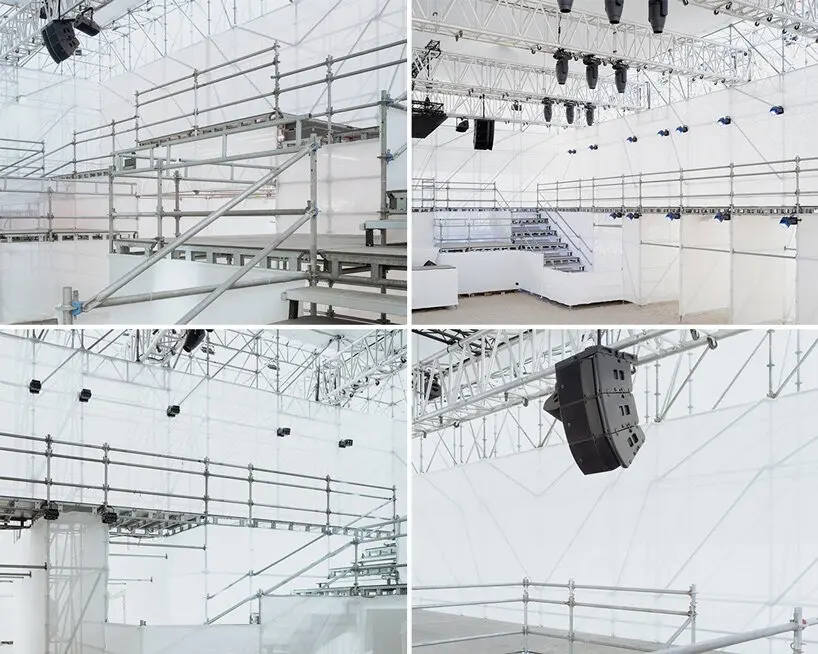
To achieve spontaneity without scripting human behavior, Gillen’s architecture relies on spatial potential: multi-level platforms, balconies, mezzanines, shifting sightlines, and deliberate structural gaps that reward risk. He cites the strategic use of a single moving spotlight that sweeps across a room before abruptly locking onto a lone dancer, prompting the collective gaze of the room to follow. These surreal, cinematic disruptions introduce an unscripted element of surprise before dissolving back into collective chaos.
However, modern image culture and ubiquitous smartphone cameras have fundamentally altered how clubs are experienced and designed. While older clubs were valued for what could not be captured or verified—living on only as fragmented memories, myths, and distortions—today’s nightlife is heavily mediated by digital extraction. Experience is frequently anticipated through its future afterlife as online content.
"If image is the primary output, if the experience itself has no implicit or sacred value—why gather physically at all?" Gillen asks.
This tension between documentation and ephemeral reality also applies to his book, which preserves past spaces through photographs and stories. Gillen acknowledges that while images can show what a place looked like, they cannot replicate the lived experience. Historically, club culture produced records only at its edges—flyers, graphics, hazy recollections, and evolving oral histories. That incompleteness added to their cultural power. Today, memory and myth risk being flattened by instant capture and continuous archiving.
Refining these concepts within large-scale environments like festivals presents unique challenges. With The Superclub at WeCanDance, Gillen recessed the DJ booth, wrapped balconies around the dancefloor, and emphasized mutual observation among the crowd. While the project successfully challenged standard festival layouts from within, Gillen notes that changing physical structures is only half the battle.
"A nightclub is a space with its own rules, codes and belief system, shared by the whole crowd even if never explicit," Gillen explains. "You can build a room that looks like a nightclub very easily. Creating the conditions that make it behave like one is much harder."
As underground club aesthetics increasingly migrate into cultural institutions and mainstream commercial spaces, Gillen warns against tokenism. True engagement requires a commitment to the underlying culture, offering not just the optics of darkness and edge, but the genuine conditions that allow a crowd to take over a room, take risks, and participate collectively.
"If you’re genuinely trying to create a collective, emergent experience, you can’t completely determine what happens," Gillen concludes. "You have to be willing to give up control."