




At The Metropolitan Museum of Art, the boundaries between sound and vision dissolve the moment violinist Audrey Wright begins to play. Wearing a complex field of custom electronics across her body, she stands as both a classical musician and a living canvas. Nearby, her husband and creative partner, Geoff Robertson, navigates a tablet interface, running sophisticated visual programs that send cascading waves of light pulsing across the wearable display. As Wright’s bow draws rich, resonant melodies from her instrument, Robertson orchestrates a vibrant visual dialogue in real time, transforming the performance space into an immersive exploration of multisensory perception.
This striking presentation represents a continuation of Luminous Being, the innovative project the pair began performing in 2024. Yet, on this particular day at the Met, the demonstration quickly shifts toward an ambitious new horizon: the development of PRISMBODY. Created in collaboration with composer Stephanie Ann Boyd, this developing work takes Boyd’s lifelong experience of synesthesia—a neurological condition where sensory inputs overlap, causing her to vividly perceive colors in response to musical sounds—as its foundational spark. Together, the trio is asking a compelling artistic question: How can a deeply private, internal perception be externalized and made visible to an entire room of observers?
Luminous “Subtitles” for the Concert Stage
Speaking with designboom ahead of the performance, Robertson offered a surprisingly intuitive analogy to describe the core concept behind the technology.
“It’s like subtitles along with audio on a screen,” he explained, drawing a parallel to how text translates spoken dialogue for viewers. In this context, however, the lights are engineered to communicate emotional and structural information paired directly with the music, pulling dynamically from Boyd’s own specific mental associations between distinct musical tones and rich chromatic palettes.
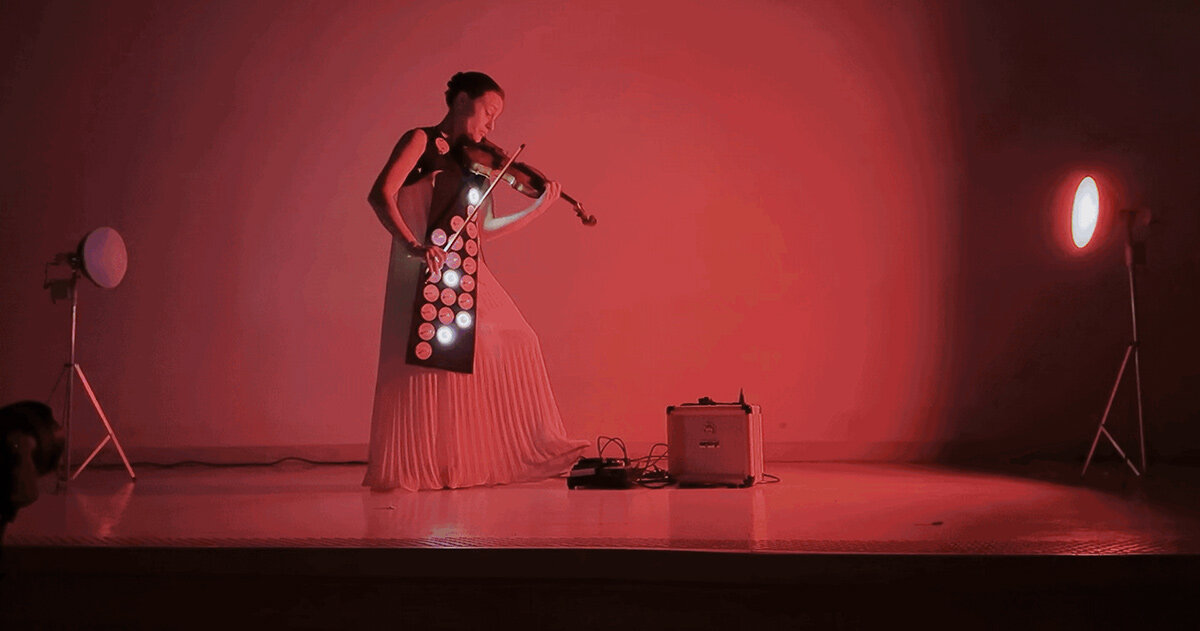
Standing inside the hallowed halls of the Met, Robertson elaborated further on the division of sensory labor during their live sets.
“Audrey is the audio, and the garment has to be the color version of the subtitles,” he noted.
Through this intricate setup, a sensory experience that originates entirely within the mind of a composer travels through the physical body and technique of a concert violinist, before finally manifesting as radiant, programmable light for an audience to witness.
The Garment Becomes an Instrument
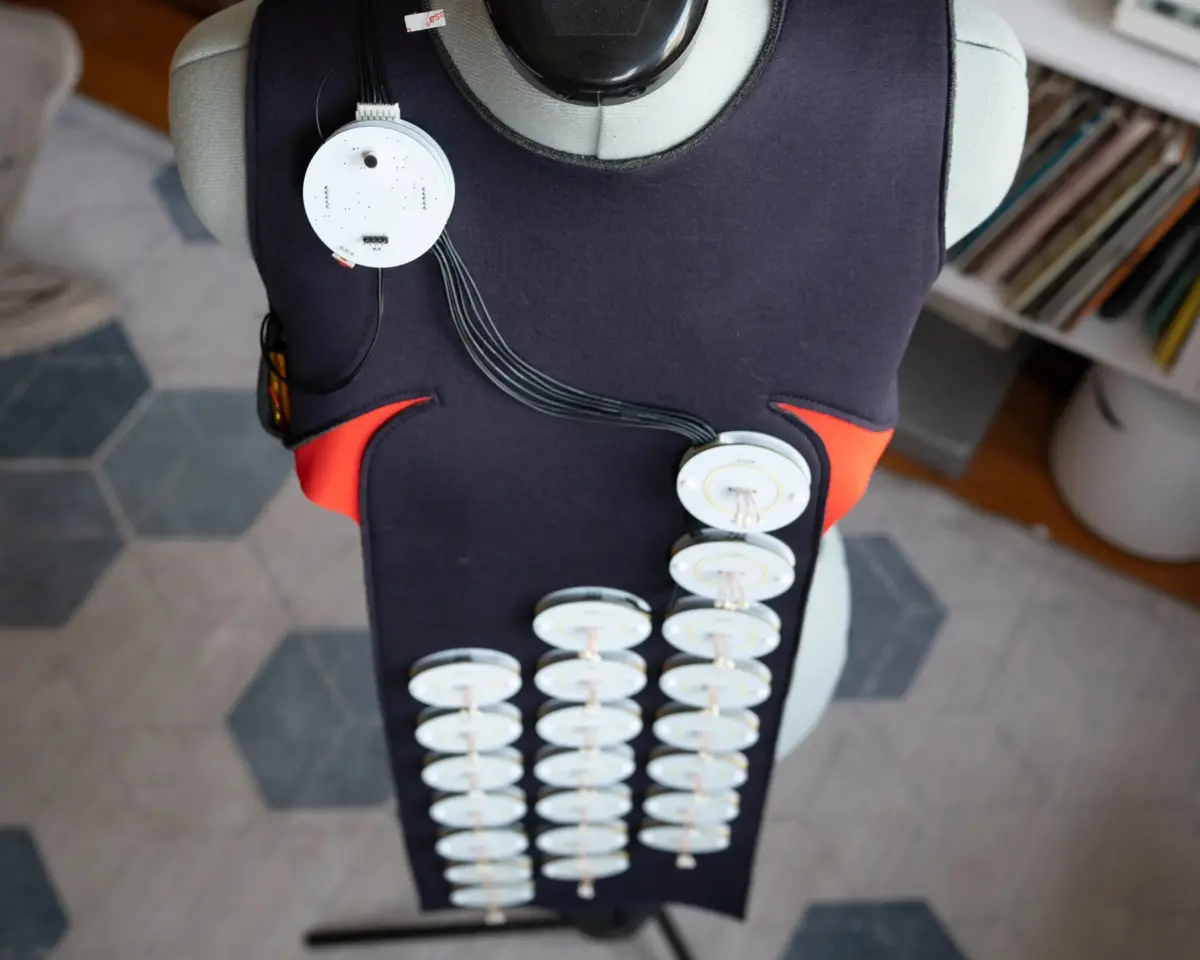
The technology making this possible is entirely bespoke. Robertson designed and constructed the original wearable garment himself, self-teaching the intricate demands of electrical engineering and low-level programming along the way. The resulting apparatus features 46 distinct display panels strategically distributed across Wright’s front and back, integrating more than 3,000 individually managed LEDs into a flexible, wearable system.
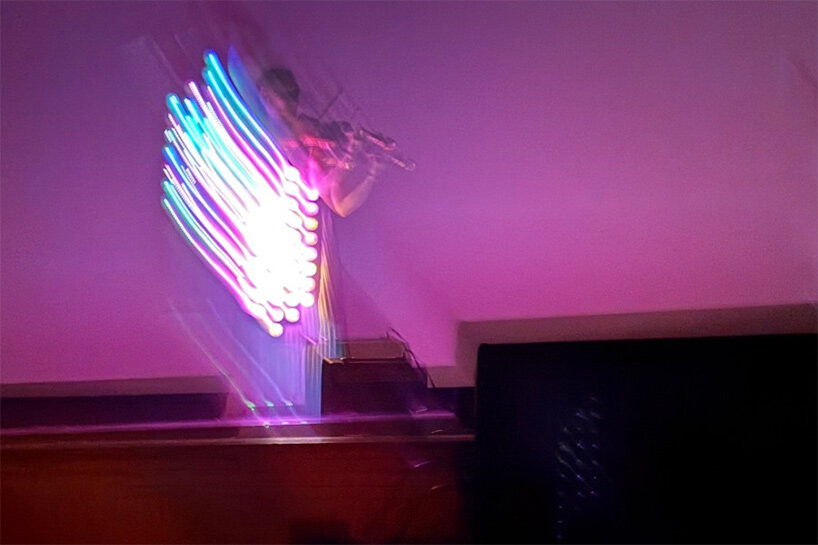
Powering this luminous infrastructure is an array of 47 small batteries, which collectively sustain the hardware while generating an independent Wi-Fi network. This network allows Robertson to connect seamlessly via his tablet, triggering complex visual scripts and dynamic lighting patterns as the music evolves. Additionally, an onboard microphone listens intently to Wright’s live playing, feeding real-time audio values directly into select visual effects to ensure a tight synchronization between sound and sight. The entire system operates smoothly at roughly 30 frames per second, maintaining fluid motion across the display panels.
For Wright, the technology transcends the traditional definition of a costume, functioning instead as a vital extension of her performance. She refers to the wearable apparatus as “a sensory musical instrument itself.”
Robertson views his own technical contribution through a remarkably similar artistic lens.
“There is a bit of that where I’m actually playing the instrument, kind of in tandem with Audrey,” he reflected.
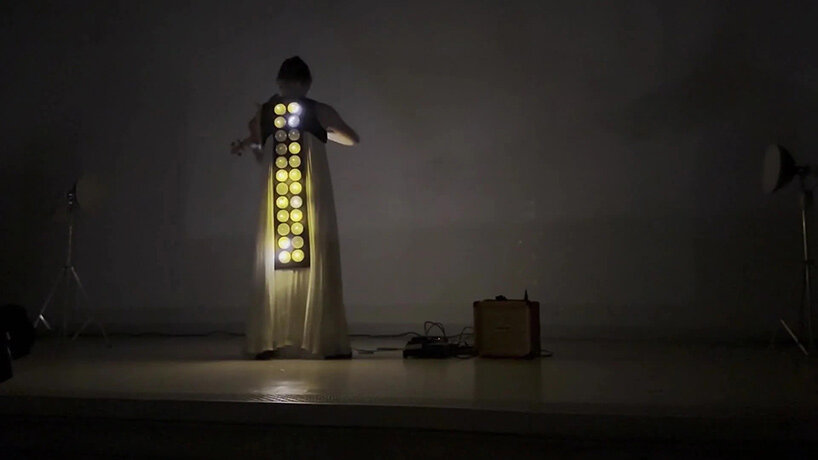
While his tablet rests quietly at the edge of the stage, his precise timing and spontaneous choices become an active component of the performance. While Wright commands her violin, Robertson simultaneously plays the sweeping visual system that envelops her.
From Multisensory to Multimodal
The conceptual engine driving PRISMBODY remains firmly rooted in Boyd’s synesthesia. Reflecting on her creative evolution during the presentation at the Met, the composer recalled realizing during her graduate school years that color had always been fundamentally inseparable from her understanding and composition of music.
“The color was there all the time, like omnipresent,” Boyd shared. “I couldn’t take them apart.”
For PRISMBODY, Boyd has begun translating these involuntary color associations into a rigorous compositional structure, describing the new piece as “a codifying of my synesthesia.” Specific musical passages flow through distinct chromatic fields tied directly to her internal perception, while Wright builds complex, atmospheric layers of violin sound using loop pedals on stage.
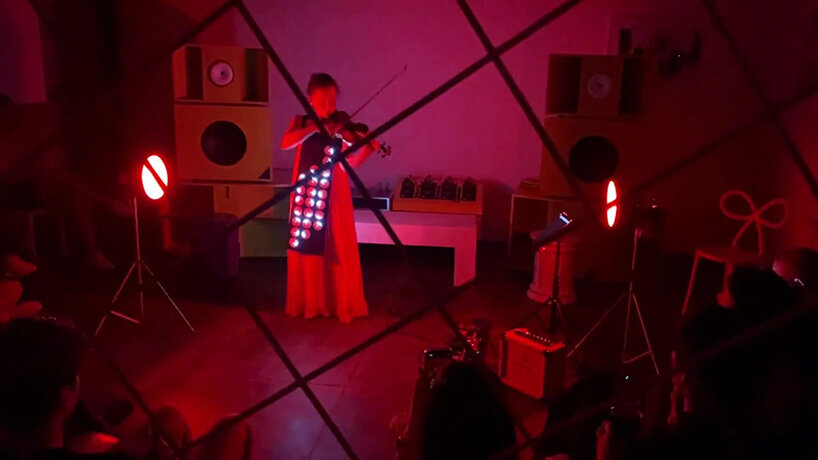
This deeper artistic ambition demanded an evolution in the technology itself. The original garment relies on five fixed LED colors on each display panel, a limitation that leaves little room for the subtle, shifting hues that Boyd perceives in response to particular musical notes and harmonies. To bridge this gap, Robertson developed Garment 2.0, which introduces full RGB LEDs capable of producing a dramatically broader and more nuanced spectrum of light.
“The garment transitions from something that is multisensory to something that is more multimodal,” Robertson explained to audiences at the Met.
Reiterating his subtitle analogy, he emphasized that the ultimate objective is to communicate harmonized information through sound and image simultaneously, achieving enough chromatic accuracy that Boyd can recognize authentic fragments of her own neurological perception shimmering across the violinist’s body.
A Screen That Wraps Around the Body
Beyond upgrading the color fidelity, the development of Garment 2.0 represents a significant physical expansion. Robertson is currently engineering transparent display panels designed to wrap completely around Wright’s torso, replacing the flat front-and-back orientation of the initial prototype with a continuous, 360-degree visual surface.
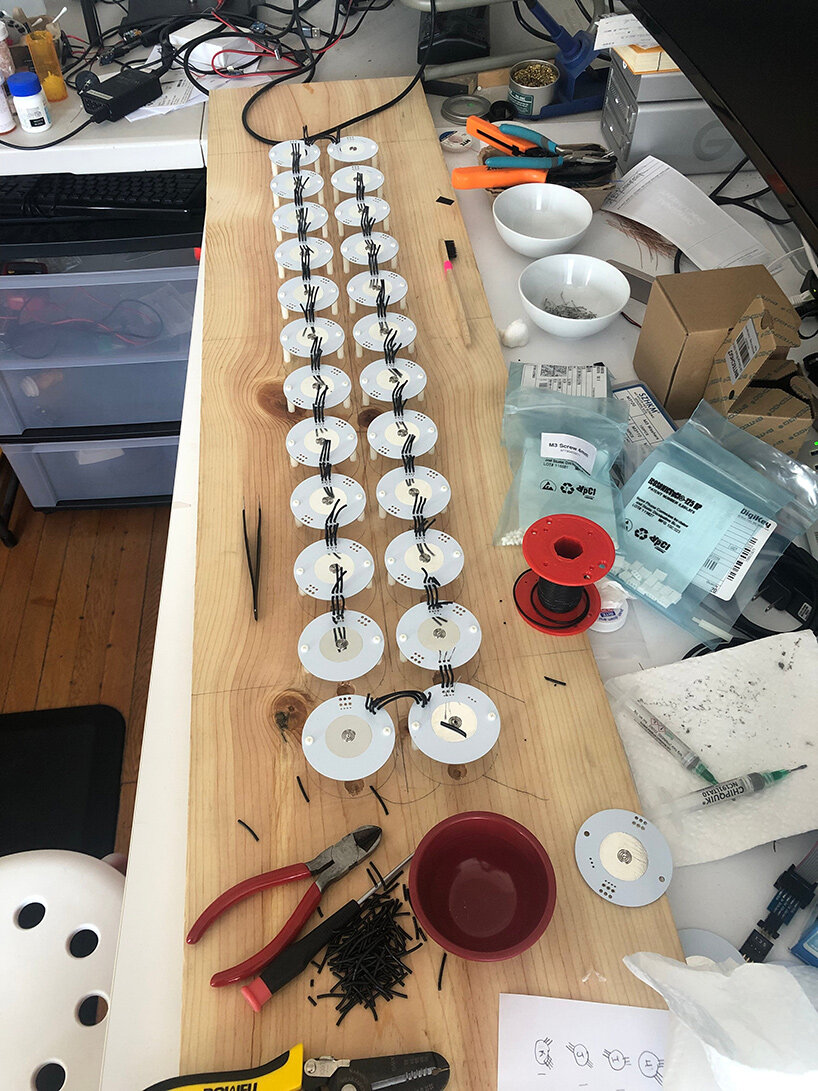
Under this new architecture, each panel will house individually controlled white LEDs alongside a dedicated RGB layer, while supplemental external lights will cast calibrated colors inward onto Wright as she performs. Furthermore, these external spotlights are evolving into sculptural extensions of the wearable display itself, designed to project the imagery outward and fill the surrounding performance space.
This desire for an all-encompassing visual field has been central to Robertson’s vision since the project’s inception. The concept originally took root during the COVID-19 pandemic, a period when artists were forced to reimagine how live performance could exist outside the confines of traditional stages and auditoriums. PRISMBODY takes that initial impulse and pushes it significantly further.
As Boyd’s unique color associations are codified into the musical score, and as Wright and Robertson translate those instructions into live sound and synchronized illumination, the audience receives an artistic interpretation shaped collaboratively by every individual involved in the chain. At the Metropolitan Museum of Art, the work remained visibly and excitingly in progress, offering a rare glimpse into the mechanics of artistic creation. In doing so, it brought its central, guiding question into sharp focus: How does one successfully capture another person’s invisible experience of music and project it outward so that an entire room can share in the wonder?