





By Fashion News Desk
PARIS — Ire. Incredulity. Intrigue. Those were just a few of the many public reactions voiced when it was announced that Zara—whose parent company, Inditex, stands as the largest fashion retailer in the world—had engaged the couturier John Galliano, widely regarded as a defining talent of our time in that rarefied métier, to create a collection. Those reactions, of course, paled in both number and intensity compared to the response generated when Galliano announced, in collaboration with The Metropolitan Museum of Art in New York, that a planned career retrospective there would not be taking place the following spring.
Reflecting on that decision in a statement, Galliano addressed his past directly: “I remain fully accountable for the pain caused by my words in the past,” he said, referring to several antisemitic and anti-Asian outbursts in late 2010 and 2011, “particularly the hurt I caused to the Jewish and Asian communities, and I remain deeply sorry…. I also recognize and respect that an exhibition honoring my work would be painful for some.”
Both Galliano’s work and his name have long resonated on a wider cultural platform. Individuals who have never worn his clothes often harbor deep-rooted and passionately held opinions about them and about the designer himself. This massive cultural footprint is precisely why he has spent months working on the Zara project within a sun-drenched atelier inside a handsome villa in the Paris suburb of Boulogne-Billancourt—both literally and metaphorically miles away from the chattering gossip of the city’s fashionable arrondissements.
Paris remains the scene of some of Galliano’s greatest triumphs, spanning nearly three decades of critically acclaimed shows that shifted the axis of global fashion again and again. Yet it is also the site of his lowest moment: his dismissal from the house of Christian Dior following those public outbursts, which he attributed to drug and alcohol addiction. Today, Galliano has marked 15 years of sobriety.
From Initial Skepticism to Creative Partnership
When met in July, Galliano was dressed down in baggy shorts and an olive-green knitted shirt from Dario Vitale’s one-and-done Versace collection. At that time, The Met retrospective had not yet been announced and was strictly off-limits for discussion. Instead, the focus was entirely on his new collection—or collaboration, partnership, and pas de deux—with Zara.
The initiative began in hushed secrecy in January, though its true genesis stretches back to 2022. That was when Galliano first met Marta Ortega Pérez, the nonexecutive chair of the board of Inditex and the creative mastermind behind Zara’s high-profile collaborations.

“Marta really supports creativity,” Galliano says, adding, “And she’s obsessed with fashion.”
In the fall of 2022, that shared obsession led to an exhibition celebrating the work of legendary photographer Steven Meisel at Ortega Pérez’s MOP Foundation in Inditex’s hometown of La Coruña in northwestern Spain.
“Steven’s been one of my biggest supporters in illustrating my work,” Galliano says, recalling his seminal 1994 American Vogue portfolio, which ultimately provided the designer with sufficient financial backing to stage what became his legendary all-black fall-winter show that same year.
Galliano and his longtime partner, Alexis Roche, traveled to Spain for the Meisel exhibition and met Ortega Pérez. From there, Galliano notes, “the relationship started blossoming.” Eventually, she posed a direct question: Would he be interested in some kind of collaboration?
His immediate answer was simple: No.
Galliano laughs recalling that initial response, delivered while he was still fully consumed by his demanding role as creative director at Maison Margiela, where he had been at the helm since 2014. Yet, a kernel of interest was undoubtedly present.
“A long, long time ago, I had lots of conversations with my dear friend Alber [Elbaz], and he was always super excited about doing something for the high street,” Galliano shares.

Following his departure from Margiela in 2024, Galliano maintained a deliberately quiet profile, spending his time deadheading roses in his country garden in Picardy, just north of Paris. Throughout this quiet period, he and Ortega Pérez kept in touch, meeting frequently for lunch. During one of these informal meals, Galliano soft-launched a brand-new concept, floating the title Reform.
“And,” Galliano recalls, “she said: ‘Yes, let’s do it.’”
Rethinking the Archive on the High Street
The concept Galliano outlined during that lunch has now materialized as an official collection titled Reform Zara Authored by the Couturier John Galliano. The unwieldy moniker exists partly for legal reasons—the John Galliano brand name is still owned by luxury conglomerate LVMH—but it is also deeply rooted in the creative premise itself. As the title suggests, Galliano is not designing entirely from scratch. Instead, he is reworking existing garments to unearth something entirely new.
“This is an innovation—this idea of going in and treating their existing garments,” he explains. “I called it Zara’s archives… but in this fast age, what denotes an archive?”
What Galliano refers to as an archive might pragmatically be described by others simply as stock. “Basically, it was the garments that were sitting around,” he says. “They became my working prototypes.”
Reform began life as a selection of standard Zara archetypes—a long wool-mix coat, a slip dress, a classic cotton shirt—pieces commonly found in everyday wardrobes. Galliano and his team cut these pieces, pressed them, and turned them inside out and upside down to transform each standard item into an authentic Galliano original.
“How could I change the form—reinvent it, re-represent it?” was the guiding question Galliano posed to himself, operating not merely as a creator, but as a re-creator. “There were no limits.”

Galliano’s eyes gleam as he walks through his complex creative process—a method that left a lasting impression on collaborators. “To watch him at work is an inspiration,” says Ortega Pérez.
Because the final garments of the inaugural Reform collection had already been packed and flown back to La Coruña following a photo shoot the previous day, Galliano relied on stacks of photographs to illustrate his new modus operandi. Flipping through the images, he charted the alchemical transformation of everyday Zara items into exceptional pieces of wearable art. A wool-mix coat is abruptly cut off in the front, its pockets pushed further and further back, lapels extended, and tails creeping down the leg. A delicate, lace-trimmed slip dress—described by Galliano as “a perfectly lovely little summer dress”—inches its way up the body to become an extravagant jabot framing the neck.
Elsewhere, a standard Zara shirt, sized up to triple or quadruple XL, is converted into a jacket through a printed trompe l’oeil leather pattern. Pockets are twisted and repositioned to alter how the human body interacts with and behaves within the clothing.
“It’s what hackers do, what DJs do—resampling, digital mixing,” Galliano says. “It’s the grammar of today.”
When asked whether he could achieve his signature haute couture posturings with high-street stock, his response is rhetorical, because the answer is self-evident. “There are things that obviously run in my veins.”
Les Incroyables and the Grammar of Today
Even today, viewing recordings of Galliano’s earlier runway shows on platforms like YouTube can cause the hair on the back of a neck to stand up for both seasoned fashion observers and newer generations of fans. His new Zara pieces induce a similar heady sense of excitement, replete with his enduring trademarks: an illustrative line, a mastery of color, and a sheer genius of cut.
“I’ve never dropped an idea or a concept completely,” Galliano notes. “It becomes part of my identity, part of my signature.”

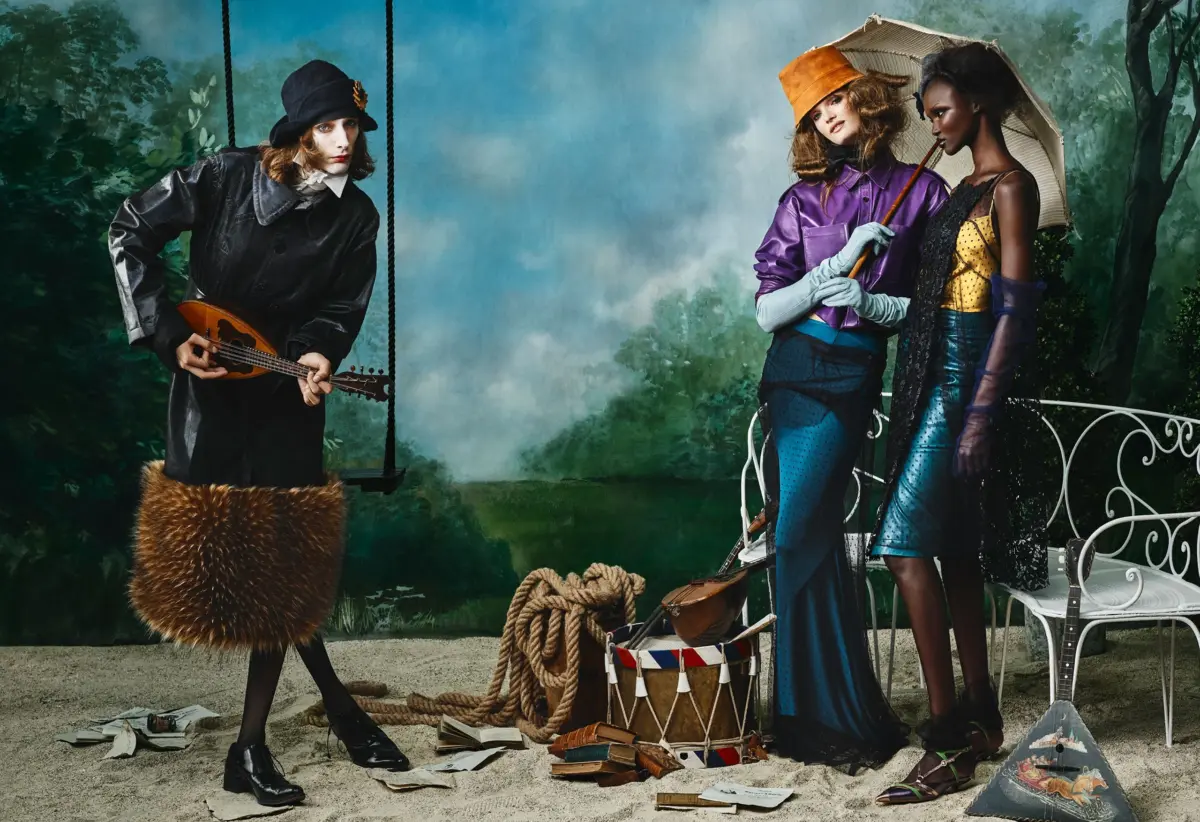
The collection features bias-cut gowns in glorious jewel tones, technical tailoring, transparent layers of tulle falling like veils of memory, and arcane historical gestures. These include beribboned bonnets, cravats, and bicorne hats inspired by Abel Gance’s 1927 cinematic epic Napoléon, one of the designer’s favorite films.
As Galliano cut, shifted, and reformed the garments, distinct characters began to emerge: men dressed in cropped tailcoats with high-tugged collars, and women wrapped in clinging, draped dresses. The new creations unexpectedly echoed the past. The exaggerated, arcane silhouettes closely resemble an aristocratic band of dandy rebels from the era of the French Revolution known historically as les Incroyables (“the Incredibles”), alongside their female counterparts, les Merveilleuses (“Marvelous Women”).
This era holds a deeply personal connection to Galliano’s history. Les Incroyables served as the direct inspiration for his 1984 Central Saint Martins graduation collection of the same name, featuring preening, makeup-slathered decadents in revelatory attire that propelled him onto the global fashion stage. It is a recurring theme and era to which he returns repeatedly: foppish recusants decked out in frills and finery, staging a quiet rebellion through dress.
“Vive la révolution,” Galliano says.
A Larger Reach and Act Three
Collaborating with Zara proves to be a move entirely on-brand for the consistently confounding designer. Having conquered haute couture and luxury houses throughout a career spanning more than four decades, stepping onto the high street is a natural progression. The collection highlights a core duality in Galliano’s work: while his purest expressions manifest through the meticulous handwork of couture, his grand visual storytelling appeals directly to the masses.
For many consumers, this Zara collection will provide their very first opportunity to own and wear a Galliano design in the wild at an accessible price point. While the secondhand market for his earlier archival work commands staggering sums—such as a Christian Dior couture piece that broke world records in January by selling for 663,000 euros—the Reform collection starts at just $29.90.
“It’s an honor to bring John’s magic to a broad audience for the first time,” Ortega Pérez says. Galliano echoes the sentiment, noting that the partnership offers “a much larger reach than I’ve had before—it’s huge.”

He was equally astonished by the industrial facilities of Inditex, particularly regarding fabric sourcing and manufacturing capabilities, which he describes as “jaw-dropping.” This technical proficiency empowered him to deliver a full-throttle expression of his prodigious talents.
“I had no intentions to dumb down,” he states.
Far from being a mere aside or interregnum, this new collection marks a major career transition. Galliano categorizes the first 30 years of his career—from Saint Martins through his tenure at Dior—as Act One, and his decade at Maison Margiela as Act Two. Reform, he confirms, marks the official beginning of Act Three. His contract with Zara spans two years, during which he is scheduled to design a total of four collections.
Asked what he was ultimately searching for as he embarked on this third chapter, Galliano’s answer is disarmingly straightforward.
“I wanted it to be fun,” he says.
With its baseball-cap bonnets, mismatched platforms, and playful subversion of standard garments, Reform is undeniably that. At the same time, it remains unmistakably, wonderfully incroyable.