




It has been a quarter of a century since Lee McQueen made the fateful decision to depart London—his home city and the crucible of his singular creative vision—to present his collections on the official calendar in Paris. The year was 2001, a pivotal moment marked by luxury conglomerate Kering’s investment in the Alexander McQueen brand. That financial partnership catalyzed a relocation to the French capital, beginning a long and illustrious romance with the Paris Fashion Week schedule that would define the house for generations.
Yet history turned a monumental page this September. For the Spring/Summer 2027 season, creative director Seán McGirr orchestrated a deeply symbolic reunion, bringing the iconic British house back to where its turbulent, brilliant story first began.
There is a distinct rawness woven into the fabric of London that Paris simply does not possess. It is an unvarnished sense of rebellion, an anti-establishment ethos that has long been rooted in the core identity of Alexander McQueen. London remains, after all, the true birthplace of punk, of fierce counterculture, and of that legendary generation of British art and design students who turned the global fashion industry entirely on its axis, with Lee McQueen standing tall as chief among them. Returning to this environment meant tapping back into the gritty, unfiltered energy that birthed the label.
The homecoming took place within the atmospheric, darkened halls of Lincoln’s Inn Chapel in London. It was an environment that allowed McGirr to honor everything the McQueen name historically stood for while simultaneously propelling it firmly into the present tense. Throughout his career, McGirr has frequently drawn inspiration from Piero Della Francesca’s masterpiece The Baptism of Christ, a subtle yet powerful thread that became vividly apparent during the opening sequence of the runway presentation.
For these initial looks, lengths of reflective satin were dramatically draped across the body, secured tightly with utilitarian harnesses crafted by Shaun Leane, an original and legendary collaborator of Lee McQueen. This masterstroke juxtaposed fluid, liquid-like gowns with hard, almost biblical structures, creating a tension between softness and severity. The garments were further accentuated by sharply tailored silhouettes featuring curled wings and piqued shoulders. Models wore their hair gelled into sharp, demonic horns, instilling the entire opening act with a palpable, unapologetic spirit of rebellion.
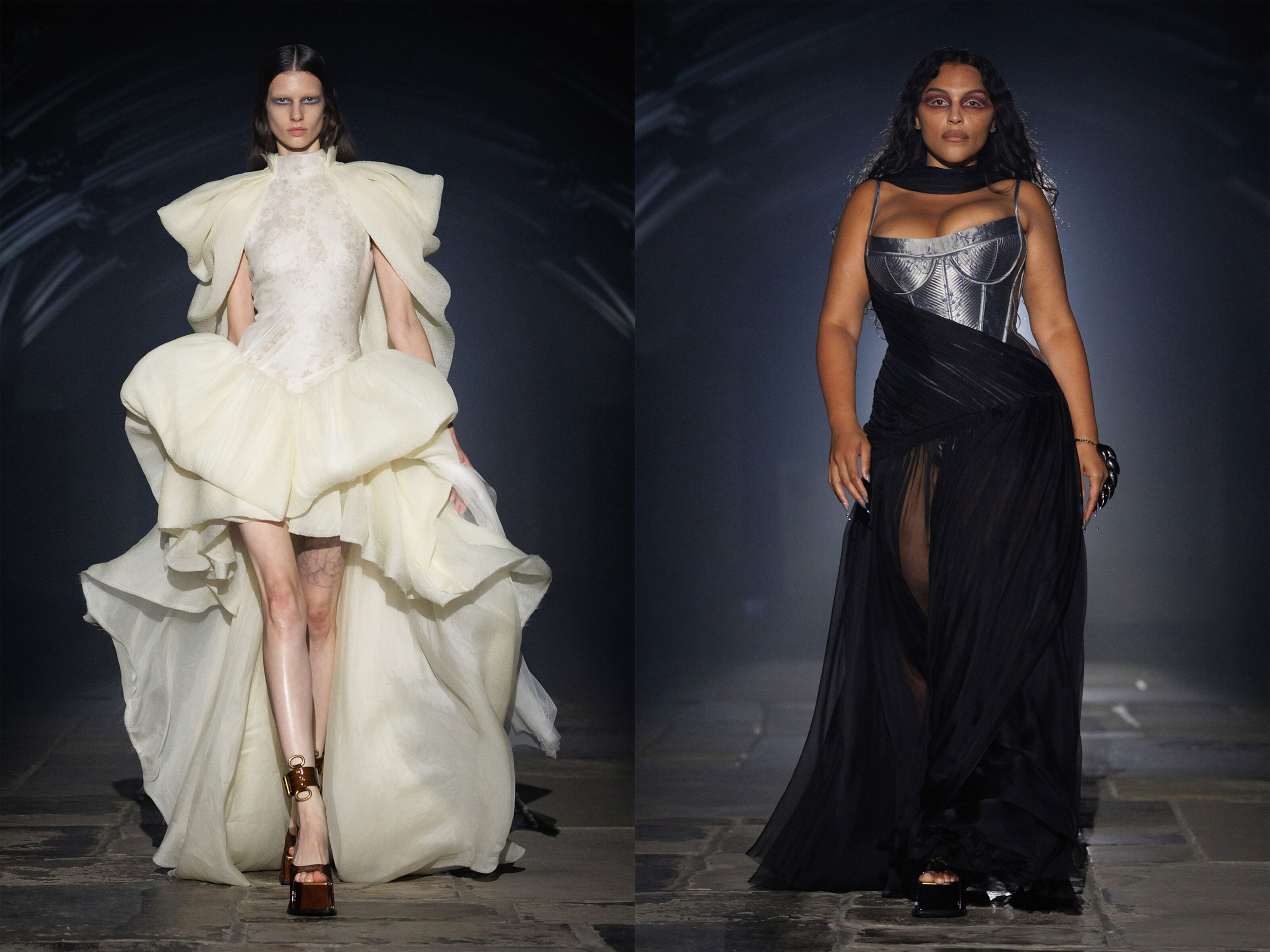
As the collection progressed, McGirr seamlessly shifted gears to incorporate heavy notes of rave culture, an element intrinsic to London’s historic underground nightlife scene. Sheer mesh, perforated leather, and watercolor-stained sheer fabrics were masterfully corseted, materializing as clingy, ruched mini-dresses and high-shine party wear. Contemporary energy was injected directly into the lineup via voluminous pannier skirts and frayed, asymmetric hems, all paired toweringly with ultra-high patent platform shoes.
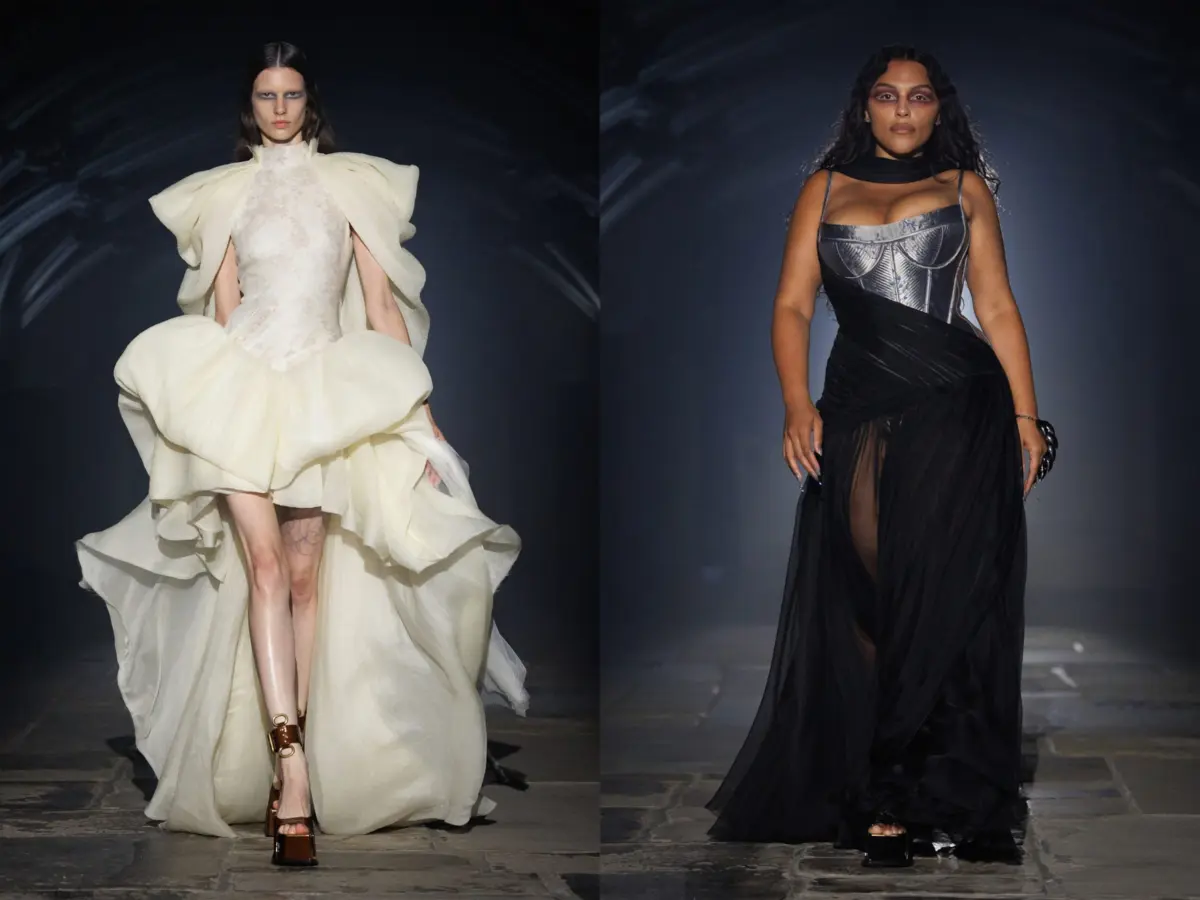
Yet, some of the most striking moments belonged to the medieval and Renaissance-inspired pieces that sliced through the modern nightlife references with haunting romantic imagery. Among them was a breathtaking chainmail dress interwoven with glittering metallic skulls, as well as a silver satin corset worn by model Paloma Elsesser. The piece was ingeniously designed to resemble a polished metal breastplate, starkly draped with flowing black crepe de chine.
As the presentation neared its climax, a magnificent, voluminous white gown emerged from the shadows. The front of the dress appeared as though it had been aggressively gathered by an unseen ghost, drawing the fabric back to expose the models’ legs and casting a brilliant spotlight on the footwear. The models strode forward in glossy platform shoes featuring intricate ankle straps and heavy brass rings that bore an unsettling resemblance to 15th-century torture accessories.
The world of Alexander McQueen has forever existed in a space that is delightfully off-beat, unapologetically dark, and occasionally teetering on the demonic. It is precisely this uncompromising aesthetic that has consistently magnetized the house’s most devoted admirers while simultaneously confounding its harshest critics. As a legendary institution, Alexander McQueen has always possessed a heritage that refuses to shy away from the shadows, choosing instead to unfurl directly toward them. For Spring/Summer 2027, Seán McGirr reached out into that darkness, firmly grasped it, and brought it home.