






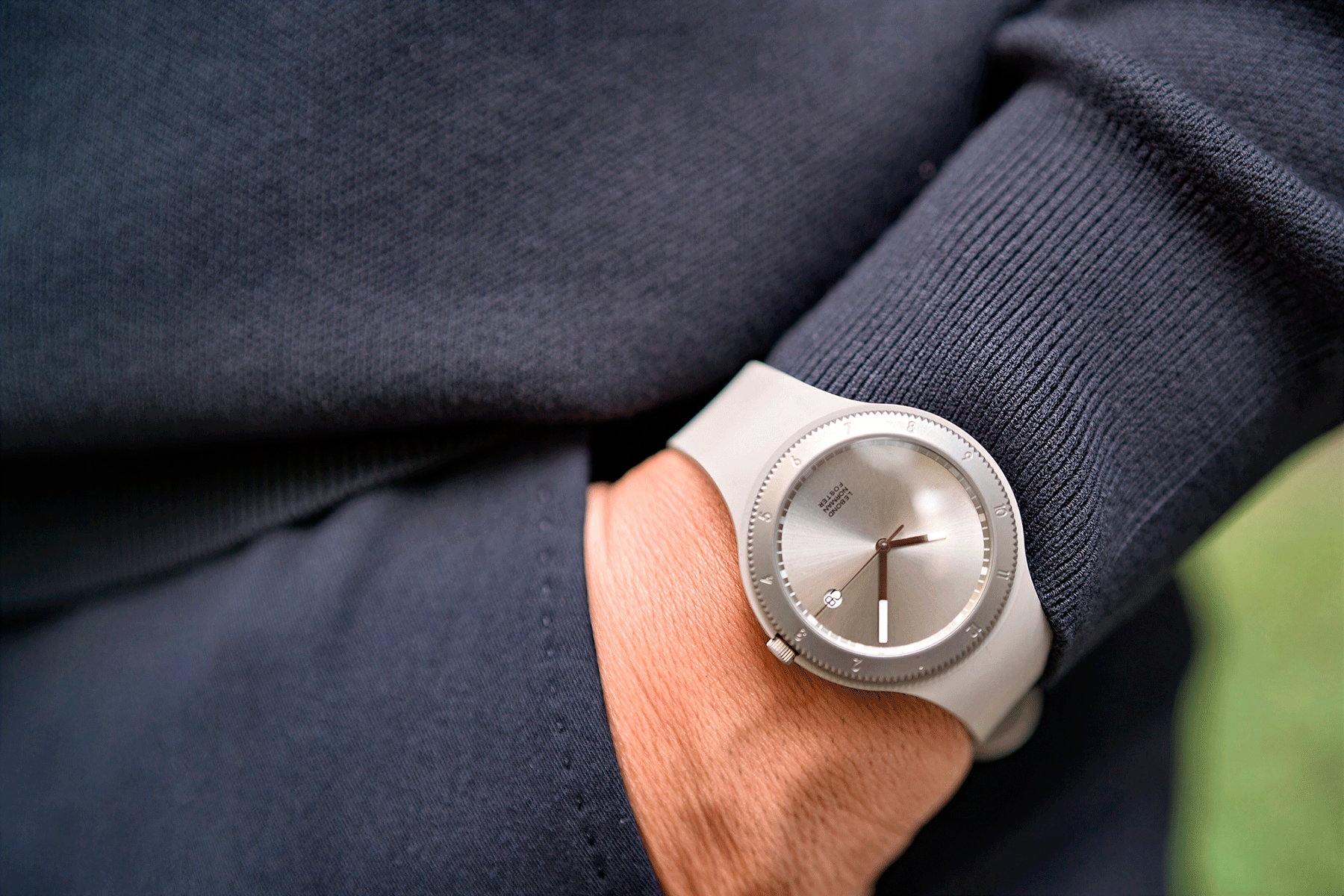
From designing towering skylines and sprawling international airports to crafting bespoke furniture, legendary British architect Norman Foster has spent decades testing the limits of structural engineering across vastly differing scales. Now, the renowned visionary is shrinking his canvas down to the human wrist. In a groundbreaking collaboration with Swiss watchmaker LEBOND and the Innovation and Design Unit of the Norman Foster Foundation, Foster has unveiled his very first wristwatch.
The LEBOND Norman Foster timepiece applies the architect’s rigorous, uncompromising philosophy regarding materials, structural engineering, and everyday utility to the realm of precision horology. At its core, the project rethinks the fundamental relationship between a watch case and its strap, introducing an integrated design profile that places a premium on ergonomic comfort, functional clarity, and user customization.
For Foster, shrinking the physical dimensions of his work does not demand a fundamental shift in his underlying design philosophy. Whether he is drafting the master plan for an entire city, engineering a sweeping commercial building, sketching an ergonomic chair, or mapping out the micro-components of a mechanical watch, the core questions remain entirely identical. In an exclusive discussion, Foster reflects on this continuity across scales, noting that the inquiry is always rooted in performance and logic: how does an object work, how is it manufactured, and how do all of its disparate parts come together into a unified whole?
Yet, transitioning from monumental architecture to a wearable accessory introduces a profoundly different dynamic. Unlike a physical structure anchored firmly to a specific geographic site, a wristwatch is intensely personal. It travels intimately with its wearer, accompanying them from high-stakes professional boardrooms and bustling international airports to private, quiet moments at home. It is an object encountered at close range and interacted with repeatedly throughout the day, turning performance, tactility, and comfort into paramount concerns.
Removing the Boundary Between Case and Strap
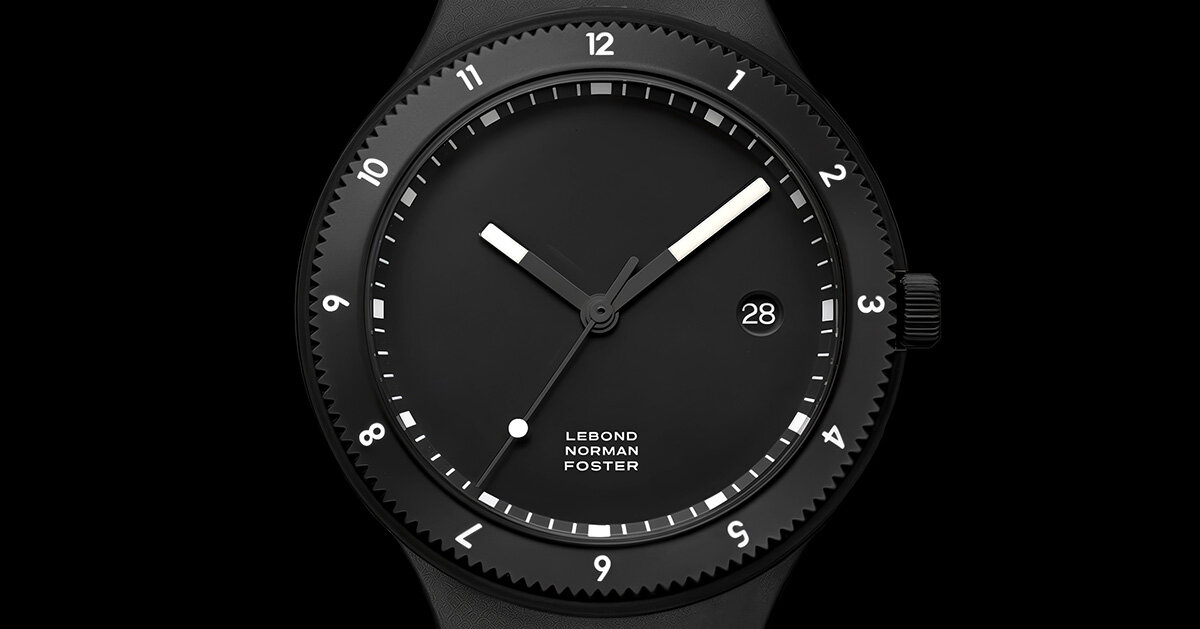
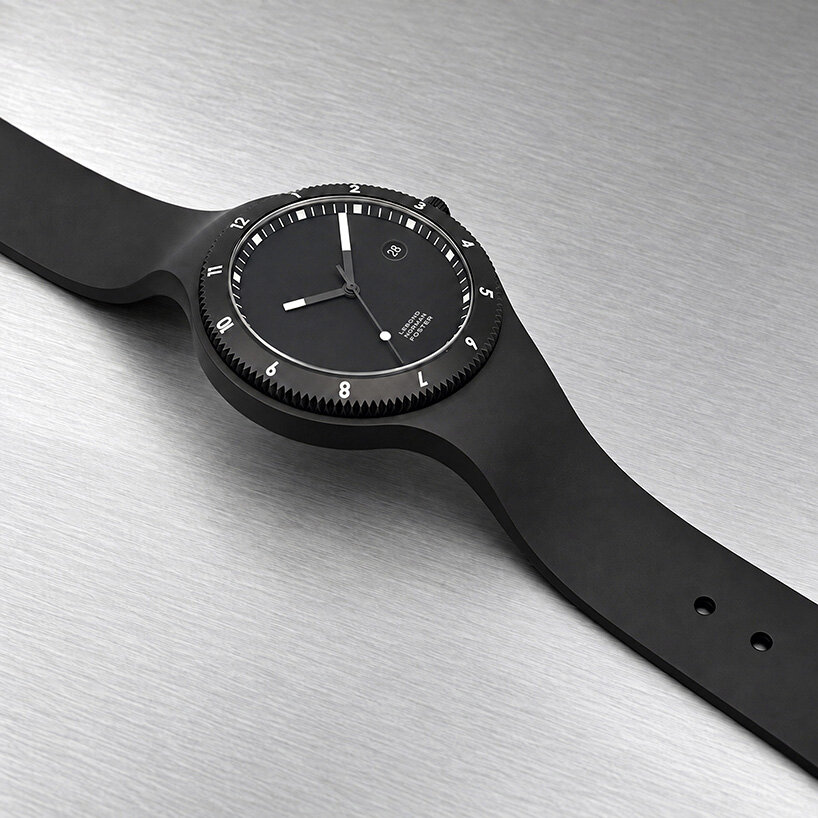
One of the most radical design decisions in the LEBOND Norman Foster watch is the complete elimination of conventional lugs—the protruding metal horns that traditionally bridge a watch case and its strap. By rethinking this standard industry convention, the design team allowed the strap to continue the precise visual line of the case itself. This integration yields a unified, continuous profile that not only elevates the aesthetic harmony of the object but also allows it to drape and contour more naturally and comfortably around the wrist.
In addition to this seamless physical profile, the watch features an easily interchangeable strap system, granting wearers the freedom to experiment with various combinations of colors and materials to suit their personal style. This questioning of convention is deeply characteristic of Foster’s broader architectural practice. When evaluating why watch cases and straps have historically been treated as two entirely separate, bolted-on objects, Foster and his collaborators chose to challenge the obvious. Once they began conceptualizing the strap as an organic continuation of the case, the entire architecture of the watch began to fall into place.
This approach reflects a design philosophy where form and function are never treated as competing forces. Instead, Foster insists that the process always starts with performance. He does not view form, structure, materials, and engineering as isolated disciplines; rather, the finest designs are those where each element actively reinforces and validates the others.
Bringing this timepiece to life required a meticulous process of iteration—sketches, physical prototypes, and successive micro-adjustments—that will feel remarkably familiar to anyone acquainted with Foster’s architectural studio. Each incremental stage strips away excess, bringing the design closer to its essential core. Through patient refinement, the object eventually reaches a state where every curve and joint feels entirely inevitable.
A Precision Instrument Shaped by Travel
The intensely practical character of the timepiece is heavily informed by Foster’s lifelong fascination with aviation and his extensive personal experience with global travel. Among its most functional complications is a bidirectional rotating 12-hour bezel, which enables the wearer to effortlessly track a second time zone using the main hour hand. This feature directly addresses the real-world logistical needs of modern travelers who constantly move across international borders and time zones.
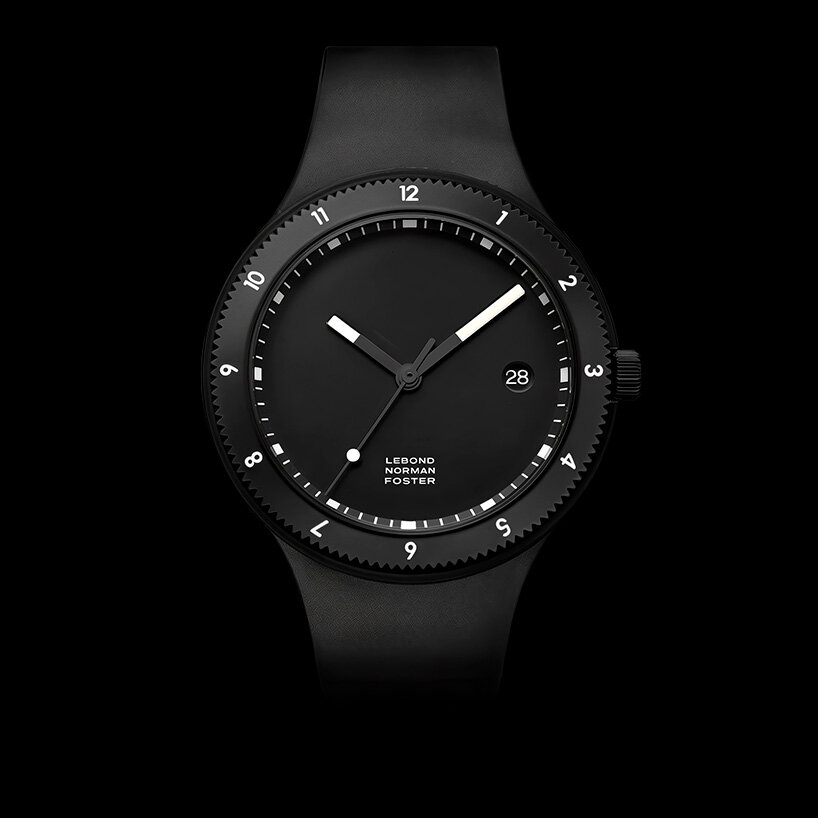
The dial follows a parallel philosophy of uncompromising legibility. Eschewing cluttered aesthetics, it features restrained typography, starkly defined hands treated with Super-LumiNova for low-light visibility, and a clean date window. This ensures that essential timekeeping information is conveyed immediately and clearly, without introducing extraneous visual noise.
This laser focus on genuine utility also underpins Foster’s perspective on timelessness. In an era where luxury watches frequently serve as fleeting status symbols driven by rapidly changing consumer tastes, Foster argues that true longevity is the natural byproduct of solving fundamental problems correctly. Transient fashion comes and goes, but a well-resolved object should continue to provide quiet satisfaction and reliable service over many years of continuous use.
Technically, the watch is housed in a Grade 5 titanium case measuring 38.5 millimeters in diameter, expanding smoothly to 40 millimeters at the junction where it meets the integrated strap, with a slender overall thickness of 10 millimeters. The case is offered in two distinct finishes: a micro-sandblasted natural titanium finish or a matte black diamond-like carbon (DLC) coating. Both editions are protected by a domed sapphire crystal featuring an advanced anti-reflective coating and boast a water resistance rating of up to 50 meters.
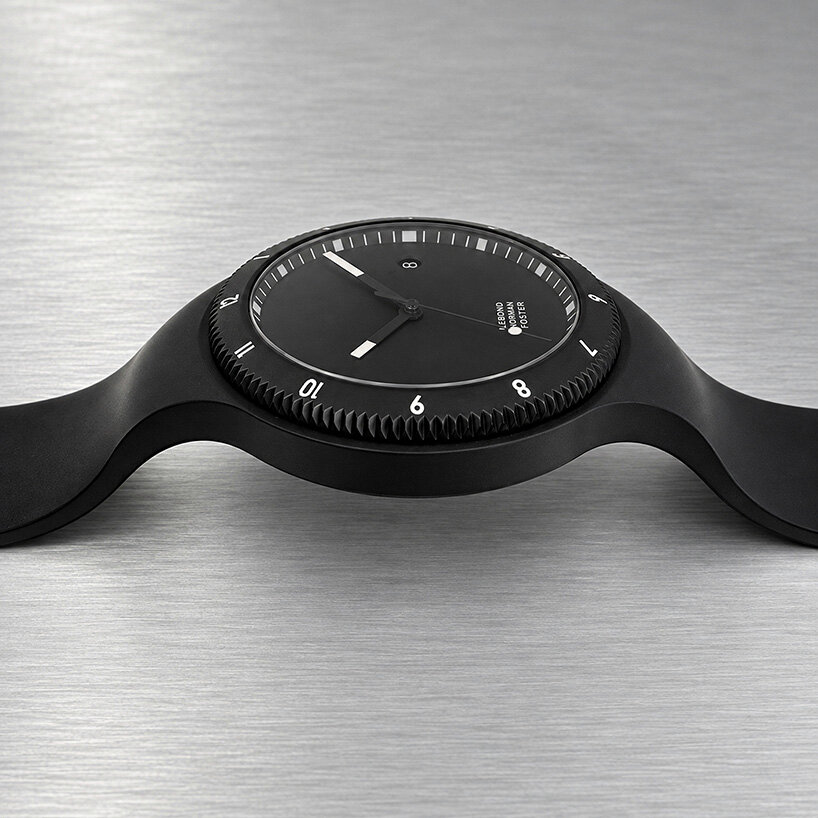
The Natural Titanium Edition pairs its raw, industrial case with a sunray-brushed dial, polished hands, and a light gray FKM rubber strap. Conversely, the Black Edition pairs its matte dark coating with a deep black lacquered dial and matching hands, secured by a sleek black FKM rubber strap. Both versions utilize a secure Grade 5 titanium deployant clasp. For Foster, these exacting material specifications matter only insofar as they faithfully support the ultimate purpose of the object: proper proportion, material honesty, structural clarity, and graceful aging.
Making the Mechanics Part of the Design
Beneath the sapphire crystal and visible through an exhibition caseback lies the mechanical heart of the timepiece, offering yet another manifestation of Foster’s fascination with engineering as an aesthetic asset. Within the automatic movement sits a custom-machined rotor—finished in a striking blue for the Natural Titanium Edition and a vibrant red for the Black Edition.
This bespoke rotor features five precision-machined perforations that impart a distinct, industrial geometry to the component. Rather than hiding the internal mechanics behind a solid metal back, the design elevates the movement into an integral part of the watch’s visual identity. The concentrated splash of color acts as an intentional focal point within an otherwise restrained and disciplined composition.
Powered by a reliable Swiss automatic ETA 2892-A2 movement, the watch operates at a frequency of 28,800 vibrations per hour, contains 21 jewels, and delivers an approximate power reserve of 50 hours. Every single timepiece produced in the collaboration is individually numbered. For Foster, this integration of engineering and appearance reinforces a belief he has held throughout his illustrious career: that true structural beauty emerges when the underlying logic of how an object works is allowed to be truthfully visible.
A Watch for Everyday Life
Beyond the immediate world of horology, this collaboration represents a significant expansion for the Norman Foster Foundation. Operating through its Innovation and Design Unit, the foundation routinely investigates design challenges across a sweeping spectrum of scales, from micro-objects to macro-urban environments. Furthermore, the project carries a clear philanthropic and educational mission. All proceeds received by the foundation through royalties from the watch sales will be directed toward funding the educational programs of the Norman Foster Institute, which trains the next generation of architects, designers, and urban leaders committed to building sustainable, resilient cities.
Ultimately, however, Foster measures the success of the timepiece by its ability to integrate seamlessly into the varied rhythms of daily life. He pictures wearing the watch while sketching in the studio, inspecting a dusty active construction site, boarding an international flight, or attending a formal evening event. A truly successful design should effortlessly adapt to these diverse contexts without ever feeling out of place or tethered to a single narrow aesthetic.
When asked what lasting impression he hopes wearers take away from the watch, Foster points to the quiet confidence of good design—the idea that an object should elevate everyday life without shouting about itself. Over time, he hopes the wearer will grow to appreciate the holistic relationship between all the constituent parts: the ergonomic contour on the wrist, the crisp clarity of the dial, the volume of space it defines, and the marriage of advanced engineering and durable materials. For Norman Foster, that is the ultimate benchmark of a successful design: when an artifact simply becomes an organic part of your life, continuing to reveal its quality and purpose through daily use.