





The world of high-end horology is set to turn its eyes toward Geneva this November as one of the most historically significant modern timepieces comes to the auction block. On November 8, the very first numbered Patek Philippe Perpetual Calendar Chronograph reference 3970 will headline Sotheby’s Important Watches sale. Originally sold at the prestigious brand salon on the Rue du Rhône in Geneva on January 14, 1987, this particular timepiece represents a crucial turning point in Patek Philippe’s recent history, capturing a transitional era that redefined how the market perceived complicated wristwatches.
The launch of the reference 3970 marked the definitive end of a legendary thirty-year run for its predecessor, the iconic reference 2499. Stepping into the shoes of such a celebrated model was no small task, yet the reference 3970 successfully inaugurated a brand-new chapter for Patek Philippe chronographs. This specific watch sits at the absolute foundation of that transition, bearing the lowest-numbered Lemania-based Patek Philippe movement ever recorded: movement number 875’000. Had this milestone piece been completed or released even slightly later, it is entirely possible that Patek Philippe would have retained it for its own corporate museum in Geneva, much like it did with the first reference 3971 bearing movement number 875’030.

Today, Patek Philippe’s perpetual calendar chronographs are often viewed by collectors as an impressive entry point into the upper echelons of the brand’s esteemed Grand Complications collection. However, during the era of its inception, complications of this magnitude were among the most advanced and complex wristwatches available on the commercial market, with production numbers frequently dipping as low as just ten pieces per year.
The landscape for high-end, highly complicated wristwatches—a segment that historically shifted between a microscopic niche and near non-existence—experienced a dramatic market explosion during the 1980s. This seismic shift transformed Patek Philippe’s perpetual calendar chronograph from an ultra-rare halo piece into a foundational staple of haute horlogerie. That evolutionary leap forward began directly with this specific watch, carrying the lineage of traditional watchmaking into a modern commercial reality.

A Closer Look
For seasoned collectors tracking the upper tier of the vintage market, this watch is far from a stranger to the auction room. It previously changed hands at Antiquorum in both 2005 and 2015, maintaining an exceptionally consistent state of preservation throughout its journeys. Fittingly for a piece of this magnitude, the watch is accompanied by its original box and certificate of origin.
While accompanying accessories and paperwork are often treated by collectors as a mere bonus, the historical weight of this unique example makes the completeness of its original set far more critical than usual. It anchors the provenance in undeniable documentary evidence, cementing its status as a primary historical artifact of the brand’s production records.

A rigorous visual inspection of the watch reveals a remarkably well-preserved exterior. While the slight softness observed on the case back hallmarks indicates that the watch has indeed undergone polishing over its lifetime, the work was evidently executed by an exceptionally disciplined hand. The sharp, defining lines of the case remain remarkably crisp, preserving the original geometry intended by the atelier.
The solid 18k gold dial, featuring a grained silver finish and distinctively charming American typewriter-style lettering, remains in an even more pristine state than the exterior case. The only exception is the minutes totalizer, which exhibits a minor degree of natural oxidation, a subtle patina that is similarly mirrored on the adjacent two o’clock hour baton. Such age-commensurate characteristics offer tangible proof of the watch’s authentic vintage pedigree without detracting from its striking visual appeal.

Triple Zero
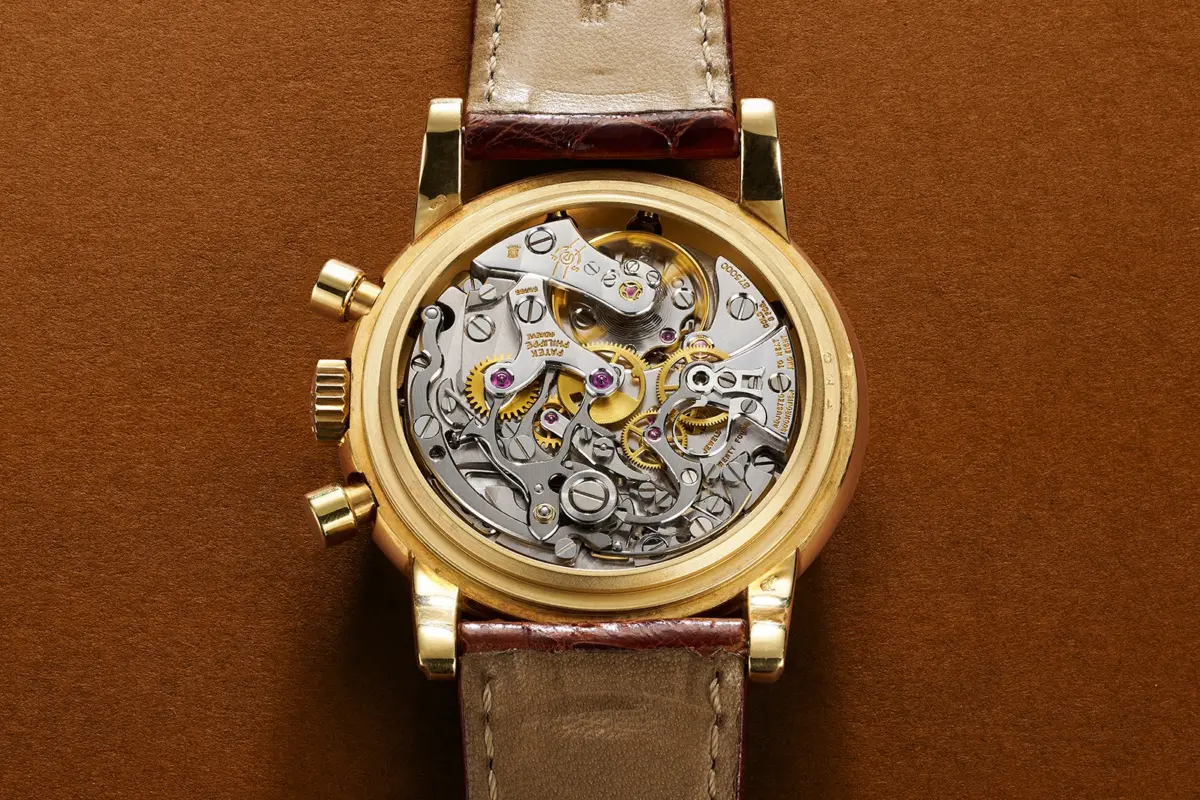
Fortunately, the true heartbeat of the watch—its intricate mechanical movement—remains in unqualifiedly stellar condition, even though its inner workings stay hidden beneath a solid, snap-on case back. This specific watch marks the historic juncture when Patek Philippe phased out the Valjoux 72-based caliber 13-130 Q in favor of the smaller, highly refined Lemania-based caliber CH 27-70 Q. This new movement architecture would go on to serve as the mechanical backbone for the brand’s premier perpetual calendar chronographs for the next quarter-century.
Patek Philippe’s engineering modifications to this new platform were more targeted than the extensive overhauls given to its predecessor. The manufacture chose to leave the three-quarter plate largely intact, preserving the friction-fit chronograph driving wheel, which explains why the bridge positioned over it lacks a jewel or mechanical bearing. Nevertheless, this bridge is far from a purely cosmetic choice; it forms an integral part of Patek Philippe’s most substantial mechanical modification to the base movement.

Preferring a layout where the clutch lever pivots precisely around the chronograph driving wheel axis, Patek Philippe discarded both the Lemania and Valjoux coupling solutions in favor of an entirely proprietary design. To elevate the performance standards of the assembly, the brand incorporated a lockable Geneva-style stud carrier, a large and slow-beating Gyromax balance wheel, and capped the column wheel with a polished protective cover.
The decorative hand-finishing found on early Lemania-era movements exhibited a certain degree of organic inconsistency. This variability was largely attributable to a less centralized, highly manual finishing process across the broader Swiss watch industry at the time, coupled with different standards of industrial attention to decoration. This characteristic is most visible in the bevelling of the components, where the width can vary perceptibly. Furthermore, the number of sharp internal angles—a detail intensely coveted by contemporary collectors—ranges from zero to four on these early movements.

Despite these organic quirks, these movements easily surpass the stringent quality thresholds required for the Geneva Seal. The bevels on this particular movement are wide and bright, even if the interior angles lack the hyper-acute sharpness seen on later iterations produced decades later. Within the vintage collecting community, such minor structural and aesthetic variations are frequently embraced as desirable markers of authenticity and hand craftsmanship rather than flaws.
While Patek Philippe movements from the mid-1980s look distinctively different from the industrialized perfection of the brand’s modern contemporary calibers, that divergence misses the broader point of this timepiece. These were among the finest-finished movements of their generation and continue to command deep respect today. More importantly, the immense historical significance of this specific watch transcends standard tangible metrics of finishing. Containing movement number 875’000, it functions less like a standard collector’s luxury item and more like a bona fide museum piece.

Reflecting its extraordinary status as the genesis of a modern legend, the watch carries a pre-sale auction estimate of 1 to 3 million Swiss Francs, translating to approximately 1.2 to 3.6 million US Dollars.
Preview and Auction
The exhibition preview and subsequent live auction for Sotheby’s Important Watches sale will be held at the Mandarin Oriental hotel located along the Rhône in Geneva.

The public preview exhibition will be open to visitors daily from November 5 through November 7, 2026, welcoming guests between 10:00 AM and 6:00 PM local time.
The live auction will commence on November 8 at 10:00 AM local time with Session I, covering lots 1 through 96, followed by Session II on November 9 starting at 10:00 AM, covering lots 97 through 188. All scheduled times are local to Geneva, operating on Central European Time (GMT+1).

The venue is situated at the Mandarin Oriental, Quai Turrettini 1, 1201 Geneva. Interested bidders and horological enthusiasts can explore the complete auction catalog directly through Sotheby’s official website.