





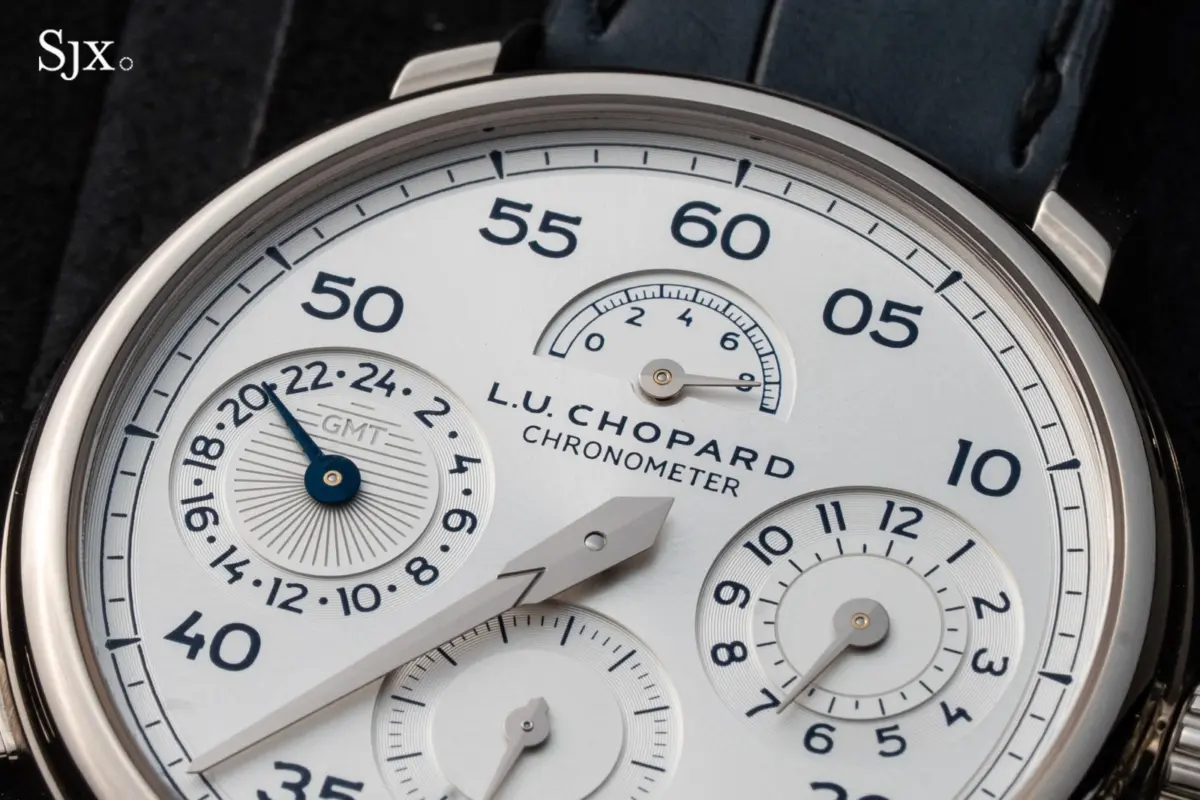
Geneva Watch Days has consistently served as a vital stage for independent watchmaking and high-end horological novelties, and one of the most compelling releases to emerge from the recent exhibition is the Chopard L.U.C 1963 Heritage Regulator. While this timepiece is not an entirely new foundational model for the Maison, it arrives with a series of deeply considered, highly welcome updates. These modifications include a more compact and wearable case size alongside a significantly more refined dial layout, one that subtly evokes the aesthetic of a classic vintage automotive instrument panel.
Beneath this overhauled exterior, the reliable L.U.C 98.02-L hand-wound movement remains firmly in service. This sophisticated calibre retains both its Official Swiss Chronometer Testing Institute (COSC) chronometer certification and the prestigious Poinçon de Genève, or Geneva Seal. Furthermore, the high-end movement continues to deliver an exceptional nine days of power reserve while maintaining the exemplary level of decorative finishing that has come to define Chopard’s high-end L.U.C collections.
Initial Thoughts and Heritage
Chopard has long established itself as a dedicated steward of the traditional regulator dial format, a layout historically prized for its precision timing capabilities. In fact, the introduction of the 1963 Heritage Regulator marks a significant milestone, commemorating 20 years since the Geneva-based brand unveiled its very first contemporary regulator wristwatch back in the early 2000s.

While the regulator format historically finds its roots in master clockmaking and observatory timing rooms, Chopard’s modern interpretation carries a distinct aesthetic that recalls an automotive dashboard. This design direction is perhaps far from accidental, given that Chopard co-president Karl-Friedrich Scheufele is widely recognized within the industry for his deep affinity and active participation in vintage car collecting and racing.
This latest iteration represents a substantial evolution and visual improvement over prior generations of the line. Through a series of careful adjustments, the brand has successfully crafted a package that feels far more wearable, balanced, and visually uncluttered on the wrist. The watch projects an undeniable sense of high-end quality, underscored by an expensive bill of materials and meticulous execution throughout every visible component.
Priced at approximately US$50,900 excluding local taxes, the L.U.C 1963 Heritage Regulator is issued as a strictly limited edition. Production is capped at a concise run of just 25 pieces, crafted entirely from ethically sourced 18-karat white gold under Chopard’s broader commitment to sustainable luxury. By contemporary Swiss watchmaking standards, the positioning is a reasonable proposition for a high-complication precious metal piece with independent Geneva Seal certification, though it places the watch slightly above the current going rate for a comparable secondary-market Patek Philippe reference 5235G regulator.

Myriad Improvements Over Past Generations
The L.U.C 1963 Heritage Regulator serves as a direct and thoughtful evolution of the original L.U.C Regulator family that Chopard introduced to the market in 2015. Objectively, the most prominent and impactful improvements center on the ergonomics of the case, which has been successfully reduced in diameter from a somewhat imposing 43 millimeters down to a much more versatile 40 millimeters, alongside a slight extension of the total power reserve.
The reduction in overall case dimensions has also triggered a cascade of secondary benefits for the dial architecture, most notably the elimination of superfluous explanatory labels previously printed above the seconds and hours sub-dials. The presence of these text labels on earlier L.U.C Regulator models had occasionally drawn critique for being redundant, as the functions of the respective registers are inherently self-explanatory. The sub-dial tracking up to 12 hours is self-evidently an hours display, while the hand that maintains constant motion can only logically be the running seconds.
While the "GMT" text label for the second time-zone display is retained—a pragmatic choice, as a secondary time zone could reasonably be mistaken for a day/night indicator—the execution has been vastly improved. The new embossed text is rendered with a subtlety and attractiveness that vastly outshines the printed markings found on the original reference. Additionally, the integrated date window has been intelligently relocated directly into the six-o’clock sub-dial, resulting in a remarkably harmonious and balanced visual layout from top to bottom.

The architecture of the 18-karat white gold case has similarly been refined, featuring a more rounded, organic profile in contrast to the flatter, slab-sided case flanks found on some of its stablemates within the broader L.U.C catalogue. One particularly clever structural detail on the case back is the integration of a distinctive "stadium" spacer ring that encircles the movement. This ring serves a protective function by housing vital case-back engravings, including the unique serial number, the Geneva hallmark, and various precious metal hallmarks, safely recessed beneath the plane of the sapphire crystal display back.
This ingenious engineering choice ensures that these critical legal and certification markings remain fully shielded against both everyday micro-scratches and the potential hazards of future case polishing, guaranteeing they will remain crisp and legible throughout the entire lifecycle of the timepiece. Perhaps in recognition of its visibility, noticeable care has been dedicated to selecting an elegant, refined font that is cleanly machined directly into the surface of the spacer ring.
Quattro Technology and Movement Mechanics
At the mechanical heart of the timepiece beats the caliber L.U.C 98.02-L, a movement that harnesses Chopard’s proprietary Quattro technology. This innovative system utilizes four distinct mainspring barrels configured in series, working in tandem to accumulate and safely distribute enough stored energy to power the 1963 Heritage Regulator for up to nine consecutive days. This extended power reserve is particularly impressive when considered alongside the movement’s brisk operating frequency of 4 Hz, or 28,800 vibrations per hour, a rate chosen to help maintain superior rate stability during daily wear.

Naturally, horological engineering involves balancing physics, and achieving a prolonged power reserve at such a high operational frequency dictates certain design trade-offs. In this instance, the configuration necessitates a relatively compact balance wheel. Nevertheless, the oscillator itself is crafted with exceptional attention to detail, featuring a traditional overcoil hairspring and a micrometric swan’s neck regulator for precise timing adjustments.
The movement is additionally certified as an official COSC chronometer. It stands as one of the longest-autonomy mechanical movements ever routinely submitted for independent chronometer certification, rivaled historically only by select high-end creations such as the Patek Philippe caliber T 28-20 REC 10J PS IRM powering the reference 5101 ten-day tourbillon.
While standard chronometer testing protocols do not formally validate rate performance continuously across the entire span of a multi-day power reserve, the fact that the L.U.C 98.02-L successfully achieves certification with its full nine-day capacity wound speaks volumes about the torque consistency and stability engineered into the Quattro system.

For international travelers, a discreet, low-profile corrector pusher set flush into the case band at the eight o’clock position allows the wearer to advance the GMT hand independently in one-hour increments. This configuration means the complication is fundamentally optimized for tracking a secondary time zone from afar rather than swiftly jumping local hours when crossing geographical borders—classifying it functionally as a "caller" GMT. While the integrated pusher makes adjusting the second time zone straightforward, the tactile feedback upon actuation could arguably offer a firmer, more positive click, as the current feel is somewhat soft.
From an aesthetic standpoint, the L.U.C 98.02-L stands as a textbook example of industrial haute horlogerie executed at the highest tier. The movement easily qualifies for the Geneva Seal, a rigorous regional certification whose legal standards now encompass the holistic finishing and integrity of the case and dial as well as the internal mechanics. However, Chopard’s hand-finishing visibly transcends the mandatory baseline requirements of the hallmark.
The machine-cut bevels and anglage executed around the barrel pivots gleam brightly under direct light, matching the polished steel components of the balance cock. The text inscriptions engraved into the movement bridges are deeply milled with sharp, clean serifs, while the Geneva striping (Côtes de Genève) across the bridges exhibits a soft, luxurious luster that rounds out an immaculate mechanical presentation.

Key Facts and Price
Chopard L.U.C 1963 Heritage Regulator
Ref. 161993-1001
Diameter: 40 mm
Height: 10.3 mm
Material: 18k white gold
Crystal: Sapphire
Water resistance: 30 m
Movement: L.U.C 98.02-L
Functions: Hours, minutes, seconds, date, power reserve indicator, second time zone (GMT)
Winding: Hand-wound
Frequency: 28,800 beats per hour (4 Hz)
Power reserve: 9 days

Strap: Grey alligator leather strap secured with an 18k white gold pin buckle
Limited edition: 25 pieces worldwide
Availability: Exclusively through Chopard boutiques
Price: US$50,900 excluding local taxes