





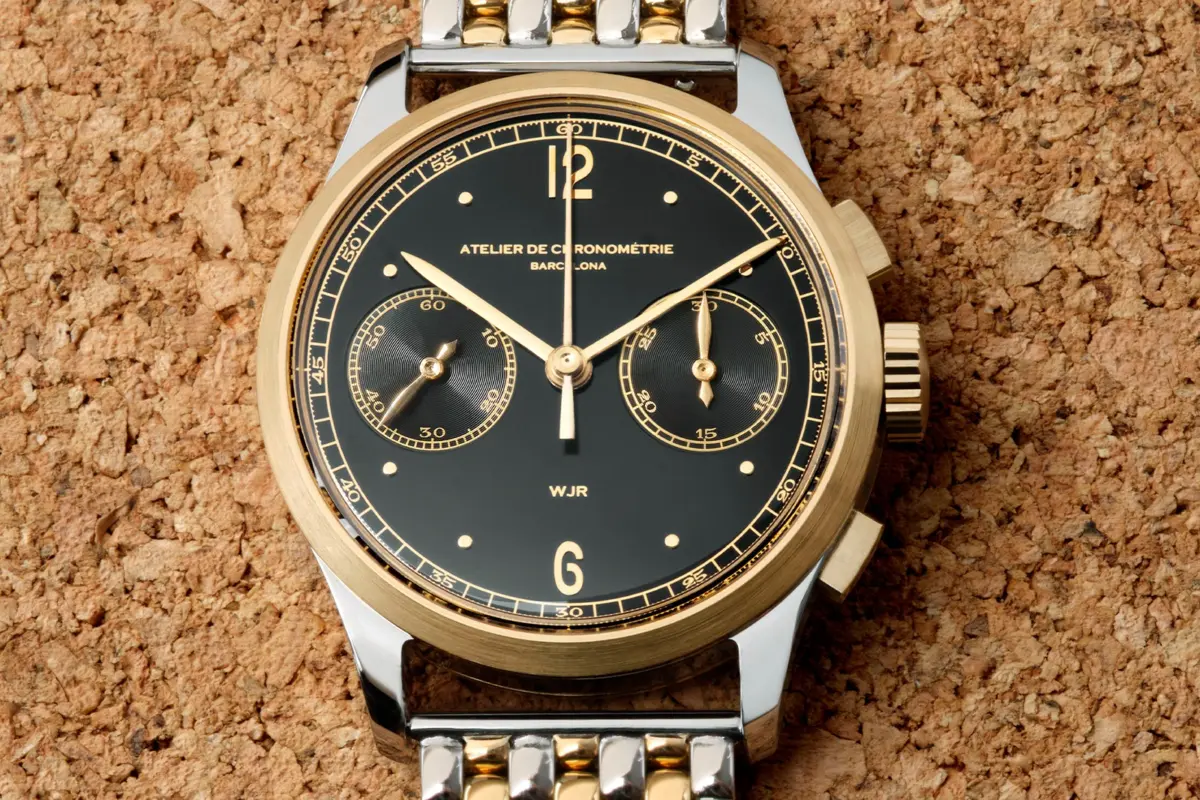
Atelier de Chronomètrie, the independent watchmaking studio now based in Andorra, has officially expanded its catalog with the introduction of its very first dual-register chronograph, the ADC16. This latest release follows the brand’s widely praised three-register rattrapantes, maintaining the meticulous, vintage-inspired ethos that has defined the independent maker since its inception. The ADC16 makes its debut as a unique, gilt-dialed commission powered by a historical Valjoux 23 movement that has been subjected to a remarkably extensive and sophisticated transformation. True to the bespoke nature of Atelier de Chronomètrie, practically every visual and mechanical element of the watch can be tailored to an individual collector’s exact preferences.
Initial thoughts
Atelier de Chronomètrie, often abbreviated as AdC, has built its stellar reputation on a foundation of bespoke, vintage-inspired timepieces that successfully combine classic aesthetics with substantive, old-world hand craftsmanship. The brand’s debut chronograph, the AdC8 Split-Seconds Chronograph launched in 2020, was an absolute sensation within elite collecting circles, and its new venture into a simple two-register chronograph proves to be nearly as ambitious and uncompromising.

The practice of sourcing, restoring, and refinishing decades-old chronograph movements is far from a new concept in high-end watchmaking. At times, the secondary and historical markets can make it seem as though there is an almost endless supply of new-old-stock Valjoux chronograph calibers waiting to be utilized. However, Atelier de Chronomètrie goes far beyond standard restoration. The independent maker substantially transforms the historical architecture to a degree that is genuinely uncommon in modern watchmaking, crafting its own redesigned bridges, manufacturing its own bespoke balance wheel, and completely replacing the stock semi-instantaneous minutes counter with a complex, instantaneous mechanism.
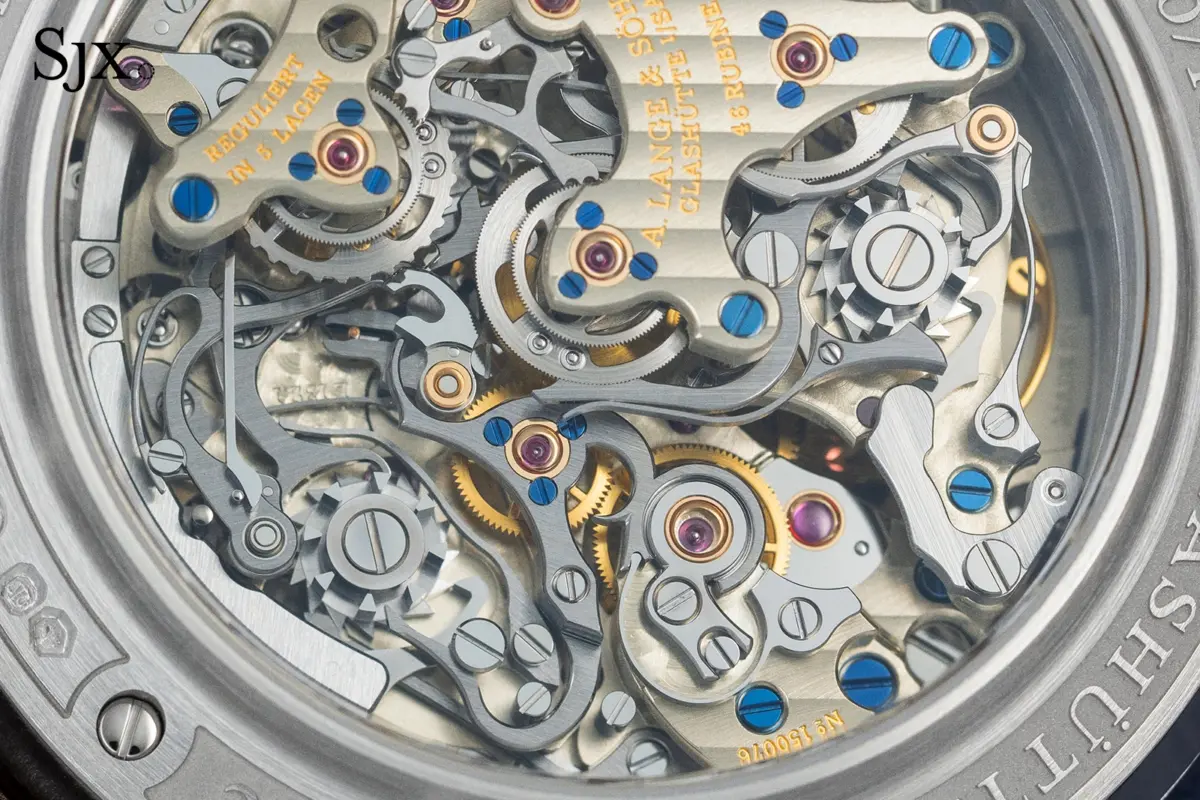
Of course, these elite-level mechanical upgrades and hand-crafted personalizations come at a substantial financial cost. With a starting price ranging from €140,000 to €150,000, AdC’s new dual-register chronograph commands a price tag significantly higher than comparable production equivalents from established heavyweights like Patek Philippe and A. Lange & Söhne. Furthermore, those major maisons often come equipped with entirely in-house developed, highly innovative modern calibers that outstrip the vintage heritage of a Valjoux base.
However, neither Patek Philippe nor A. Lange & Söhne humour the kind of deep, comprehensive customisation that forms the core of Atelier de Chronomètrie’s philosophy. This is precisely where AdC’s unique value proposition emerges, offering passionate collectors the rare opportunity to commission a truly one-of-a-kind, vintage-inspired dual-register chronograph that is finished to the most rigorous contemporary expectations of the twenty-first century.

Movement glow up
While Atelier de Chronomètrie has undeniably lavished the movement with exquisite decoration, the brand understands that ornamentation alone does not inherently make a movement mechanically superior, just as frosting alone does not make a good cake. Frivolous decoration, no matter how finely or painstakingly executed, remains merely superficial without sound underlying architecture.
Fortunately, the Valjoux 23 is a historically celebrated and robust construction, and AdC has implemented several remarkably smart upgrades for the newly designated caliber S440 that elevate the movement to an entirely new echelon. One such crucial mechanical improvement directly addresses the friction-fit chronograph driving wheel—a notable architectural quirk that often detracts from the performance and purity of many vintage chronographs.
Historically, Patek Philippe addressed this exact operational issue on its own vintage Valjoux-based movements by splitting the combined escape and fourth wheel bridge into two separate components, neatly tucking the chronograph driving wheel underneath the newly isolated fourth wheel bridge.

Similarly, Atelier de Chronomètrie has split the Valjoux 23’s combined escape and fourth wheel bridge into two separate elements, though the brand stopped short of replicating the full bridge design found on Patek Philippe’s current contemporary manually wound chronographs. AdC has also thoughtfully reshaped other critical components throughout the mechanism, including the intricate clutch bridge.
The incorporation of an instantaneous minutes counter represents another key engineering upgrade relative to the original Valjoux 23 architecture. According to horological historian François LeCoultre in A Guide to Complicated Watches, traditional watchmakers historically came to regard this instantaneous approach with a degree of skepticism due to the high parasitic friction that occurs if the tiny components are not exceptionally well-designed and fabricated. This technical challenge is precisely why the true instantaneous minute jump largely died out with the traditional pocket watch era.
That is, until A. Lange & Söhne successfully resurrected the complication with the debut of the iconic Datograph in 1999. The secret to a successful instantaneous minute mechanism lies in a remarkably light touch, with Patek Philippe famously pioneering the use of a dedicated hairspring for this specific purpose to minimize contact area and energy loss.

The instantaneous minutes counter has since become a beloved darling of the ultra-high-end segment of independent watchmaking. The aspiration even briefly seemed poised to break into the more accessible affordable market years ago with the ill-fated Eterna caliber 39 project, though it remains a hallmark of true haute horlogerie.
Movement finishing on the ADC16 is just as lavish as collectors have come to expect from the brand’s past chronographs. It features thick, lustrous hand-polished anglage outlining the frosted, palladium-plated bridges, many of which are entirely of new manufacture by the studio.
The divided chronograph seconds and minutes totaliser bridges represent the most obvious visual departures from the donor movement. This deliberate structural change successfully obscures the underlying donor architecture, though it notably reveals the unsightly friction spring for the sweep seconds that is normally hidden beneath the classic horseshoe-shaped bridge of a standard Valjoux.

The balance wheel is likewise an entirely original creation by Atelier de Chronomètrie. Fabricated from beryllium copper (BeCu) and fitted with 18k rose gold weight screws alongside platinum inertia screws, the assembly is further supplemented by a meticulously black-polished micrometric regulator.
A blued overcoil hairspring and the addition of modern shock protection round out a decidedly high-end, contemporary assortment that clearly distinguishes AdC’s sophisticated interpretation of the Valjoux 23 from any standard restoration project seen elsewhere in the industry.
Calatrava-inspired
As has become typical for Atelier de Chronomètrie, the watch takes aesthetic and structural cues from the classic Calatrava style. In this specific two-tone configuration, the case features a robust stainless steel midcase paired harmoniously with a bezel, chronograph push buttons, crown, and case back crafted entirely from solid 18k yellow gold.

If the ADC16 is anything like Atelier de Chronomètrie’s previous work, the exterior metal finishing will exhibit a radiant mirror polish. Interestingly, the traditional Calatrava-esque lug forms do not showcase this brilliant finishing to the exact same dramatic extent as the teardrop-shaped lugs chosen for some of the brand’s past chronograph references. Nevertheless, the exact same obsessive attention to detail is clearly evident in the accompanying two-tone beads of rice bracelet, which the brand meticulously fabricates by hand.
Timepieces like the ADC16 offer much of the romantic charm and visual warmth that naturally attracts collectors to vintage chronographs, but they do so while incorporating modern conveniences such as a scratch-resistant sapphire crystal and significantly superior water resistance. Naturally, a newly manufactured timepiece also offers the kind of pristine, unblemished physical condition that is virtually impossible to find within the vintage market.
Furthermore, contemporary independent workshops like Atelier de Chronomètrie provide a level of immaculate movement finishing and mechanical execution that was entirely unheard of when the original Valjoux caliber first left the factory decades ago.

A traditional gilt dial
Unambiguously vintage-inspired—with a dial layout that takes after one of the more classic configurations of the historic Vacheron Constantin reference 4072—Atelier de Chronomètrie produces its signature gilt dial the old-fashioned way. This laborious process means that all the dial markings and minute tracks are meticulously printed onto the raw gilt dial base as a protective mask before the entire base is galvanised in black. Afterward, the mask is carefully removed, exposing the warm gold underneath in striking relief.
This is the exact same historical manufacturing approach utilized by modern elite pieces such as the Daniel Roth Extra Plat Gilt. When viewed closely under magnification, the resulting aesthetic is quite different from that of most conventional modern gilt dials, which are typically produced using simple pad-printing with gold-tone ink.
All five hands are meticulously crafted in-house from solid 18k yellow gold. This includes the central sweep seconds hand, a component which many traditional watchmakers otherwise craft from blued steel simply for weight-saving purposes. The hands are pleasantly substantial with a noticeable sense of physical depth, though they are not quite as three-dimensional as the brand’s signature leaf hands used for its time-only models.

Of course, none of these specific design details are permanently set in stone. Atelier de Chronomètrie routinely works directly with individual collectors to determine the final, personalized design for the dial layout, handset materials, and case configurations. Two other unique commissions based on this new platform are expected to be unveiled publicly in the near future, with several additional custom projects currently in active development.
Key facts and price
Atelier de Chronomètrie AdC16
Diameter: 36 mm
Height: Unavailable
Material: Stainless steel and 18k yellow gold
Crystal: Sapphire
Water resistance: Unavailable

Movement: Caliber S440
Features: Hours, minutes, seconds, and chronograph
Frequency: 18,000 beats per hour (2.5 Hz)
Winding: Manual
Power reserve: 52 hours
Strap: Two-tone beads of rice bracelet, accompanied by an additional black leather strap with a stainless steel pin buckle
Limited edition: Unique piece in each individual customer configuration
Availability: Available directly from Atelier de Chronomètrie
Price: €140,000 to €150,000, depending on the extent of customisations selected