




By Dr. Zobaida Khan
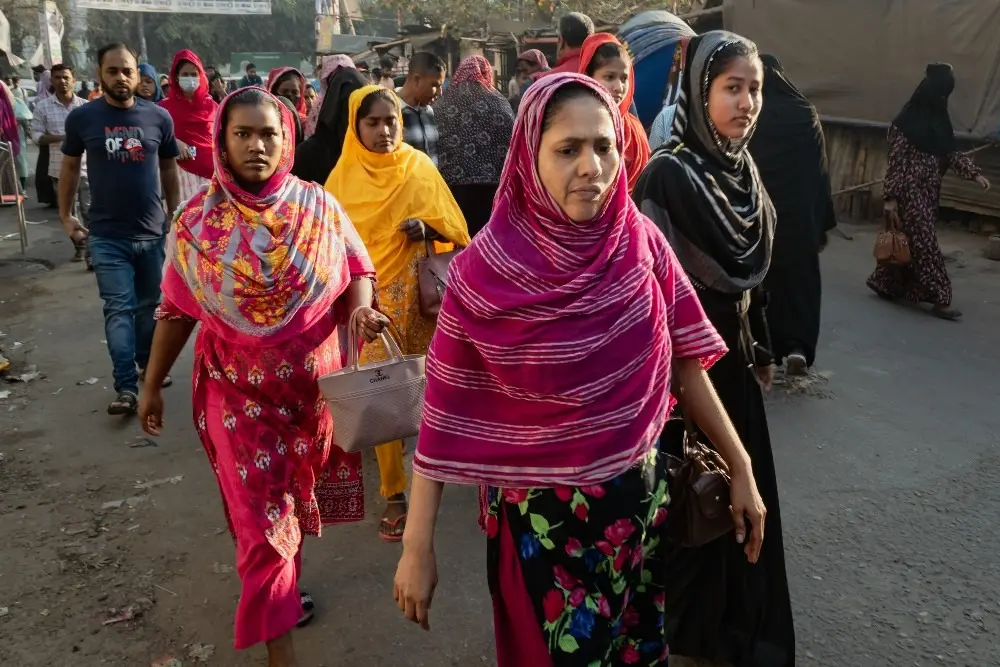
The streets of Bangladesh’s key industrial hubs have become a focal point of economic and social tension. Since August 2026, garment workers across the country have sustained ongoing protests demanding a minimum monthly wage of Tk 30,000, equivalent to roughly $241.15. This demand represents more than double the current statutory floor of Tk 12,500, or $100.48, which has remained unchanged since December 2023. As these demonstrations escalated significantly through the late weeks of October, the government responded by establishing a new Minimum Wage Board on November 1. However, the board’s scheduled deliberations have faced delays, with a meeting originally set for November 16 postponed to November 23, leaving workers and industry observers waiting anxiously for a resolution.
Despite the widespread disruption and the critical nature of the negotiations, the international fashion brands and major retail corporations that purchase the vast majority of these garments have remained remarkably silent. When Sourcing Journal reached out to nearly 30 major global buyers for comment on the unfolding situation, only a handful responded. Those that did reply offered only vague, generalized statements regarding collective bargaining or monitoring ongoing developments, choosing to avoid taking a definitive stance on the specific wage demands put forward by the labor force.
A Minimum Wage Is Not a Living Wage
The core of the dispute highlights a fundamental discrepancy between legal compliance and human necessity. In 2024, a tripartite gathering of governments, employers, and workers facilitated by the International Labor Organization (ILO) established a clear definition for a living wage. According to the ILO, a living wage is remuneration sufficient to afford a decent standard of living for workers and their families, taking fully into account local economic circumstances, average family size, and normal working hours.
In contrast, a legal minimum wage serves strictly as a statutory floor, offering no guarantee that a worker’s family can meet their basic needs. Data compiled by the Global Living Wage Coalition places the estimated 2025 living wage for Dhaka City at Tk 30,459, or approximately $244.84 per month. The current legal minimum wage for garment workers in Bangladesh accounts for a mere 41 percent of that necessary benchmark.
For years, international buyers have maintained that they comply fully with local labor laws whenever their contracted suppliers pay the statutory minimum wage. Yet this defense raises profound ethical and structural questions about corporate responsibility. What obligation do major brands bear when the legally mandated minimum falls drastically short of a true living wage? Do these corporations share a responsibility to adjust their purchasing prices to enable suppliers to pay adequate wages?
Findings from the Clean Clothes Campaign’s (CCC) 2026 Fashion Checker provide troubling insight into corporate accountability. Assessing 110 global buyers, the report found that while 32 percent of companies had made formal commitments toward achieving a living wage, only 4 percent could report tangible progress toward that goal. Furthermore, a mere 3 percent disclosed the actual wages paid at their suppliers’ facilities. Workers surveyed in Bangladesh reported earning an average of 73 percent below the CCC’s calculated living-wage benchmark.
Separate research conducted by the Clean Clothes Campaign and Public Eye revealed an even more alarming trend: inflation-adjusted sourcing prices paid for cotton T-shirts manufactured in Bangladesh have declined by as much as 30 percent over roughly two decades. These empirical findings challenge the narrative promoted by brands that their supply chains are managed through responsible and ethical sourcing practices.
Buyers Can Help Close the Gap
While the apparel sector lags behind, examples from other industries demonstrate that achieving living wages within global supply chains is entirely possible when companies alter their purchasing strategies. Dutch chocolate manufacturer Tony’s Chocolonely, for instance, implements a system where it pays cocoa farmers a financial premium on top of the prevailing market price. The company recalculates this premium annually to reflect changing economic realities, disbursing more than 3.7 million euros, or roughly $4 million, in premiums during the 2024–2025 period.
Practical guidance and analytical tools for calculating and implementing living wages already exist across the global trade landscape. Frameworks such as the Road Map to an Asia Floor Wage, Oxfam’s Getting to a Living Wage: Recommendations for Brands, A Sewing Kit for Living Wages, and the Ethical Trading Initiative’s (ETI) Living Wages in Global Supply Chains offer comprehensive methodologies. Consequently, the primary barrier to progress is not a lack of policy statements or calculation tools, but rather a persistent lack of purchasing commitments from buyers to support those policies financially.
Poverty Wages Feed Forced and Child Labor
The issue of a living wage is inextricably linked to the ethical sourcing claims made by international brands. Providing a living wage stands as one of the most effective structural defenses against severe labor abuses that brands publicly claim to prohibit, including forced labor and child labor. In numerous jurisdictions, multinational corporations face strict legal reporting requirements regarding their efforts to eliminate forced and child labor from their supply chains. Despite these obligations, the systemic consequences of poverty-level wages are extensively documented.
The Ethical Trading Initiative points out that when workers are denied a living wage, they are frequently compelled to endure excessive overtime, take on multiple jobs, fall into cycles of bonded debt, or pull their children out of school and send them into the workforce to supplement household income. Wages that sit far below the cost of living actively drive coercive work environments and child labor. This dynamic is underscored by Walk Free, which cites research from Oxfam Australia revealing that all 472 Bangladeshi garment workers interviewed in a comprehensive study earned below a living wage.
Conversely, paying workers a living wage yields clear operational benefits, including enhanced productivity and greater labor retention. A survey of accredited Living Wage employers conducted in the United Kingdom found that 86 percent of businesses experienced an improvement in their reputation as an employer. Among larger organizations with more than 500 staff members, 76 percent reported better worker retention rates, and 78 percent noted significantly higher employee motivation.
Zero Tolerance Policies on Forced and Child Labor Need a Wage Policy
Failing to pay a living wage is not legally synonymous with engaging in forced or child labor. Nevertheless, nearly every major apparel brand publishes a formal policy declaring a strict "zero tolerance" stance toward forced and child labor within its operational footprint. Given that the direct link between poverty wages and these severe abuses is thoroughly documented, industry analysts increasingly question how brands can maintain claims of zero tolerance while remaining largely indifferent to wage structures that make such exploitation predictable and widespread.
Factory audits and routine risk assessments cannot compensate for sourcing prices that leave suppliers with virtually no financial margin to raise wages. While direct suppliers remain legally responsible for paying their workers, international buyers hold the ultimate economic leverage to determine the financial terms of production. Brands that champion responsible or ethical sourcing must align their purchasing prices and procurement policies with their suppliers’ obligations to pay a living wage.
This alignment requires ring-fencing labor costs within the final prices paid to factories, ensuring that any mandated wage increase is fully absorbed rather than squeezed out of factory profit margins. It also requires a firm commitment from buyers to maintain their sourcing relationships in Bangladesh after a new minimum wage takes effect.
While the wage board deliberates, international brands need to make public commitments that they will absorb the financial impact of a wage settlement approaching the living-wage benchmark. Recent steps taken by companies like H&M—which committed to updating its internal costing tools automatically once a new legal wage is established—illustrate a practical mechanism, though covering the legal minimum wage remains distinct from committing to a true living wage.
How We Got Here
The widespread silence from major international brands is symptomatic of a liberalized market framework built on globalized production systems. Over recent decades, capital owners secured the freedom to source manufactured goods from regions where labor and environmental regulations, along with their enforcement, were weakest. In this environment, international competitiveness became synonymous with cheap and flexible sourcing policies. Within a labor-intensive production model, independent suppliers are forced to rely on depressed wages and minimal operational costs simply to remain commercially viable.
This liberal market approach is also reflected in international labor law, which historically established a sharp distinction between core rights and redistributive rights. The 1998 ILO Declaration on Fundamental Principles and Rights at Work emphasized core standards, treating freedom of association and collective bargaining primarily as enabling rights designed to help workers organize and bargain for fair conditions.
Prominent labor law scholars, including Philip Alston, have long warned that this framework effectively downgraded the redistributive rights that give enabling rights their practical meaning. A safe and healthy working environment was incorporated into the core fundamental principles only in 2022—nine years after the Rana Plaza disaster. A living wage remains conspicuously absent from the list.
Ultimately, the globalized production system has consistently ignored imbalances of power. In settings where international buyers retain the mobility to shift their orders to alternative countries at a moment’s notice, and where local labor unions face persistent repression, collective bargaining struggles to deliver a living wage. Instead, it frequently fosters a race to the bottom in which vulnerable workers underbid one another simply to secure employment.
Legal and Ethical Accountability
The landscape governing corporate accountability is undergoing a gradual shift. The European Union’s Corporate Sustainability Due Diligence Directive explicitly lists an adequate living wage among the rights that in-scope companies must identify and address. Although the 2026 omnibus amendments narrowed the directive’s overall scope, delayed its full application until July 2029, and removed an EU-wide civil liability regime in favor of national laws, the regulatory direction remains clear. Even without mandating a specific universal wage figure, the directive establishes wage adequacy as a legitimate due-diligence concern for major corporations.
In the United States, similar legal pressures are emerging. Under the Trafficking Victims Protection Reauthorization Act, U.S.-based companies can face lawsuits if they knowingly benefit from commercial ventures that engaged in forced labor, or if they should have known about such practices. If an apparel brand is fully aware that its suppliers pay wages far below the cost of living and understands the well-documented connection between poverty wages and forced labor, questions arise regarding whether that brand can claim it has fulfilled adequate due diligence obligations.
While low wages alone do not automatically establish forced labor or legal liability, discovering clear indicators of coercion prevents a buyer from treating compliance with the statutory minimum wage as the end of its inquiry.
Claims regarding responsible or ethical sourcing are also facing rigorous scrutiny in courts. A federal judge in Washington is currently weighing Starbucks’ motion to dismiss a class-action lawsuit challenging its "100 percent ethical" sourcing labels, following a similar ruling by a D.C. judge in 2025. In April 2026, the Clean Clothes Campaign filed a lawsuit against Levi Strauss & Co., alleging misleading statements regarding supply chain conditions, while a separate legal complaint in Washington, D.C., targets Nestlé over zero-tolerance claims related to child labor.
Although these legal challenges have yet to result in formal findings of liability, they signal a growing intolerance for unsubstantiated marketing claims. Brands that advertise rigorous due diligence and ethical sourcing while knowingly procuring goods from factories that pay poverty wages face substantial legal liabilities alongside reputational risks.
Government Action and Brand Commitments Must Go Together
Living wage commitments initiated voluntarily by international buyers cannot reach every tier of the workforce. Informal subcontractors and smaller factories operating outside the primary export supply chains will not benefit directly from buyers’ responsible purchasing prices. Because the lowest wages and most severe forms of exploitation frequently occur within these informal sectors—where brand audits rarely reach—it remains essential for national governments to establish a fair statutory wage floor that reflects realistic living costs.
Nevertheless, if international brands are genuinely committed to the integrity of their public due diligence reports and ethical sourcing claims, they must back living wages by integrating them directly into their purchasing terms and pricing structures. As the Bangladeshi wage board deliberates on the new minimum wage, international buyers should publicly support the workers’ proposal of Tk 30,000, commit to maintaining their sourcing footprints in the country, and adjust the prices they pay to reflect higher labor costs.
While these measures alone will not resolve every systemic labor challenge within the global supply chain, they would provide substantive meaning to corporate commitments and help ensure that workers share equitably in the benefits of a new wage structure.