





When New Yorkers land in Los Angeles, the first thing that invariably rattles them is the quiet realization of a deceptively simple question: “Where is everyone?” Unlike the bustling, pedestrian-packed sidewalks of Manhattan, life in Los Angeles tends to unfold within closely guarded bubbles. It is a deeply insular city by design, dictated by geography, sprawl, and the ubiquitous automobile—or, for the younger Gen Z set, a Waymo gliding quietly down the boulevard. Over time, however, newcomers and longtime residents alike learn to adapt. You curate your own personal constellation of favorite haunts, neighborhoods, and hidden corners, navigating between them from the interior of another mobile bubble: your car.
Holland Denvir set out to tackle that spatial and social fragmentation head-on in 2024 when they co-founded LA Design Week/end (LAD/W) alongside Meghan McNeer, who serves as the festival’s creative director. Now celebrating its third consecutive year, the festival has quickly established itself as a vital anchor for the region’s artistic ecosystem. During the first week of October, the 2026 edition successfully brought together more than 130 independent designers, design studios, art galleries, and major brands spread across more than 15 distinct Los Angeles neighborhoods. Rather than pulling crowds solely toward the traditional tourist magnets of the coastline or the Hollywood sign, LAD/W drew thousands of locals and curious visitors deep into the urban fabric to discover what truly makes the city tick: its sprawling, multifaceted creative community.

Attempting to make the complete rounds at all participating studios in a single week is an exercise in overwhelming ambition. Yet, much like flipping through the pages of a Choose Your Own Adventure book, the genuine delight of the festival lies in discovering just how many different versions of the event you can curate for yourself.
My journey through LA Design Week/end 2026 began at Small Green Door (SGD), a vibrant creative studio complex tucked away within an unassuming cluster of industrial warehouses on the single tree-lined street in the industrial zone of Boyle Heights. Stepping into the sunlit courtyard, I was warmly greeted by a friendly wave from someone who turned out to be Denvir. Shortly after, we connected with SGD co-founder Leo Estévez, who graciously offered a comprehensive walking tour of the sprawling complex. The multifaceted space houses dedicated artist workspaces, an advanced research and development kitchen, several rotating galleries, and even an unexpected underground bunker.

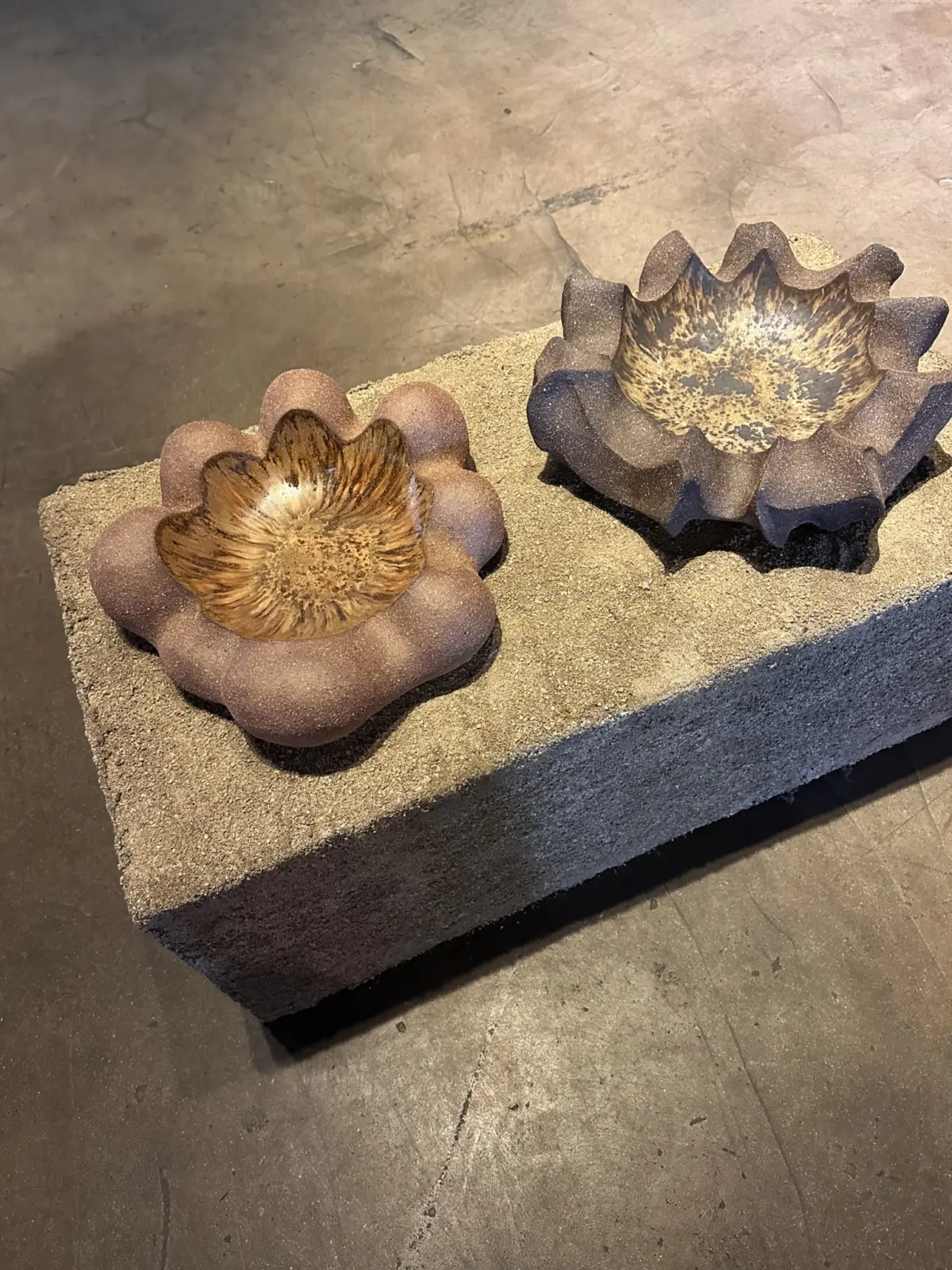
Among the exhibition highlights at SGD was After the Tide, an open-call group show curated by Nadia Khagani and Rose Zhang. The exhibition gathered 19 artists and designers whose work is deeply influenced by the raw, unpredictable forces of nature. The room was dominated by ceramics, many bearing a striking, gothic edge. A hypnotic sonic water installation crafted by Edge Sound Research provided an ambient, grounding acoustic layer to the presentation, complementing a series of custom sand pedestals fabricated right on-site. Circulating through the sea of sand-filled displays, the exhibition sparked immediate sensory connections—so much so that I found myself imagining the bay scallop and pineapple guava aguachile I would eagerly serve inside Kimberly Meyer’s shallow clay bowls, which were prominently featured in the show. Before departing, Estévez handed out retro cassette cases filled with miniature zines. Evoking the spirit of a secret neighborhood skate spot from decades past, each cassette case concealed a hidden green key rumored to grant future access to the studio.
Following the morning studio visits, Holland Denvir and I sat down for lunch at Henrietta, a charming neighborhood spot in Echo Park. Housed in an unassuming brick storefront, Henrietta functions as a market-driven sandwich shop by day and a sophisticated California bistro by night under the leadership of owner Mark Lesser. Over lunch, Lesser shared stories of growing up amidst the cardboard boxes in the storage room of his mother’s toy store back east, and detailed the painstaking, arduous process of sourcing the understated tiles that line the restaurant’s counter façade. Henrietta operates as a quintessential neighborhood anchor, featuring a gourmet bodega corner stocked with giftable olive oils, artisanal chocolate bars, and carefully curated bottles of wine. Yet, it was the mountainous, snowy Parmesan-capped radicchio salad and the decadent, impossible-to-leave-unfinished fried smashed potatoes that left a lasting impression.

Between courses, Denvir elaborated on the core philosophy driving LAD/W’s decentralized approach. The goal, they explained, is to ensure the festival remains genuinely accessible to everyone, whether they work professionally in the design industry or are simply design enthusiasts. The aim is to create pathways for people to discover and forge direct connections with the creatives who give Los Angeles its distinct cultural identity.
This ethos explains why the festival format is deliberately decentralized. Rather than anchoring itself inside a sterile convention center or confining operations to a single designated design district, LAD/W unfolds organically across the metropolis. Each day focuses on one specific neighborhood or a tightly clustered group of Eastside communities, with events scheduled to allow attendees to navigate easily on foot, by bicycle, scooter, or via the Metro system.

"Leave your car at home? In LA?" I asked Holland with a mix of skepticism and amusement.
"I want every moment you spend participating to be about discovery and connection, not sitting in your car in traffic; we can do that any other day of the week," they replied.

To prove that exact point, our lunch was followed by a short walk down the block to view Our Joy is Resistance at Alabaster Gallery, hosted by Enzo. But what followed immediately after embodied the serendipitous charm that makes living in Los Angeles so rewarding.
Our next stop brought us to the Living Paul McCobb Museum, where I met Yogi Proctor and, later that evening, his wife, documentary filmmaker Carol Martori. Proctor, a British transplant who originally relocated to the United States through a passion for skateboarding, transformed a private obsession into a living museum dedicated entirely to collecting, preserving, and studying industrial designer Paul McCobb’s iconic 1950s Planner Group furniture and its accompanying accessory lines.

During the 1950s, Paul McCobb’s name was universally synonymous with modern, American-made furniture. Operating out of Manhattan, McCobb was among the first designers to recognize the value of a designer’s signature as an independent brand, utilizing a watermark stamp and later a foil mark to make his pieces instantly recognizable. Proctor’s collection began modestly after he encountered a McCobb piece while living in Chicago. After two decades of dedicated collecting, his midcentury Silver Lake home—built originally in 1949 and meticulously remodeled in 2017—now houses roughly a third of his massive archive.
Walking through the domestic museum space feels like an immersion in midcentury history, with McCobb designs stacked and arranged seamlessly throughout the rooms. Searching for non-McCobb items became a playful challenge: a lone cat sculpture near the front entrance, a towering wall of books in the study, and personal anniversary cards resting on a nightstand. In the living room, however, the eye was immediately drawn to the vibrant colors and remarkably minimal shapes of the Contempri tableware and functional objects on display. Proctor noted that back in 1957, McCobb collaborated closely with porcelain manufacturers in Japan to pioneer early iterations of dishwasher-safe porcelain tableware. Our conversation naturally drifted toward the unique challenges of maintaining a "living" museum—namely, navigating the inevitable wear and tear that comes with actively using historic objects in daily life. I confessed my own hesitation to use my Wilhelm Wagenfeld-designed Kubus glass storage jars for fear of chipping them, though as McCobb’s work proves, the designs are simply too brilliant to remain locked away behind glass.

From Silver Lake, I made my way toward the Silver Lake Reservoir to visit the Neutra VDL Studio and Residences, the former home and studio of architect Richard Neutra. Now a designated National Historic Landmark and house museum dedicated to education, architecture, art, and culture, the historic site hosted Companionship, an exhibition mounted by the Yamaha Design Laboratory—the company’s in-house design division established in 1963. The exhibit thoughtfully positioned musical instruments not merely as tools, but as lifelong companions that stay by one’s side through the years, distributing ten distinct design works and instruments throughout the modernist spaces for visitors to explore.
On the ground floor, visitors met multimedia artist and photographer Johnny Le, who served as the exhibition’s guest curator. Le’s striking photographs, captured inside Yamaha’s corporate headquarters and piano manufacturing plant in Japan, offered a mesmerizing exploded overhead perspective of every single component required to build a Yamaha piano. Moving upstairs, visitors encountered innovative guitar stand-stools designed specifically to integrate musical instruments smoothly into domestic living spaces, alongside the modern TransAcoustic guitar, which is capable of playing audio via Bluetooth integration.

The exhibition also marked the first public showing of a prototype titled Dreaming of the Sea, a low seating design developed in collaboration with Karimoku Case. The chair generates soothing, wave-like acoustic sounds when a user sits on the cushion and shifts gently, causing small internal metal balls to roll and rub against one another, mimicking the transition from crashing ocean waves to quiet shoreline ripples. The visit concluded on the roof, where Manabu Kawada’s installation, The Backrest for Sky Viewers, invited guests to lean back against a simple wooden plank, look up at the expansive Southern California sky, and reflect on the quiet beauty of the world.
As evening approached, the destination shifted to the Haas Brothers studio for an energetic gathering. True to form, the building’s industrial exterior gave no hint of the whimsical interior awaiting inside, where playful, imaginative sculptures were scattered casually throughout the active fabrication workshop where they were brought to life.

Food displays conceptualized by Zehra Ahmed proved just as sculptural and interactive as the surrounding artwork. Running across a suede-like tablecloth, two serpentine sandwiches made from braided brioche stretched more than ten feet long, punctuated by a neat row of long-stemmed roses. The meticulous execution—splitting and lacing the braided loaves to form a continuous culinary runner—was a masterclass in food design. Dessert featured a rectangular bed of sugar-dusted doughnut holes accompanied by three dipping sauces served on pedestals. The evening culminated on the back patio, where guests gathered around freshly baked wood-fired pizzas and natural wines.
Another standout exhibition of the week was Los Angeles Sets a Table hosted at Ravenhill Studio. The presentation featured two expansive dining tables representing dawn and dusk respectively, utilizing contrasting color palettes to showcase a diverse array of handmade objects. Conceived initially by Cathy Callahan back in 2019, the tablescape exhibition finally materialized under the guidance of curators Chelito Villaflor and Chris Albanese of Thought Forms Studio, celebrating the enduring power of gathering in person around handmade craft.

If this third edition of LA Design Week/end demonstrated anything definitively, it is that Los Angeles’ creative community can successfully build deep, meaningful connections without relying on a centralized convention center. By coaxing residents out of their familiar neighborhood bubbles and encouraging them to stroll through someone else’s, the festival fostered a rare sense of urban cohesion. Though many attendees were lifelong Angelenos, the recurring sentiment across the week’s studio visits was the shared pleasure of experiencing familiar neighborhoods through an entirely fresh, creative lens.