





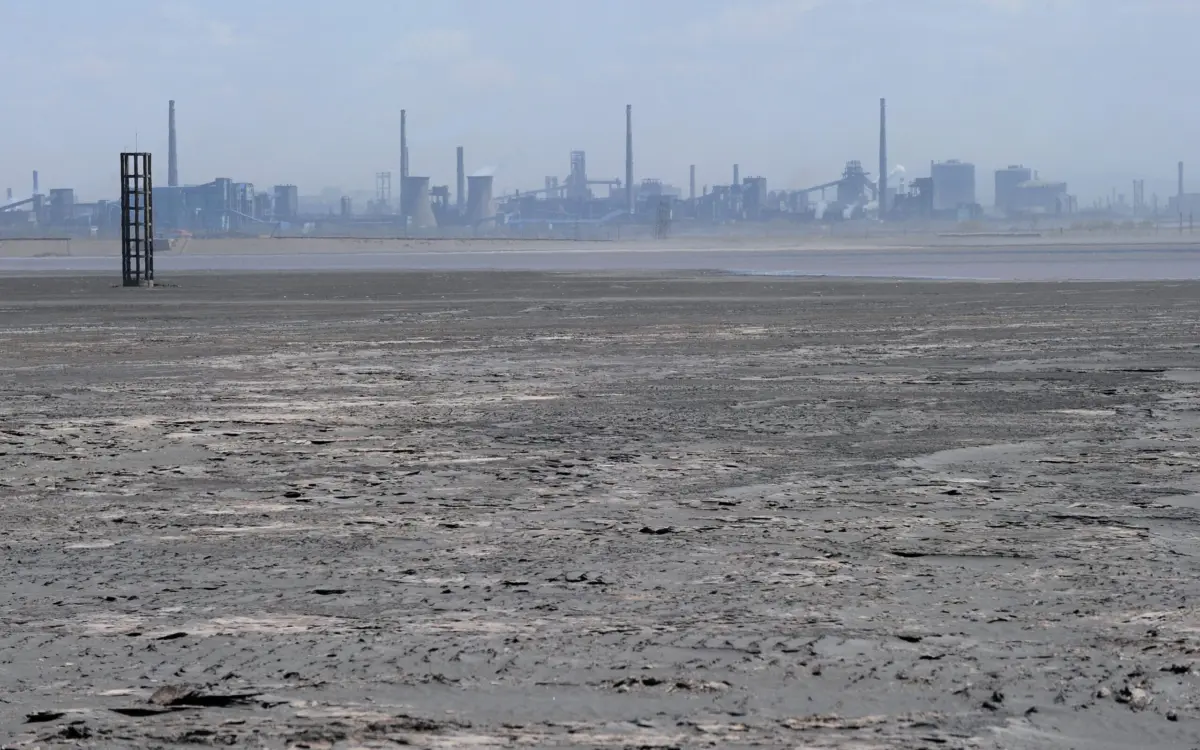
One of the singular features of Baotou, an industrial city of 2 million people situated in China’s Inner Mongolia autonomous region, is a sprawling, 10-square-kilometer (4-square-mile) artificial lake that ranks among the most polluted bodies of water on the planet. Officially referred to by the name of the massive dam associated with it, the Weikuang Dam—also widely known as the Baogang Tailings Dam—has served for decades as the ultimate resting place for the heavy effluent generated by the mineral processing sector powering China’s globally dominant iron, steel, and rare-earths industries.
Built during the late 1950s as a cornerstone of China’s rapid industrialization, the lake contains a highly toxic stew of industrial chemicals combined with substantial amounts of radioactive thorium. This radioactive component is the byproduct of processing monazite ores, which are heavily relied upon for the extraction of critical rare-earth elements. In the decades since the dam’s creation, China has significantly tightened its domestic environmental regulations, placing stringent restrictions on mining and mineral processing facilities nationwide.
The legacy of the Weikuang Dam disaster heavily influences modern Chinese industrial policy. Today, the country does not permit the development or operation of stand-alone monazite mines—meaning facilities where nothing is mined except monazite ore itself. Because of the severe environmental hazards associated with managing radioactive waste and acidic chemical byproducts, the state strictly controls how monazite is extracted and processed, integrating it into broader, multi-mineral mining operations where regulatory oversight can be more centrally managed.
Now, as industrialized nations across North America, Asia, and Europe inject billions of dollars into their domestic economies to shore up vulnerable rare-earths supply chains, many Western governments and corporations are placing their bets on monazite to help them break free from foreign dependence. As these nations ramp up their efforts, China’s decades-long history and deep accumulated experience with monazite offer critical lessons about the immense technical, environmental, and geopolitical challenges inherent in controlling this vital resource.
Monazite ore remains a foundational pillar of China’s unparalleled rare-earths industry because it serves as a prime, indispensable source for some of the less common but exceptionally vital rare-earth elements. Most notably, monazite is rich in dysprosium, terbium, yttrium, and erbium—elements that are absolutely essential for the manufacturing of high-strength permanent magnets used in electric vehicles, wind turbines, advanced defense systems, and consumer electronics. To maintain its dominance, China not only mines and processes vast quantities of domestic monazite ore but also imports massive amounts of the mineral from international sources for domestic refinement.
The vast majority of the monazite ore mined domestically in China comes from a single colossal source: the mammoth Bayan Obo complex, located roughly 150 kilometers north of Baotou in Inner Mongolia. Bayan Obo is primarily operated as an iron-ore mine, but it happens to also contain the single largest known rare-earth deposit anywhere in the world. It is the source of nearly half of all the rare-earth ore mined on the planet in any given year.
The primary rare-earth mineral mined at Bayan Obo is bastnaesite. It is the large-scale commercial mining of that bastnaesite that legally permits and facilitates the co-extraction of monazite ore at the Bayan Obo site. All told, ore extracted from the Bayan Obo complex was used to produce an astonishing 170,000 tonnes of rare-earth metal last year, according to David Merriman, research director at the specialized minerals intelligence firm Project Blue. Industry data indicates that roughly 30 percent to 40 percent of the rare-earth ore mined at Bayan Obo is monazite. That massive domestic volume alone would be more than enough to establish China as the world’s leading processor of monazite for rare-earths.
China’s 2025 Monazite Imports Topped 70,000 Tonnes
However, a far more complete and detailed picture of China’s enduring strategic interest in monazite emerges when examining the country’s robust importation of the ore from foreign nations. Last year, China’s imports of monazite ore amounted to more than 70,000 tonnes, according to Thomas Kruemmer, a Singapore-based consultant specializing in international minerals and metals markets.
That import figure becomes even more impressive and telling when considering the unique logistical and regulatory challenges associated with shipping monazite by sea. Because of its inherent natural radioactivity, concentrated monazite ore is strictly classified as Class 7 dangerous cargo under the rigorous International Maritime Dangerous Goods Code. Because of this hazardous classification, Kruemmer points out that the radioactive ore can legally be imported through only four designated ports across the entirety of China.
Furthermore, regulatory frameworks dictate that the importation of certain types of monazite into China is supposed to be channeled through a specialized joint venture consisting of the China National Nuclear Corp. and Shenghe Resources, both of which maintain partial or total state ownership. However, a significant volume of imported monazite bypasses those specific state-backed organizations entirely, as Merriman notes.
This happens because heavy mineral sands, which typically contain roughly 2 percent or 3 percent monazite by total weight, are not subjected to the exact same stringent import controls and quotas as concentrated monazite ore. Consequently, industrial processing companies import these bulk heavy mineral sands, separate out various profitable commercial concentrates—including the monazite mineral concentrate—and subsequently process that extracted monazite concentrate to recover the high-value rare-earth elements.
In recent months and years, China has stepped up its aggressive efforts to secure rare-earth ore supplies and mining rights around the world. One primary reason for this renewed international push, Kruemmer explains, is simply to make up for recently lost supply volumes and changing geopolitical alignments.
For instance, in 2025, the U.S. government invested a substantial US $400 million in MP Materials, the domestic company that operates the Mountain Pass mine and rare-earth processing facility located in California. That landmark financial deal effectively put an end to long-standing commercial contracts under which MP Materials had been selling tens of thousands of tonnes of rare-earth concentrate annually to a trading affiliate of Shenghe Resources, cutting off a major feed stream for Chinese processors.
At the same time, Western industry observers and geopolitical analysts speculate that China maintains broader strategic motivations for stepping up its acquisition of heavy mineral sands and other foreign rare-earth assets. By proactively locking down exclusive rights to promising mineral deposits and extraction projects abroad, Chinese organizations effectively prevent non-Chinese developers and Western competitors from accessing those vital feedstocks, according to this line of reasoning.
Conversely, Merriman points out that an observer’s view of these aggressive international resource activities largely depends on where they sit geographically and politically. The United States government recently made a conditional loan commitment of up to $725 million to Energy Fuels, a U.S.-based monazite processor that has been aggressively securing substantial monazite supply agreements across Australia, Brazil, and Madagascar. To a Chinese policy observer or industry insider, those Western government-backed moves likely look just as strategic and calculated as Beijing’s own overseas investments.
As Western nations scramble to build independent industrial supply chains and reduce their reliance on a single dominant supplier, China continues to operate according to a long-term playbook it has refined over several decades. As Merriman succinctly puts it, China is simply playing its game.