






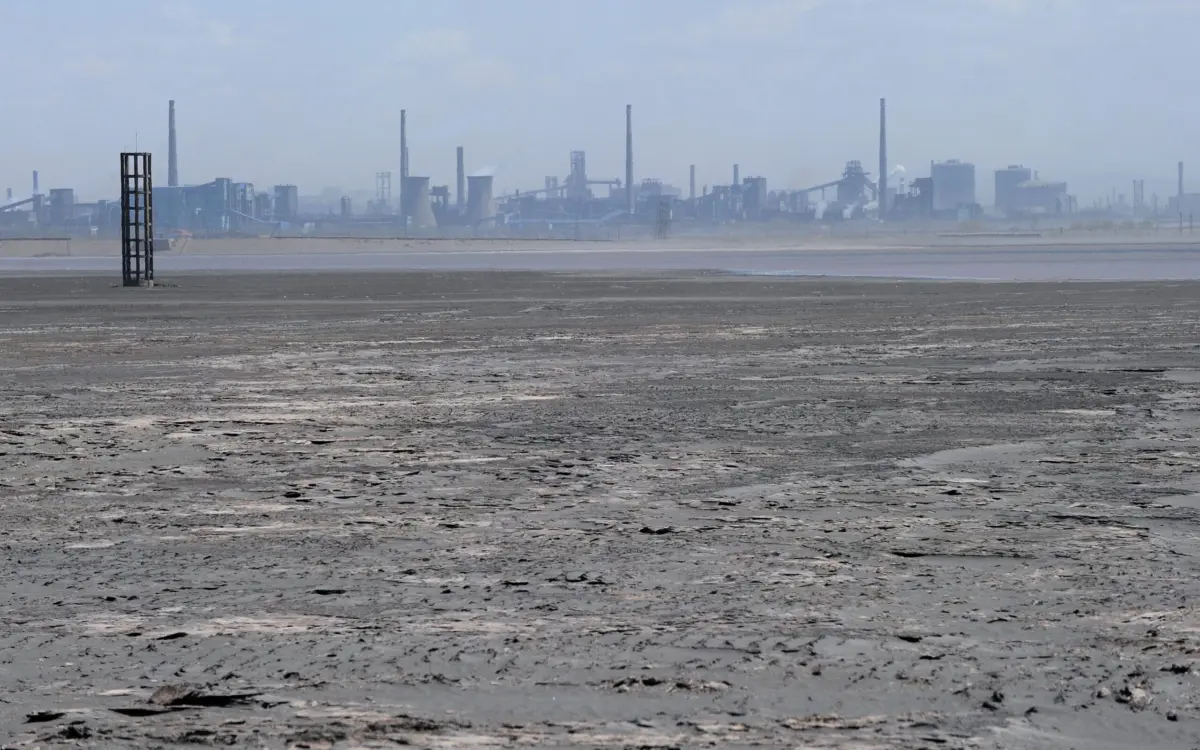
One of the singular, sobering features of Baotou, a sprawling industrial metropolis of two million residents in China’s Inner Mongolia autonomous region, is a 10-square-kilometer artificial lake widely considered to be among the most polluted bodies of water on Earth. Known locally by the name of the massive engineering barrier associated with it, the Weikuang Dam—alternatively referred to as the Baogang Tailings Dam—has spent decades serving as the ultimate repository for industrial effluent. Specifically, it collects the chemical runoff and waste slurry generated by the mineral processing facilities that feed China’s globally dominant iron, steel, and rare-earths manufacturing complex.
Constructed in the late 1950s, the lake contains a highly toxic stew of industrial chemicals combined with substantial, hazardous quantities of radioactive thorium. This radioactive burden is a direct byproduct of processing monazite ores for rare-earth elements. In the decades since the dam’s creation, China has significantly tightened its domestic environmental regulations, enforcing much stricter restrictions on mining and mineral processing operations. A primary catalyst for this regulatory evolution was the severe environmental degradation epitomized by the Weikuang Dam disaster. Today, China’s regulatory framework strictly forbids the development or operation of stand-alone monazite mines—meaning commercial operations where nothing is extracted except monazite ore itself.
Now, as industrialized nations across North America, Asia, and Europe inject billions of dollars into securing and shoring up their independent rare-earths supply chains, many are explicitly counting on monazite to help them bridge the gap. As Western and allied economies look for ways to break Beijing’s grip on these critical materials, China’s long, complicated history and ongoing operational experience with monazite offer crucial strategic lessons for the rest of the world.
The Dual Nature of Monazite Ore in China’s Industrial Strategy
Monazite ore serves as a critical pillar of China’s immense rare-earths industry because it functions as a prime, high-yield source for some of the less common yet extremely valuable rare-earth elements. Most notably, the mineral yields critical quantities of dysprosium, terbium, yttrium, and erbium—elements that are indispensable for high-performance permanent magnets, defense technologies, and advanced electronics. To meet insatiable global and domestic demand, China both mines vast quantities of domestic monazite ore and imports massive amounts of the raw mineral from international sources for domestic refinement.
The vast majority of the domestically mined monazite ore originates from a single, gargantuan source: the Bayan Obo mining complex, situated roughly 150 kilometers north of Baotou in Inner Mongolia. Bayan Obo is primarily operated as an iron-ore mine, but its geological fortune includes hosting the largest known rare-earth deposit on the planet. In a typical year, this single complex accounts for nearly half of all the rare-earth ore mined globally.
Crucially, the predominant rare-earth mineral mined at Bayan Obo is bastnaesite. Under Chinese regulatory practices, it is the large-scale commercial mining of that bastnaesite that legally permits the concurrent extraction and recovery of monazite ore at the site.
According to David Merriman, research director at the minerals intelligence firm Project Blue, ore extracted from the Bayan Obo complex was leveraged to produce approximately 170,000 tonnes of rare-earth metal last year alone. Industry data indicates that roughly 30 percent to 40 percent of the rare-earth ore mined at Bayan Obo consists of monazite. That domestic volume alone would be more than sufficient to position China as the world’s largest processor of monazite for rare-earth recovery, even before accounting for its extensive international procurement efforts.
Navigating Complex Logistics and China’s 2025 Monazite Import Surge
A much more comprehensive and revealing picture of China’s enduring strategic interest in monazite emerges when examining the country’s aggressive import channels. According to Thomas Kruemmer, a Singapore-based consultant specializing in minerals and metals, China’s imports of monazite ore topped 70,000 tonnes last year.
That import figure becomes even more impressive and operationally demanding when considering the unique logistical and regulatory challenges associated with shipping monazite via international maritime routes. Because of its inherent radioactivity stemming from the presence of thorium, concentrated monazite ore is strictly classified as Class 7 dangerous cargo under the International Maritime Dangerous Goods Code. Because of this hazardous classification, Kruemmer points out, the imported ore can legally enter China through only four designated ports.
Furthermore, regulatory guidelines dictate that the importation of certain types of monazite into China should flow through a specialized joint venture involving the China National Nuclear Corp. and Shenghe Resources, both of which maintain partial state ownership. However, Merriman notes that a substantial portion of imported monazite bypasses these specific organizations entirely through legal and structural nuances in global trade.
This happens because heavy mineral sands, which may contain roughly 2 percent to 3 percent monazite by weight, do not fall under the exact same stringent import controls applied to concentrated monazite ore. Consequently, commercial entities can import these heavy mineral sands relatively unhindered, separate out various profitable industrial concentrates—including the monazite mineral concentrate—and subsequently process that recovered monazite to extract critical rare-earth elements.
Geopolitical Friction and the Global Scramble for Rare-Earth Assets
In recent months and years, China has visibly stepped up its efforts to secure rare-earth ore and mineral deposits across the globe. According to Kruemmer, one primary driver for this international outreach is simply the need to compensate for recently lost supply agreements.
A stark example of this shifting landscape occurred when the U.S. government invested $400 million in MP Materials, the company that operates the Mountain Pass mine and processing facility in California. That strategic infusion abruptly ended long-standing commercial contracts under which MP Materials had been selling tens of thousands of tonnes of rare-earth concentrate annually to a trading affiliate of Shenghe Resources, cutting off a major pipeline of material to China.
At the same time, many Western observers and industry analysts speculate that China’s aggressive pursuit of heavy mineral sands and foreign rare-earth assets is driven by broader strategic motives. By proactively locking down exclusive rights to promising international deposits and development projects, Chinese organizations are effectively keeping those critical resources out of the reach of non-Chinese competitors and developers.
Yet, as Merriman points out, perspective on these high-stakes economic maneuvers largely depends on where one sits. The U.S. government recently demonstrated its own aggressive industrial policy by issuing a conditional loan commitment of up to $725 million to domestic monazite processor Energy Fuels. That company has been actively and aggressively securing substantial monazite supply agreements across Australia, Brazil, and Madagascar to feed its North American processing facilities.
To a Chinese observer, those Western government-backed interventions undoubtedly look just as strategic and calculated. Meanwhile, China continues to execute a long-term playbook it has refined over decades of industrial dominance. As Merriman succinctly puts it, China is simply playing its game.