






NEW DELHI — On the eve of India’s Independence Day, the historic Humayun’s Tomb stood brilliantly illuminated on 14 August 2026, serving as a shining testament to a quiet municipal revolution. For millions of residents across India’s bustling capital, the glowing monument represented more than a patriotic display; it was a visible symbol of an epic infrastructure turnaround that transformed one of the world’s most failure-prone electrical systems into a modern, highly reliable power grid.

The stark contrast between Delhi’s current energy landscape and its grim reality two decades ago is personal for people like an anonymous electrical engineering professor at Jamia Millia Islamia. Looking back to a cold January morning in 2002, daily life in the city was defined by crippling uncertainty. Power outages struck almost daily, plunging homes into darkness for hours at a time. When electricity did flow, its quality was so poor that it dimmed lights, flickered screens, and wrought havoc on household appliances. Simple morning routines—such as preparing breakfast, getting children ready for the school bus, or running kitchen mixers—frequently ground to a halt amid a chaotic scramble for flashlights and candles. Streetlights routinely failed, customer service among local utilities was virtually nonexistent, and residents were left to fend for themselves with backup inverters and noisy diesel generators.
These systemic problems had steadily deteriorated through the 1980s and 1990s. The underlying culprit was an aging distribution grid starved of crucial technological investments, paired with electricity providers lacking any meaningful accountability. By the turn of the century, the city was hemorrhaging more than half of its power through obsolete equipment and rampant theft. Utilities were collecting payments for only a fraction of the electricity they attempted to deliver, creating a financial vacuum that prevented any hope of infrastructure reinvestment.

Over the subsequent quarter century, however, a monumental coordinated effort by government authorities and the city’s private distribution utilities fundamentally altered Delhi’s electrical destiny. Power losses plummeted from over 50 percent in 2002 to just 5 to 6 percent by 2026, placing the capital on par with European nations like France and Belgium, and outperforming countries like Greece and Serbia. Even more impressively, Delhi’s grid reliability index—a crucial metric tracking how often electricity can be counted upon—surged from roughly 70 percent in 2002 to top 99.9 percent today.
With reliable power now underpinning daily life, businesses across the capital have flourished, streetlights shine brightly through the night, and the adoption of electric vehicles and city buses continues to scale upward. While Delhi still grapples with perennial urban challenges like pollution, overcrowding, and noise, reliable electricity is mercifully no longer among them. Experts suggest that the capital’s successful overhaul can serve as a vital blueprint for other regions across the globe—including parts of Albania, Argentina, Bangladesh, Brazil, Estonia, India, Kenya, Pakistan, Sri Lanka, Uganda, and Venezuela—that continue to reel from heavy distribution grid losses reminiscent of Delhi’s situation 25 years ago.

Delhi’s Power Grid and Energy Mix
As the capital of the Republic of India, Delhi stretches along the Yamuna River in the northern part of the country, housing approximately 23 million people within one of the most densely populated urban areas on the planet. Managing power for this massive population requires thousands of kilometers of distribution lines, with peak electricity demand reaching an all-time high of 8,748 megawatts. The city currently procures 76 percent of its electricity from central generating companies and private players located in neighboring states, while internal generation is largely restricted to natural gas and renewable sources. Overall, nearly 48.5 percent of the capital’s power originates from coal, roughly 26.5 percent from natural gas, and the remainder from carbon-free sources, spearheaded by hydropower at 15.6 percent.
By the early 2000s, this complex network relied on a nearly century-old distribution infrastructure in severe disrepair. Essential components—including lines, transformers, circuit breakers, and switches—were antiquated and incapable of handling modern electrical loads. The network’s structural deficiencies triggered massive technical losses, a phenomenon where electricity vanishes primarily as heat due to excessive current flowing through an inefficiently designed system.

Modern power grids typically operate through generation, transmission, and distribution. Transformers step generated electricity up to high voltage levels—ranging from 132 to 765 kilovolts in India—for long-distance transmission. Receiving substations then step the voltage down for local distribution networks, which carry both active and reactive power. Active power performs useful work measured in watts, while reactive power flows back and forth to build electric and magnetic fields measured in volt-ampere-reactive (VAR). Although reactive power performs no direct work, it remains necessary for devices featuring inductance or capacitance, such as induction motors, transformers, and computers.
When an excessive number of devices consume reactive power along the same line, the overall current must increase, generating intense heat and wasting energy. Coupled with inherent electrical resistance in aluminum distribution lines, losses multiply exponentially, as line loss equals the square of the current multiplied by the resistance. Furthermore, reactive power triggers voltage drops along the line, prompting modern electrical devices to draw even higher current to maintain performance, thereby fueling a vicious cycle of escalating losses and dropping voltages. In healthy grids, utilities deploy compensatory equipment to mitigate these issues, but in early-2000s Delhi, such interventions were entirely absent.

Electricity Loss and Theft in Delhi
Technical failures alone did not account for Delhi’s staggering power losses. Commercial losses driven by rampant electricity theft were systemic, practiced by individuals across the socioeconomic spectrum. Businesses, residential consumers, and even utility employees with vested interests routinely siphoned electricity by tapping directly into overhead distribution lines or streetlights running near homes and factories. Utilities possessed neither the resources to identify theft nor the enforcement mechanisms to penalize offenders, while the judicial system remained heavily overburdened and regulatory oversight was in its infancy.
Systemic corruption compounded these vulnerabilities. Junior engineers and frontline line workers, many lacking adequate technical training, wielded excessive authority over everyday operations, including handling outages, flickering power, and billing issues. Simultaneously, consumer billing was plagued by archaic practices. Meters were old, frequently faulty, and easily tampered with. Employees manually read meters, recorded figures in ledgers, and generated physical bills subject to human error. Customers faced cumbersome payment procedures, often requiring them to stand in long queues during restricted business hours. Lacking viable incentives or legal repercussions for non-payment, many residents simply opted not to pay, leaving utilities collecting revenue on less than half of the power they supplied.

India’s Electricity Act and Power Reforms
These systemic hurdles reflected a nationwide crisis, with state utilities across India averaging electricity losses of nearly 37 percent in 2002. Authority over the power sector was fractured between central and state governments, and most states concentrated generation, transmission, and distribution within a single monolithic organization, stifling transparency and market competition.
A watershed moment arrived with the passage of India’s landmark Electricity Act, 2003. The legislation unbundled state-level grid oversight, established distinct entities for generation, transmission, and distribution, introduced private sector participation, and permitted large industrial consumers to bypass local utilities. Furthermore, it established a central regulatory agency to govern interstate tariffs and introduced stringent legal mechanisms for prosecuting power theft.

Simultaneously, Delhi took aggressive localized action by dissolving the legacy Delhi Vidyut Board and transferring distribution responsibilities to two private entities: Tata Power, which assumed control over the northern half of the city, and BSES (now Reliance Infrastructure), which took over South and East Delhi. These private operators inherited deteriorated networks, widespread theft, broken billing frameworks, and untrained workforces facing combined losses exceeding 50 to 60 percent. Both companies promptly instituted sweeping structural reforms and human resource development programs to overhaul operations.
Delhi’s Electricity System Overhaul
Transforming the grid required a collaborative approach engaging consumers, municipal authorities, and utility workers at every level. The private operators revamped corporate hierarchies, curtailing the unchecked authority of junior staff while deploying digital supervisory control and data acquisition (SCADA) systems. These centralized control hubs provided operators with real-time visibility over equipment status, voltage levels, power flows, and switch positions, enabling rapid identification of theft and expedited fault isolation.

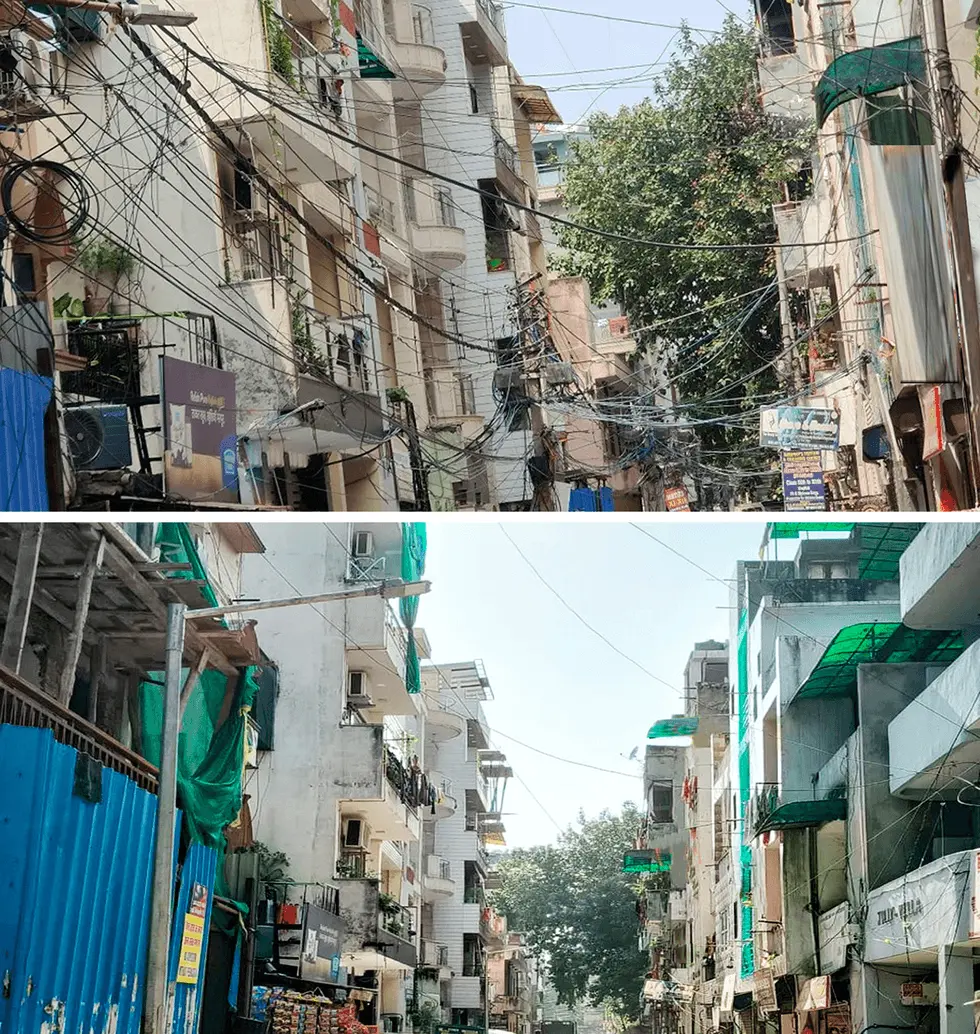
Technically, utilities replaced thousands of aging transformers and circuit breakers, slashing transformer failure rates from 11 percent down to less than 1 percent. To stabilize voltage and reduce line current, hundreds of fixed and mobile capacitor banks were strategically deployed across the network alongside dedicated voltage regulators. Bare distribution wires were systematically replaced with bundled, insulated cables, which effectively curbed illegal tapping and minimized ground faults caused by falling tree branches. Field workers were also equipped with advanced safety gear, including helmet-mounted voltage sensors and thermal scanning tools to detect hidden insulation flaws.
To combat billing inaccuracies and tampering, electromechanical meters were superseded by digital units read via handheld devices, followed by the deployment of radio-frequency group metering and modern smart meters. To facilitate revenue collection, utilities established 24-hour payment kiosks, web portals, and mobile applications. In low-income neighborhoods where losses had historically peaked at astronomical rates, companies implemented innovative community-engagement strategies. Rather than relying solely on punitive measures, utilities improved local water access and partnered with resident women—hired as community payment collectors—to promote financial literacy and bill compliance.

In recent years, the integration of rooftop solar installations, energy-efficient LED appliances, and artificial intelligence-driven analytics for demand forecasting and theft detection has further optimized the network. Today, the fruits of this quarter-century endeavor are visible across the capital, where a resilient, modern power grid reliably supports millions of residents, growing commercial enterprises, and an expanding electric transportation ecosystem, turning a once-paralyzed city into a global model for infrastructure renewal.