





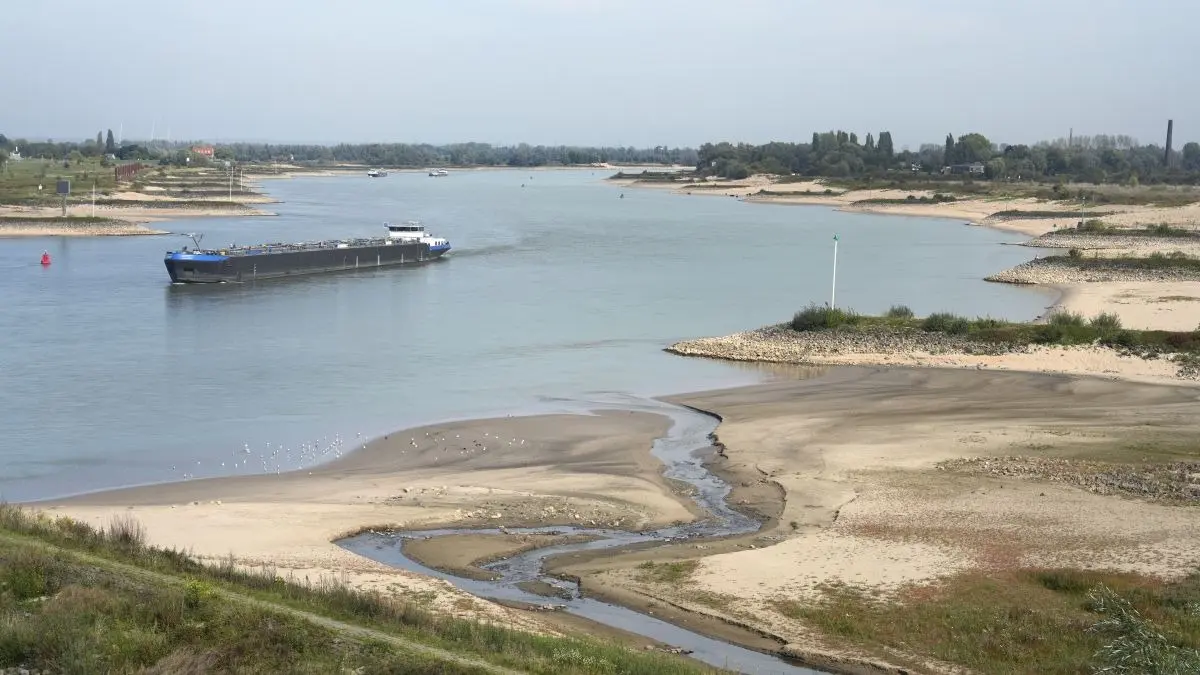
Rivers in the eastern regions of the Netherlands have plummeted to such extreme lows that transport authorities are no longer able to measure whether commercial vessels can pass safely. The unfolding crisis has forced inland skippers to make hazardous, unassisted judgments on whether or not to sail, risking costly groundings as vital supply chains face unprecedented pressure.
Rijkswaterstaat, the executive arm of the Dutch Ministry of Infrastructure and Water Management responsible for the design, construction, management, and maintenance of the country’s main infrastructure facilities, confirmed to national broadcaster NOS that its survey boats can no longer reach the shallowest stretches of several major waterways. The affected sectors include the IJssel, the Nederrijn, the Pannerdensch Kanaal, and significant portions of the Waal.
In certain trouble spots across these key arteries, the navigation channel has dropped to a depth of less than 125 centimeters. This shallow depth means that only three agency vessels in the entire fleet possess a draft small enough to navigate the areas safely. However, these specialized boats are simultaneously in high demand and urgently needed across other regions of the country, leaving the most critical areas unmonitored.
Without these survey boats on location, Rijkswaterstaat is unable to publish its crucial daily shipping readings detailing exact water depths. Commercial barge operators rely heavily on these official government metrics to chart safe courses and avoid getting stranded on hidden sandbanks. While private commercial firms do collect and sell alternative depth data, not every skipper possesses the technical access or financial means to purchase these expensive commercial subscriptions.
Transport Under Pressure
The inability of authorities to provide reliable depth data has sent ripples of anxiety through the commercial shipping sector, which forms the backbone of Dutch and European logistics. Fiona Oomen of Koninklijke Binnenvaart Nederland, the primary trade association for inland shipping in the Netherlands, voiced deep concern over the trajectory of the crisis during an interview with broadcaster NOS.
"This is very worrying," Oomen said, highlighting the compounded stress currently affecting national logistics networks. "All transport is under pressure, on the roads and on the waterways. What if the water drops even further? Where is everything supposed to go?"
The hydrological distress is driven by exceptionally low water levels originating upstream. The flow of the Rhine at Lobith, the critical hydrological gateway where the river enters Dutch territory from Germany, has dropped to approximately 545 cubic metres per second. This current measurement falls significantly below the previous record low of 614 cubic metres per second set during the severe drought in August.
The impacts of these historic lows are already disrupting cross-border operations and passenger travel. Over the previous weekend, a Dutch river cruise ship carrying 140 passengers became stranded near the German city of Cologne as the Rhine continued to plunge to unprecedented depths.
On the IJssel river, authorities were forced to implement a restrictive one-way shipping system last week to manage the narrowing navigable channel. This safety measure has compelled numerous commercial vessels to execute detours stretching up to 300 kilometers, severely inflating fuel costs and delivery times.
Statistical data released by Statistics Netherlands (CBS) illustrates the severe economic toll the drought has taken on the sector. Freight carried across Dutch waterways plummeted by 19% in August alone. Cross-border commercial traffic traversing the border with Germany has emerged as one of the hardest-hit segments, as persistent low water levels prevent barges from carrying full cargo loads.
Although the infrastructure ministry officially lifted the national water shortage status in early September, officials simultaneously issued a sobering warning that river levels could remain abnormally low through the end of the calendar year. Despite mounting appeals from industry stakeholders, the Dutch cabinet has firmly ruled out any financial compensation for businesses suffering losses due to the prolonged drought.
Rain Needed
Rijkswaterstaat officials admit they cannot predict when relief will arrive or how long the precarious navigation conditions will persist. A spokesperson for the agency told NOS that a meaningful recovery depends entirely on meteorological developments far beyond national borders.
"We need rain in the catchment area," the spokesman explained, emphasizing that precipitation must fall predominantly outside the Netherlands to feed the major river basins. Current medium-term weather forecasts suggest that while the water flow is unlikely to deteriorate further in the immediate future, it is equally unlikely to experience any significant improvement.
Furthermore, hydrologists and infrastructure managers are already bracing for a paradoxical shift in weather patterns once the dry spell eventually breaks. The North Sea is currently experiencing exceptionally high water temperatures, a factor that climatologists warn could set the stage for a remarkably wet and stormy autumn.
"When it’s over, we get the next problem," the Rijkswaterstaat spokesperson cautioned regarding the volatile seasonal transition. "Then we’ll have high water again."