






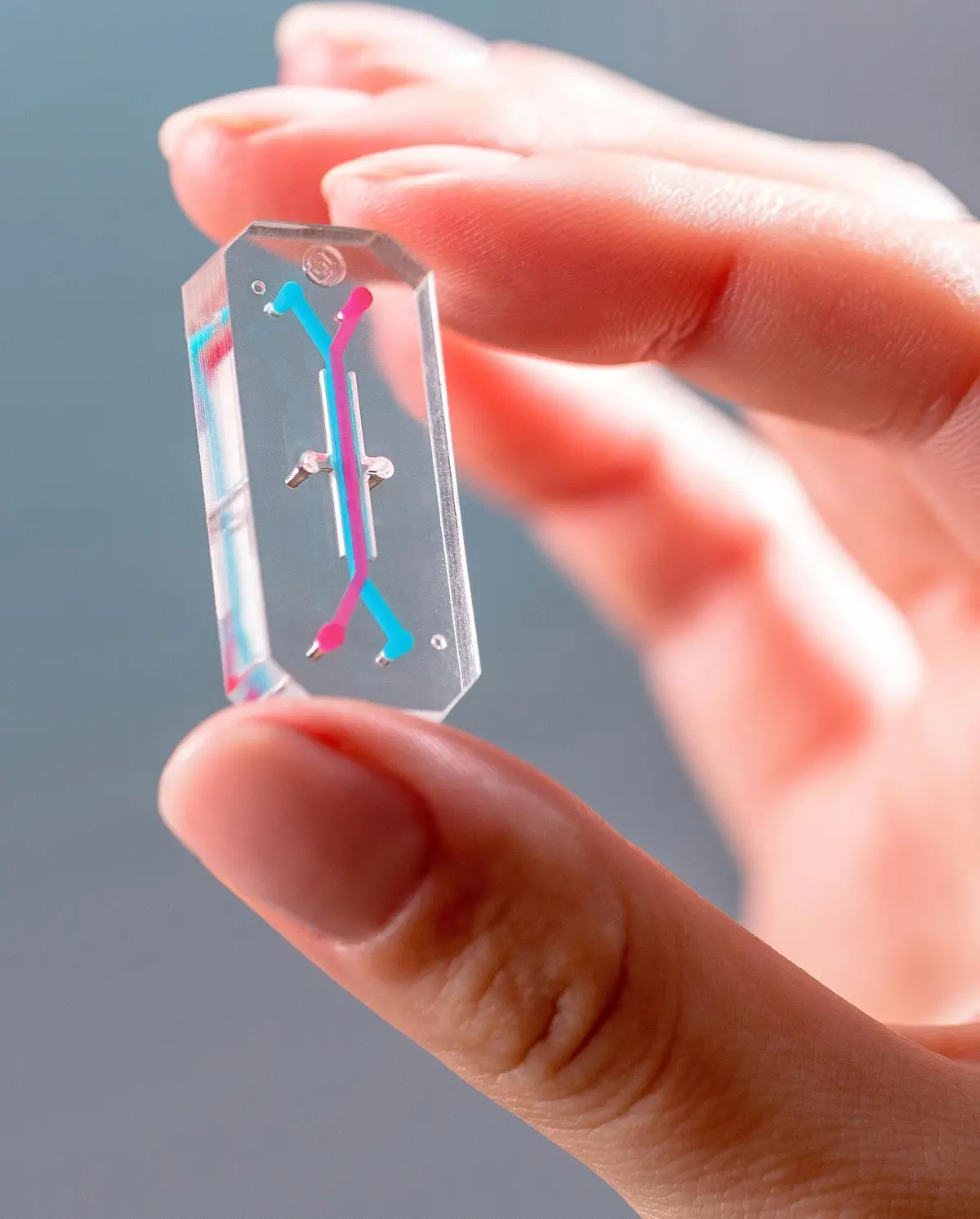
For generations, lab rats, mice, and other animals have been a foundational pillar of biomedical research and drug development. They are trusted to help scientists understand diseases, test toxicity, and determine whether a compound is safe enough to enter human clinical trials. However, the scientific community is slowly standing on the precipice of a major shift. Advanced technologies, ranging from microfluidic organ chips to complex artificial intelligence models, now aim to model human biology with high fidelity—without requiring a single animal.
Despite the technical breakthroughs, bringing these non-animal alternatives into the mainstream has proven to be an uphill battle, not because the technology lacks promise, but because the human infrastructure of science is slow to change.
Seventeen years ago, cell biologist Donald Ingber and his colleagues at Harvard University’s Wyss Institute for Biologically Inspired Engineering submitted a paper to the journal Science describing a novel model human lung. Smaller than a standard USB stick, the device was made of a clear polymer slab containing narrow channels lined with the exact type of cells that populate a human lung’s air sacs and blood vessels. When air was rhythmically pumped through hollow chambers beside the channels, the device expanded and contracted—it effectively "breathed."

This lifelike movement marked a dramatic departure from older generations of lung models, which relied on static tissue cultures incapable of simulating the mechanical movements critical to lung function. When Ingber’s artificial lung was exposed to inflammatory proteins and bacteria, it reacted much like a living human lung. Subsequent exposure to silica nanoparticles, used to model the effects of ultrafine particulates, revealed that physical movement directly affected how tissues absorbed them.
It was a powerful proof-of-principle demonstration. Yet, the editors at Science were initially hesitant, rejecting the paper and suggesting that Ingber’s team run parallel tests in mice. While the request was understandable given that the Harvard system was entirely new, the incident underscored how deeply entrenched animal models were as the default standard of modern biomedical research. Ingber’s team completed the mouse experiments, and the study was published a year later in 2010. It has since been cited nearly 5,400 times.
A stark contrast to that cautious beginning can be seen today. Ilka Maschmeyer, a translational toxicology researcher and executive at the German biotech company TissUse, points to a recent encounter that highlights how regulatory tides are turning. TissUse specializes in organ-on-a-chip systems used by pharmaceutical companies for preclinical research. A few months ago, Maschmeyer recounted, a pharmaceutical firm approached TissUse after the U.S. Food and Drug Administration denied them permission to launch a clinical trial for a new drug. The reason? The company had submitted traditional animal data, but the FDA requested data derived from organs-on-a-chip or a comparable alternative.

This moment reflects a broader, foundational shift away from animal testing in toxicology and drug development. While still relatively uncommon, such regulatory demands are becoming more frequent. Over the years, researchers have developed a host of alternatives collectively known as NAMs—an acronym that stands for new approach methodologies, novel alternative methods, or nonanimal methods. While many NAMs are still undergoing rigorous testing, early studies consistently demonstrate their immense potential.
The Technologies Replacing Animal Testing
For decades, animal welfare advocates and numerous scientists have raised serious ethical and practical concerns regarding animal experimentation. Statistics show that an estimated 92 percent of all drugs entering U.S. clinical trials ultimately fail to reach the market. While some failures are driven by commercial factors, many occur because drugs prove ineffective or unexpectedly toxic in humans—failures that standard animal tests completely failed to predict. Failure rates are even higher for drugs targeting heart disease, cancer, and neurological disorders.
These sobering failure rates do not automatically point to animal models as the sole culprit; flawed study designs and the sheer complexity of human disease also play significant roles. Yet, there is little debate that animals frequently serve as poor physiological surrogates for humans. Just as animal tests can provide false hope regarding a drug’s efficacy or safety, they can also erroneously flag safe and effective compounds as dangerous. Some researchers suggest that if everyday staples like aspirin or acetaminophen had been subjected to modern preclinical requirements, they might have been discarded entirely.

Modern NAMs have pushed far beyond rudimentary tissue cultures. Today’s landscape includes sophisticated organoids that closely mimic the cellular composition, structure, and function of human organs. Even more advanced are organ-on-a-chip platforms. Alongside Ingber’s pioneering lung-on-a-chip, scientists have developed chips that replicate the brain, heart, kidney, and placenta. Researchers have successfully linked up to 10 such organs together, creating multi-organ systems that simulate human physiology far more accurately than a mouse or monkey ever could. These wet-lab systems are further supported by computational organ simulations and artificial intelligence tools that analyze data in an iterative, high-powered feedback loop.
Even as pharmaceutical companies increasingly adopted NAMs in-house, the U.S. regulatory framework remained a formidable hurdle. That barrier shifted dramatically in late 2022 with the passage of the FDA Modernization Act 2.0, which explicitly authorized the use of NAMs in preclinical safety studies required before human trials. The law broke decades of precedent that practically mandated animal testing.
The regulatory momentum accelerated further in 2025, when the FDA pledged to make animal studies the exception rather than the norm for drug safety evaluations. By September 2026, the agency issued a formal rule replacing references to "animal tests" in its drug-development regulations with the broader term "nonclinical tests." This subtle yet powerful semantic shift explicitly validated human-cell systems, organs-on-chips, and computer models.

Public funding bodies are following suit. In 2025, the U.S. National Institutes of Health announced that applicants seeking grants for animal models must also incorporate nonanimal research, such as real-world data or NAM studies. Meanwhile, the European Commission and the United Kingdom have unveiled comprehensive roadmaps to phase out animal testing, and the Organisation for Economic Co-operation and Development has updated its chemical safety guidelines to embrace NAMs.
These institutional changes are crucial. Without regulatory acceptance, researchers have little incentive to pivot away from tried-and-true animal protocols. Maschmeyer notes that TissUse’s client base now increasingly includes scientists who spent their entire careers working exclusively with animals, but who are now legally and professionally compelled to integrate in vitro models into their workflows.
Proving That NAMs Work
Regulatory approval alone is not enough; the scientific community also requires a robust framework to establish how these technologies should be validated. A prototype brain-on-a-chip developed in an academic laboratory may perform brilliantly under controlled conditions, but true validation requires global reproducibility, mass production, and strict performance metrics. Minute variations in the hydrogels used as tissue scaffolds, for instance, can yield wildly divergent cellular growth patterns.

Standardizing workflows, metrics, and reporting criteria remains an ongoing challenge. While Ingber’s company, Emulate, provides hands-on coaching to industry researchers, maintaining consistency across complex biological cultures requires meticulous care. Furthermore, researchers must prove that NAMs deliver clear clinical benefits. Biomarkers measured on a chip must be genuinely relevant, and algorithms translating chip data to whole-body effects must be reliably predictive.
Validating these systems requires massive investments of time and money. A landmark study by Emulate demonstrated that a liver-on-a-chip successfully flagged roughly seven out of eight drugs that safely passed animal trials but proved toxic to human livers. A similar study by Oxford University and Janssen Pharmaceutica showed that computational simulations of human heart cells predicted dangerous heart arrhythmias with 89 percent accuracy, compared to 75 percent for animal tests.
However, these validation studies are extraordinarily complex. Emulate’s study required 870 individual chips and the labor equivalent of 16 full-time employees working for 16 weeks. Replicating such massive validation efforts for every available NAM and every potential medical application is a daunting task, particularly for smaller biotechnology companies. Experts argue that deeper academic-industry partnerships, government funding, and open-access data repositories shared by pharmaceutical companies and regulators are vital to overcoming these barriers.

Christian Maass, a computational biologist at the German biotech firm ESQlabs, emphasizes that direct head-to-head comparisons are essential for good science. ESQlabs builds "digital twin" simulations that integrate organ chip data with whole-human models. While Maass champions the field, he notes that researchers have yet to universally provide the empirical proof that NAMs consistently outperform animal models. Conducting these comparative studies is necessary not only for regulatory validation, but for convincing industry skeptics who are waiting for a definitive paradigm-shifting moment.
Changing Scientific Habits
Even when head-to-head data is available and regulations change, institutional inertia can severely stall adoption. For example, the monocyte activation test—an assay using human blood cells to evaluate immune responses—was developed and validated in the mid-1990s to replace the archaic rabbit pyrogen test. Yet, it took until 2010 for the European Pharmacopeia to officially accept it, and rabbits are still used for the test globally.
This sluggish pace stems from deeply ingrained habits within scientific culture. Even when formal requirements vanish, informal expectations linger. Grant reviewers, peer reviewers, journal editors, and institutional leaders frequently retain a cultural bias toward animal data, viewing NAM-only proposals as risky or unconventional. Early-career researchers often fear that moving away from established animal models could jeopardize their funding, publication prospects, and career trajectories.

Overcoming this cultural resistance requires a concerted focus on education and training. Major institutions, including the NIH and the FDA, now offer educational resources on NAMs. Online learning modules and webinars are helping train a new generation of scientists and regulators. Experts note that as these newly trained researchers populate industry labs and academic faculties, they will gradually replace the traditional guard.
With sufficient time, funding, and generational turnover, the research culture surrounding drug development and safety testing is poised to transform. Whether NAMs can completely replace animals in basic biological research—which accounts for the vast majority of animal use outside of regulatory testing—remains a longer-term question. Yet, as pioneers like Donald Ingber and Thomas Hartung observe, the successful adoption of NAMs in toxicology serves as a guiding light for the rest of the biomedical sciences, opening doors that were once firmly shut.