




As Chiharu Shiota’s monumental, globe-trotting retrospective “The Soul Trembles” continues its international journey, the artist periodically cuts down her intricate, immersive thread installations, reducing them to piles of string before restringing them anew at their next destination. Born in Osaka and based in Berlin since 1996, Shiota has consistently captivated international museum-goers with her dramatic, large-scale works in fine art and performance, frequently setting attendance records along the way. With its latest opening in Montreal, curated by Mami Kataoka of the Mori Art Museum in Tokyo alongside Iris Amizlev of the Montreal Museum of Fine Arts (MMFA), the celebrated exhibition has officially docked in North America for the very first time.
“This is my life. All of my emotions are in my work,” Shiota reflects as the final, meticulous touches are applied to the Montreal installation. She is acutely aware that after each exhibition closes, the sprawling threads will be cut down and her complex sculptural creations dissolved back into raw materials. Yet, she finds peace in the ephemeral nature of the process. “I hope people can keep the memories and that their memories will last forever,” she says.
Following an early preview of the exhibition, Shiota expressed her appreciation for the warm reception she received in Canada. “I’m very happy that the set-up is done,” she notes. “Everyone was so welcoming, and the opening was such a wonderful event. Montreal is beautiful.” Installing a show of this magnitude requires managing a dedicated team of local students and artists, yet Shiota still managed to carve out time to explore the city’s vibrant outdoor markets, including the historic Marché Jean-Talon, which originally opened its doors in 1933.
Architectural Dialogue and a Grand Entrance
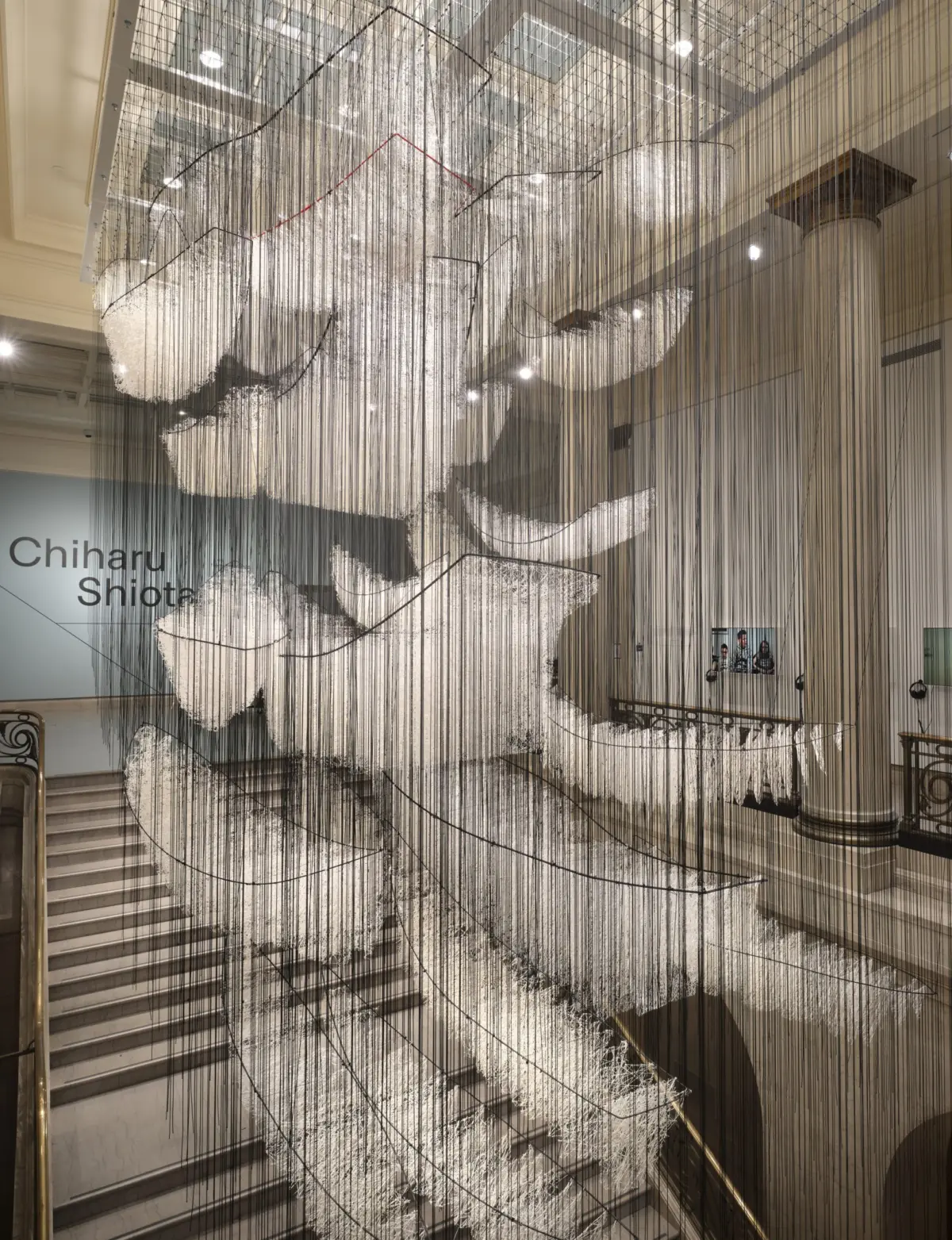
Housed in a grand Beaux-Arts building designed by architects Edward and William S. Maxwell in 1912, the MMFA’s striking white marble façade and tall colonnaded portico might initially seem like an unexpected backdrop for contemporary works. However, the historic architecture provides a powerful counterpoint to Shiota’s installations. To enter the exhibition, visitors ascend the grand staircase beneath a haunting fleet of ghostly white boats suspended overhead, flanked by cascading black fringe. Entitled Where are We Going?, this dramatic overhead installation serves as a visual harbinger for the emotional journey that lies ahead.
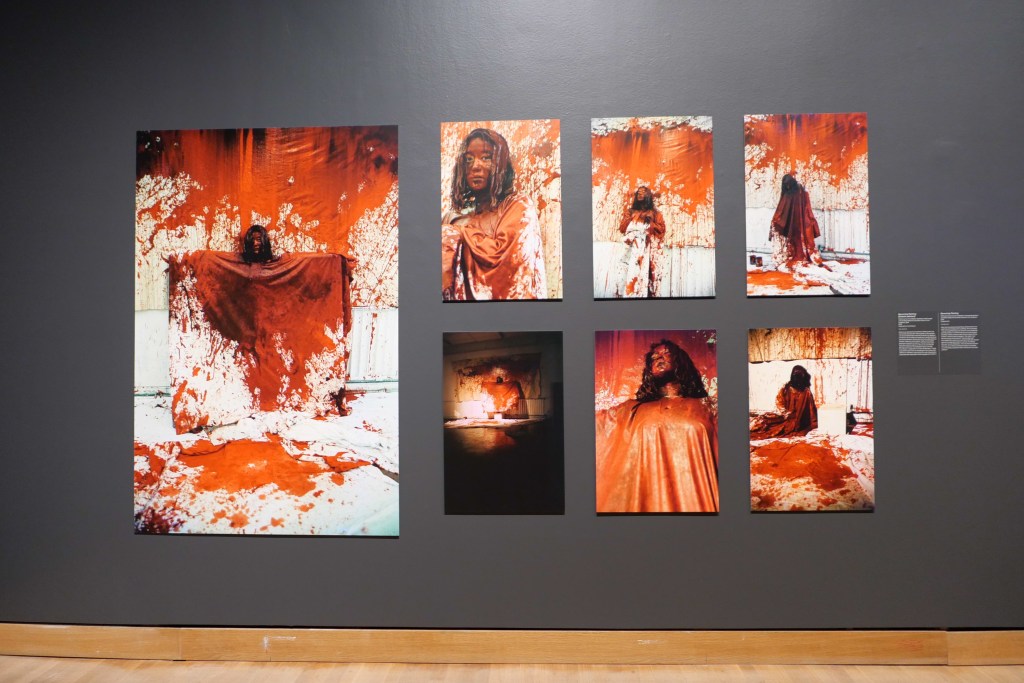
Stepping into the first gallery room, visitors are greeted by a delicate flower painting from Shiota’s childhood. Positioned on the same wall is a vibrant abstract painting that marks a pivotal turning point in her artistic career—the moment she decided to quit traditional painting because she felt the medium could no longer fully articulate her inner state. What followed was a profound exploration of performance art, utilizing her own body and unconventional materials. In the provocative work Becoming Painting, Shiota covered herself entirely in red enamel paint. Later explorations involved wrapping her body in fabric while surrounded by tubing designed to evoke the organic flow of blood. Her eventual relocation to Berlin led to studying under renowned performance artist Marina Abramovic and participating in numerous body-focused photo and video projects, several of which are displayed to chart the evolution of her early artistic identity.
Tactile Bonds in a Digital Age
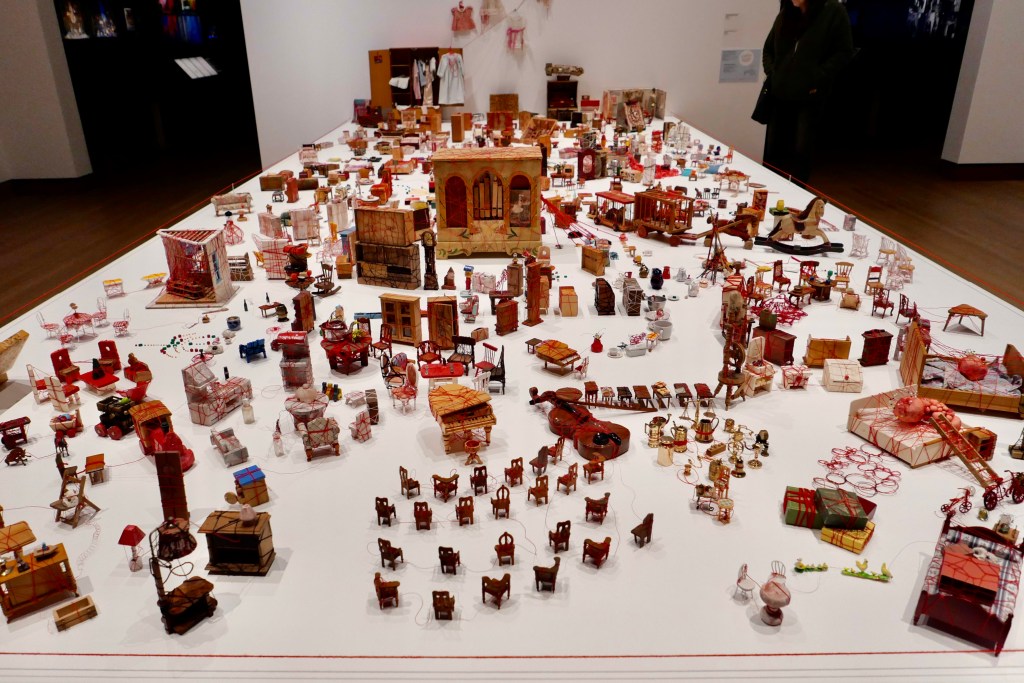
Progressing through the galleries, visitors encounter an early fabric installation alongside a massive platform populated by dollhouse furniture and vintage flea market finds. These miniature objects have been painstakingly linked to one another by web-like networks of red threads of varying widths, establishing a fragile, interconnected universe. In a contemporary art landscape increasingly dominated by digital media, artificial intelligence, and rapid technological advancements, Shiota’s steadfast focus on tactile bonds—ranging from the delicate to the bold—feels profoundly poignant. Throughout “The Soul Trembles,” the artist successfully transports viewers into an otherworldly, deeply personal interiority constructed entirely from hand-woven thread.
Subsequent galleries showcase photography and video documentation derived from her extensive work in theatre, dance, and opera stage design. “My last theatre project was the stage design for Idomeneo, re di Creta in 2024,” Shiota explains. “Working with choreographer Sidi Larbi Cherkaoui was a great experience. I enjoy creating for the stage. It’s very different from an exhibition because I have to work together with many people and the performers have to interact with all the materials.”
The exhibition continues with Inside – Outside, a large-scale installation composed of a towering stack of white-framed windows that sits directly across from two hand-sewn white dresses and a mirror, all encased within a giant box frame wrapped tightly in black threads. In the adjoining room, Shiota enrobes a burned piano in a web of black strings that stretch outward toward an audience of empty chairs, framing arched passageways designed for visitors to navigate.
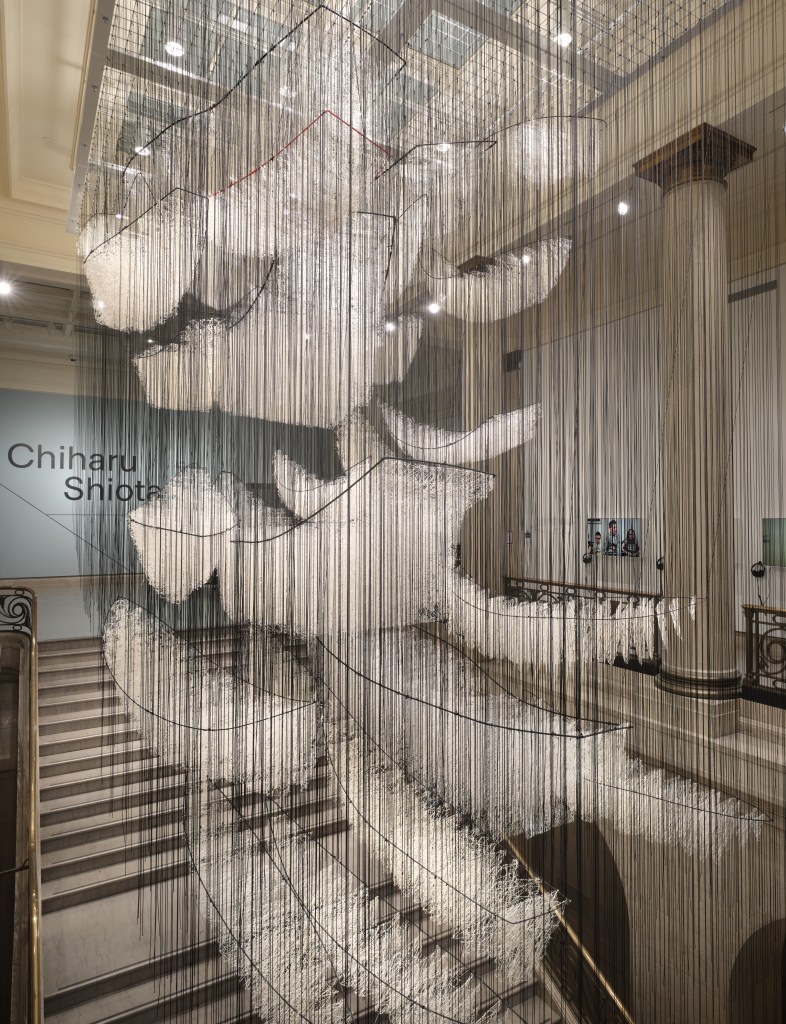
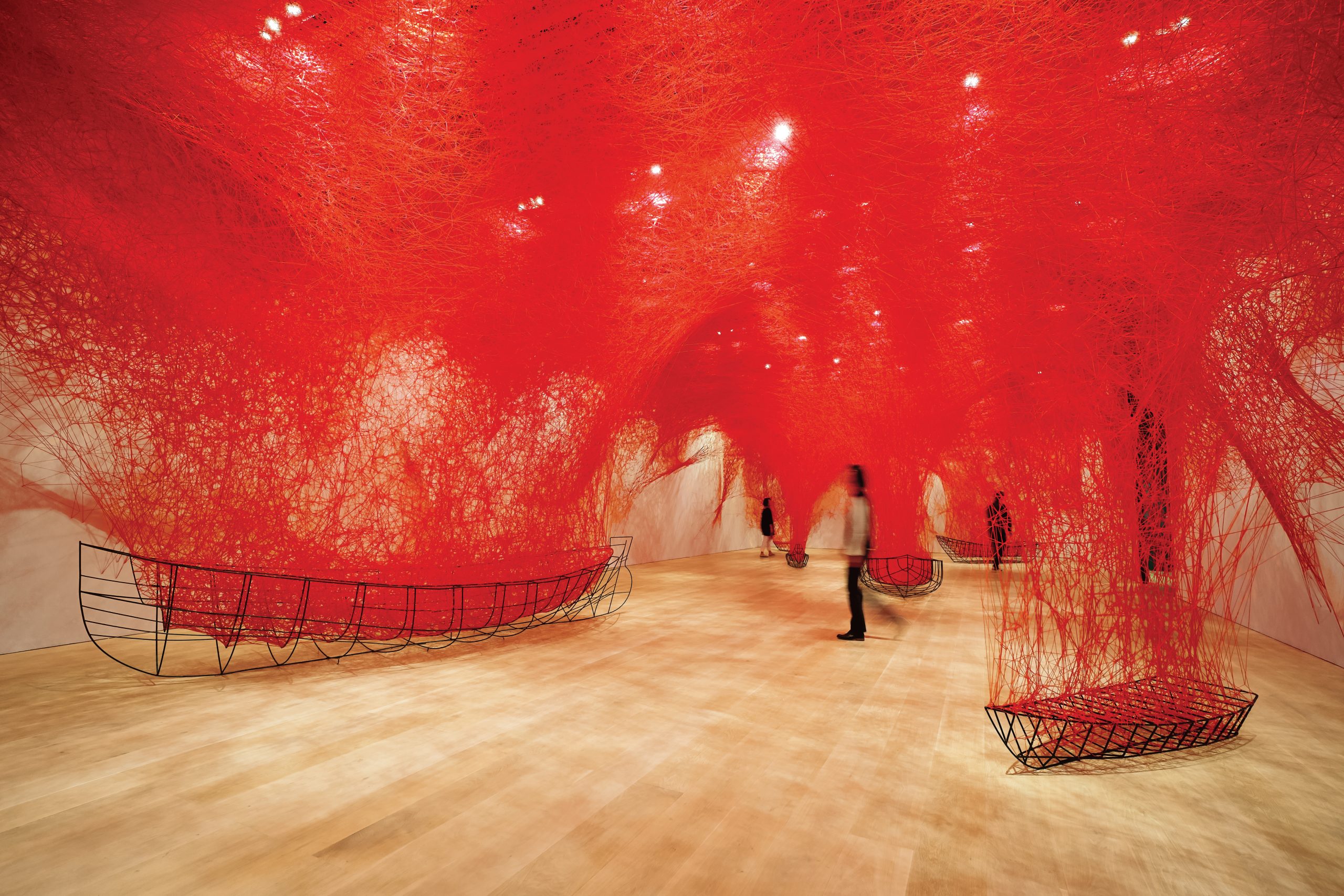
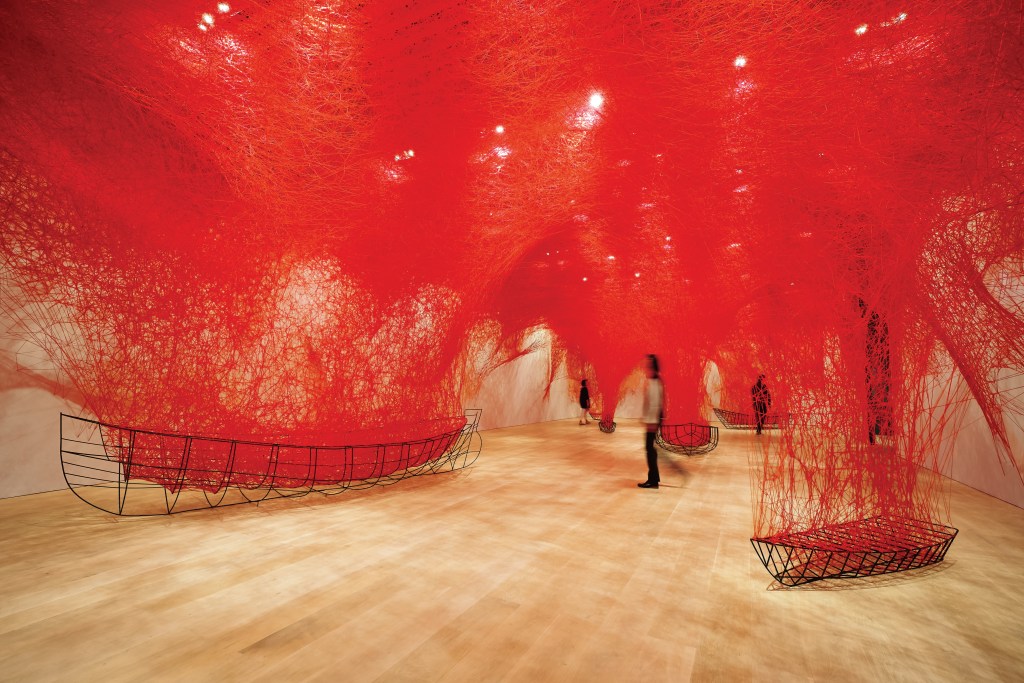
At the emotional and visual center of the exhibition is Uncertain Journey, one of her most recognizable signature installations. In this piece, thick tangles of red thread burst forth from the frames of small suspended boats, swirling upward and outward to span the perimeter of the walls and ceiling. While photographs and videos capture the striking geometry of these spaces, they merely hint at the visceral, immersive experience of wandering through Shiota’s world-building in person.
Adapting to Global Spaces
The MMFA installation marks the tenth iteration of “The Soul Trembles” since its acclaimed debut in 2019 at the Mori Art Museum in Tokyo. While Shiota brings core structural elements to each international stop, she must continually adapt the works to fit the distinct architectural constraints of each host institution. “The artworks themselves do not change,” she explains. “But the political climate and the museum space are always different, so the feeling within the installation might change. Sometimes the museum’s own collection is presented right next to my work, like at the MAO in Italy. Other times the museum asks me to create additional work specifically for the show.”
Collaborating closely with curators Mami Kataoka and Iris Amizlev to integrate the exhibition into the historic MMFA building became an integral part of the artistic process. “The ceiling is quite low compared to other presentations,” Shiota notes, “so the feeling changes. For the installation Accumulation: Searching for the Destination, the suitcases are normally suspended, but for this location that wasn’t possible.” To resolve this spatial limitation, Shiota chose to stack the vintage suitcases all the way up to the gallery ceiling on a lower floor.
Previous iterations of the exhibition have consistently drawn record-breaking audiences worldwide. “I am happy to see so many different people visit the exhibition, from children to elderly people,” Shiota says. “My artwork is about something deep and touches on fundamental questions about death, which I had when I had cancer. But some works are made with very mundane objects like doll furniture; they are connected to my life, and this is a life everyone can connect to, playing with dolls or facing the meaning of death. My work is very universal.”
As “The Soul Trembles” continues its global itinerary, each temporary residency ultimately concludes with a dismantling process. Yet, the artist views this cyclical destruction without sorrow. “I’m not sad about the de-installation, or about cutting the thread because I often already have the next destination planned,” Shiota concludes. “I’m excited to show at the next stop, and I’m thinking only about the future. The exhibition lives on in the memory of the viewer and memory is everything.”
“The Soul Trembles” is currently on view at the Montreal Museum of Fine Arts through February 14, 2027.