





Unlike the famously ambiguous and much-debated conclusion of Colleen Hoover’s best-selling psychological thriller Verity, the wardrobe evolution of protagonist Lowen Ashleigh in the seductive film adaptation makes remarkably perfect sense.
When audiences first encounter Lowen, portrayed by Dakota Johnson, she is a struggling novelist caught in the precarious crosshairs of personal tragedy and financial ruin. She is actively juggling the profound grief of her mother’s recent death with an impending eviction notice that threatens to leave her with nowhere to turn. Just before she is forced out onto the proverbial curb, however, a lifeline appears in the form of a lucrative publishing offer. She is offered a hefty advance to step in and finish the bestselling book series penned by renowned author Verity Crawford, played by Anne Hathaway, after a severe car accident leaves the celebrated writer bedridden and incapacitated.

There is, of course, a significant catch. To complete the work, Lowen must relocate to the Crawford family’s foreboding and isolated lake house in Vermont. Once there, her assignment is to sift meticulously through Verity’s private notes, archives, and manuscripts to fully absorb and embody her unique writing voice. Given the character’s initial financial distress, an outside observer might logically assume that luxury items like Céline cardigans and Loewe sweaters have no rightful place in Lowen’s rustic, cottage-core capsule rotation. Yet, Verity costume designer Jacqueline Demeterio argues passionately that high-end designer price tags ultimately do not matter, provided the pieces authentically look like something this specific “downtown Brooklyn cool girl” might unearth while combing through local vintage shops.
Addressing the deliberate mix of high and low pieces integrated into Lowen’s cinematic wardrobe, Demeterio notes that the character’s financial reality was always front of mind, balanced with creative intuition. The designer explains that she did not restrict herself by thinking the character could never afford a specific label, focusing instead on whether the garment felt genuinely correct for the person Lowen is on the page and on the screen.
The Protective Armor of Outerwear
Throughout the course of the film, Demeterio utilized impenetrable leather silhouettes and warm, protective knits to visually narrate the internal journey of a deeply guarded woman slowly unraveling under the crushing weight of the Crawford family’s dark, unsettling secrets. It is only as Lowen pieces the terrifying truth of the narrative together that she is finally able to step fully into Verity’s shoes—or, in a striking visual pivot, a dramatic red Valentino dress—and aggressively claim the elevated lifestyle she ultimately feels she deserves. At least, that is the trajectory until a final, chilling letter from Verity casts profound doubt upon Lowen’s seemingly self-righteous ending.

Like many viewers leaving the theater, audiences are left with more questions than answers, though a substantial portion of those lingering curiosities naturally center around the writer’s impeccable collection of fall fashion basics. Fortunately, a direct conversation with the costume designer provides a transparent look at exactly how Lowen was dressed and how Jacqueline Demeterio managed to style her cozy, atmospheric wardrobe with such deceptive effortlessness.
The jackets Lowen wears throughout Verity ultimately tell her psychological story more effectively than almost any other category in her personal wardrobe. Before she even bears witness to the bloody, tone-setting car wreck that initiates the narrative trajectory of the film, she is captured on her way to a mysterious publishing meeting wrapped in a classic, practical wool coat designed by Theory. Initially, Demeterio leaned toward an oversized alternative from The Row before ultimately deciding on a more nondescript, understated option. Explaining the creative pivot, Demeterio noted that the team reached a point where they questioned whether an ultra-luxurious piece felt like too much for the character. They agreed that they did not want the look to cross into editorial territory because she is, first and foremost, playing a struggling character grounded in reality. The Theory coat provided a much more toned-down, grounded aesthetic.
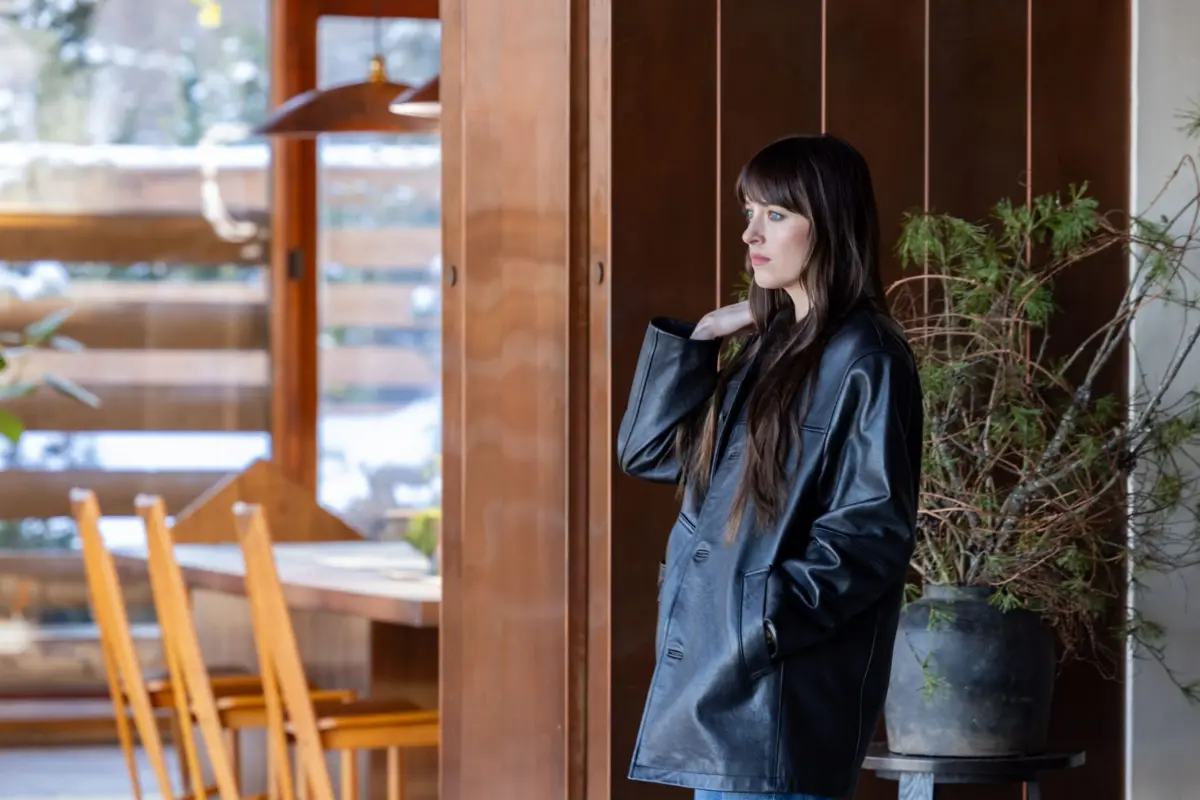
By the time Lowen physically arrives at the brooding estate in Vermont, she is swathed in what is arguably one of the most striking pieces from the entire film: a gorgeous, oversized Dunst leather jacket that she deploys almost like physical armor against her new environment. Demeterio points out that Lowen arrives at the lake house heavily shielded because she fundamentally does not know what she is getting herself into. That specific cinematic framing of Lowen against the dark, imposing architecture of the Vermont house was considered critically important—she represents the quintessential city girl stepping uninitiated into the isolated country, armored in her sharp leather jacket.

As the narrative progresses, Lowen’s financial standing undergoes a radical transformation. While she begins her journey on the brink of economic collapse, she eventually departs the cottage having effectively seized Verity’s empire from underneath her. Along with this shift in power comes a visual shedding of her moody, protective New York wardrobe in favor of a pale blue rib-knit midi dress by Proenza Schouler and a supple suede trench coat. According to Demeterio, the suede trench still captured the core essence of Lowen’s style identity, but elevated it into the luxury version of what she would naturally wear after stepping into a successful, high-earning career.
Ironically, the specific jacket intended to broadcast her newfound wealth was not sourced from an ultra-exclusive luxury fashion house like The Row, but rather from the significantly more accessible high-street retailer Mango. For Demeterio, selecting every single item in Lowen’s closet ultimately came down entirely to how the garment presented visually on camera, completely independent of the prestige attached to the label.
The Foundation of Everyday Denim
When Lowen’s high-rise bootcut Levi’s first appear on screen, it is easy to assume that Demeterio pulled the character’s denim directly from Dakota Johnson’s personal closet. As it turns out, that assumption is only partially accurate. Demeterio notes that when costume designers enter into collaborative wardrobe conversations with actors, a natural starting point involves asking what specific denim brands and cuts look best on them.

Johnson spent the vast majority of the film comfortably clad in vintage-inspired Levi’s and AGolde denim, cycling seamlessly through light-wash straight-leg styles and relaxed black jeans. Although both denim labels are known favorites of the actor herself, the production team still had to source and purchase independent inventory for the project. While Demeterio acknowledges that Johnson likely owns similar pairs of Levi’s in her real life, the wardrobe department had to acquire multiple duplicates of the clothes to accommodate the rigorous demands of film production and continuity.
The Intricate Art of Layering
Beyond outerwear and denim, Lowen’s sartorial identity relies heavily on her extensive collection of cozy knitwear. Demeterio curated a wardrobe that artfully balances vintage finds and designer knits, layering them thoughtfully over slim-fit T-shirts by Re/Done and classic denim silhouettes. This approach creates a surprisingly wearable capsule wardrobe that remains remarkably easy for audiences to emulate across varying budgets.
Particular attention is drawn to Lowen’s intricate layering choices throughout her time in the house, especially a combination featuring an olive sweater vest by Éterne paired with a simple white Re/Done t-shirt. Demeterio completes these layered ensembles with the delicate, understated gold necklace stack that the character wears consistently throughout the film. To successfully replicate this look in everyday life, Demeterio advises against choosing boxy t-shirts that add unnecessary bulk underneath structured knits. Instead, the designer prefers a slightly slimmer cut for the foundational layer—one that stays close to the body without becoming uncomfortably tight—describing the styling approach as a very delicate balancing act.

Other standout knitwear moments include a striped cardigan identified as an Isabel Marant piece, alongside an oversized, ultra-cozy sweater that Lowen hastily layers over a vintage cardigan while she absorbs the terrifying, gruesome details hidden within Verity’s private manuscript. Much like her protective leather outerwear, Lowen instinctively reaches for these heavy, enveloping layers as a physical and psychological defense mechanism. Demeterio explains that the character experiences profound shock and physical illness upon reading the manuscript’s contents, turning to clothing for immediate comfort away from the mounting chaos of her surroundings, feeling acutely that the entire estate has descended into madness.