






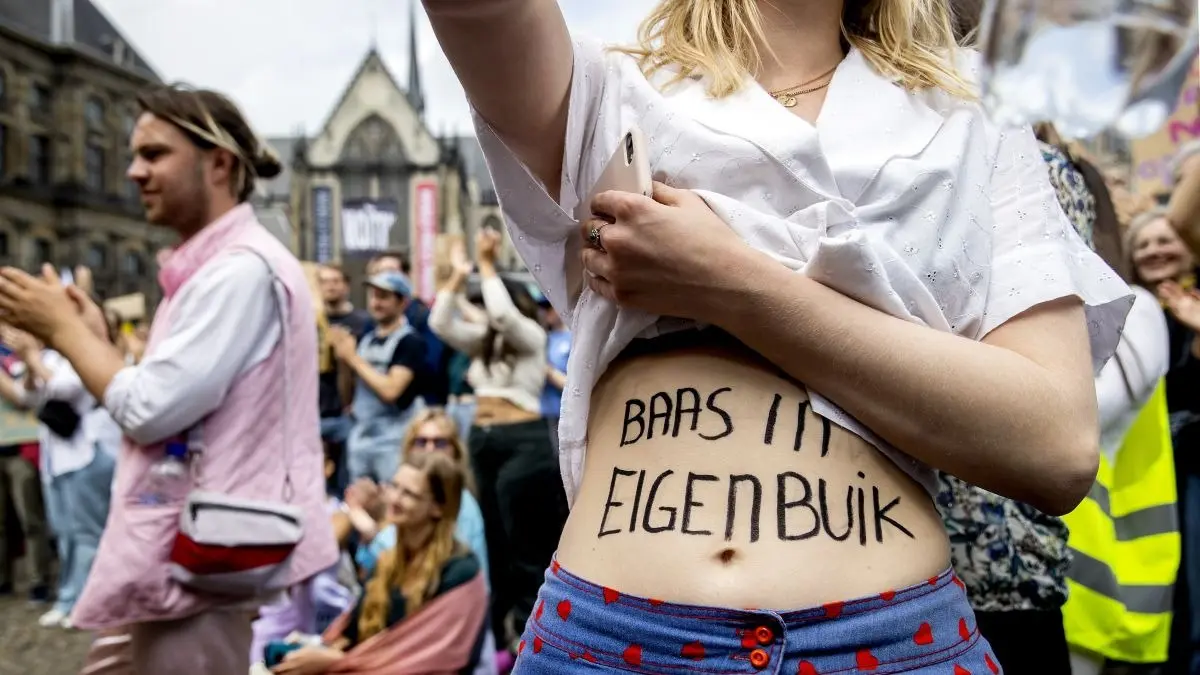
THE HAGUE — Opposition party Pro has put forward a landmark legislative bill aimed at removing abortion entirely from the Dutch criminal code and officially reclassifying and regulating it as a standard component of healthcare.
While abortion has enjoyed legal status in the Netherlands since the 1980s, the country’s legislative framework remains uniquely complicated. Under the current wording of the Dutch criminal code, performing an abortion is technically classified as a criminal offense. It is only permitted because specific legal exceptions shield doctors, hospitals, and licensed clinics from prosecution, provided they strictly adhere to the rigorous conditions laid out in the Termination of Pregnancy Act.
MP Lisa Vliegenthart, representing the Pro party and drawing on her professional background as a former midwife, officially handed the new bill over to campaigners from the feminist activist group Dolle Mina outside the Dutch parliament building on Monday morning, as reported by broadcaster NOS.
"This is incredibly important because abortion is healthcare, and as far as I am concerned healthcare has no place in the criminal code," Vliegenthart told journalists and supporters gathered at the scene. "That is why we want to remove abortion from the criminal code and include it in healthcare legislation."
Already Legal, But Technically a Crime
Under the existing legal framework established decades ago, abortion has been legal in the Netherlands for more than forty years. However, the architectural design of the law treats the procedure through a lens of penal law rather than medical practice. An article within the criminal code explicitly states that performing an abortion is a crime, creating a legal anomaly where the procedure is simultaneously lawful yet criminalized in principle.
The sole exception to this criminalization applies when an abortion is carried out by a qualified medical doctor inside a licensed clinic or hospital, and strictly under the conditions defined by the Termination of Pregnancy Act. These statutory conditions include a strict gestational limit of 24 weeks, alongside a legal requirement that the woman seeking the procedure explicitly indicates she is experiencing a situation of personal distress.
Importantly, under current Dutch law, women themselves cannot be prosecuted for undergoing an abortions, but the medical professionals and practitioners who administer them can face criminal liability if any conditions are breached.
Pro’s newly introduced bill seeks to alter this paradigm fundamentally while preserving all existing care requirements and safeguards, including the 24-week gestational time limit. "Of course abortion has to be carried out carefully," Vliegenthart emphasized. "But you don’t need the criminal code for that."
Proponents and legal experts who support the bill argue that maintaining abortion within the criminal code needlessly contributes to the social stigma surrounding reproductive healthcare. They also contend that penal legislation creates unnecessary bureaucratic rigidity, making the rules and regulations far more cumbersome to update as medical science and healthcare practices evolve.
The current legal structure was originally forged through a hard-fought political compromise. Passed by the narrowest of margins in 1980, the legislation scraped through the lower house of parliament by 76 votes to 74, and subsequently cleared the Senate by 38 votes to 37. In the decades since its enactment, the rules have occasionally been modernized and loosened. Notably, a mandatory five-day waiting period that patients previously had to observe before undergoing the procedure was formally scrapped by senators in 2023. Additionally, regulations have been adapted to allow family doctors and general practitioners to prescribe the abortion pill directly to patients.
VVD Support and Political Hurdles
Whether the ambitious new bill manages to successfully clear parliament depends largely on the political stance of the right-wing liberal VVD party.
In 2023, the political landscape looked rather different when the VVD joined forces with a bloc of conservative and right-wing parties, including the CDA, ChristenUnie, PVV, SGP, and FvD, to successfully vote down a previous, similar legislative attempt aimed at removing abortion from the criminal code. However, the political winds have shifted somewhat; the VVD’s official 2025 election manifesto included a firm commitment to "actively work" toward removing abortion from the criminal framework.
If the VVD follows through on its manifesto pledge and votes in favor, the bill could realistically secure a narrow majority in parliament, bolstered by support from D66 and various smaller opposition factions. Even so, formidable political obstacles remain. The parties’ coalition partner, the Christian Democratic Appeal (CDA), remains steadfastly opposed to the measure.
The VVD itself has not yet definitively declared how it will vote on Pro’s specific text. "हम are going to read the proposal and wait for the Council of State’s response," the party stated, indicating a cautious approach before making a final commitment.
Constitutional Protection and Online Access
Should the legislative proposal successfully pass through both houses of parliament, the Pro party has signaled that it intends to push the envelope even further. The party ultimately wants to enshrine the fundamental right to abortion directly into the Dutch constitution, mirroring the historic step taken by France in 2024.
Vliegenthart pointed to international developments, particularly the United States, where the Supreme Court controversially overturned the federal constitutional right to abortion in 2022, dismantling decades of legal precedent. "That pressure exists in Europe and the Netherlands too," she warned, arguing that robust constitutional safeguards are increasingly necessary to protect reproductive rights from future political shifts.
Beyond the legal and constitutional debates taking place in parliament, practical accessibility remains a pressing daily issue for women seeking care across the Netherlands. In many cases, practical hurdles regarding access and logistics prove to be a more immediate barrier than the wording of the law itself.
Highlighting the evolving landscape of reproductive healthcare, the Dutch health inspectorate permitted the country’s only online abortion service to continue operations after the provider altered its internal practices. That specific online service currently issues roughly a quarter of all abortion pills dispensed in the Netherlands, underscoring how modern digital healthcare delivery continues to intersect with the ongoing national conversation surrounding reproductive rights, regulation, and patient access.