






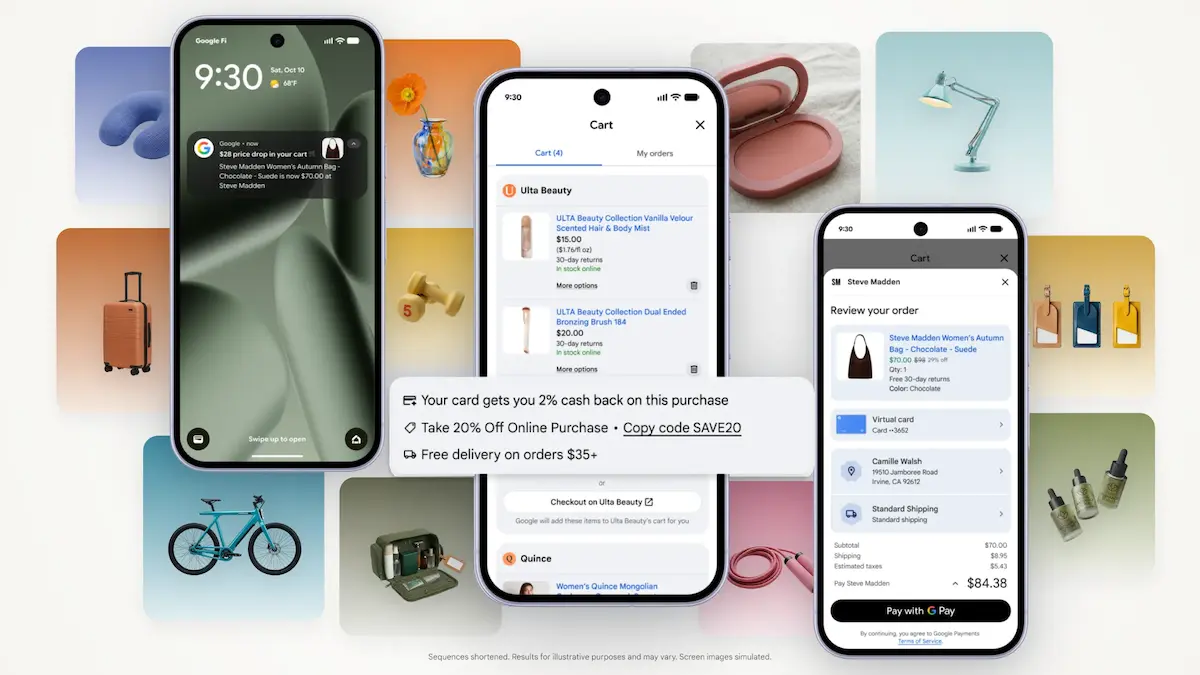
Google on Thursday announced that "Universal Cart," a centralized tool designed to let users collect, monitor, and manage products found across Google Search and within the Gemini app, is now officially available to users across the United States. The technology giant first previewed the innovative shopping tool earlier this year at the Google I/O developer conference in May, generating significant interest among retail analysts and consumers alike who are looking for ways to streamline an increasingly fragmented digital marketplace.
The core concept behind Universal Cart is to make online shopping significantly easier to manage from a single, cohesive interface. Modern web browsing often involves jumping between dozens of tabs, individual retail sites, and search engine results pages, which can make keeping track of potential purchases a frustrating and disjointed experience. With Universal Cart, when a shopper finds a product they like while browsing or interacting with Google’s ecosystem, they can save the item directly to their cart and continue with their day. When they return to the platform later, their items, selections, and overall shopping progress are still preserved, eliminating the tedious need to hunt down the exact same products or start their search from scratch.
By allowing items from multiple different retailers to be collected in one place, the tool effectively transforms Google into a central hub for browsing and keeping track of prospective purchases. This cross-retailer capability addresses a major pain point in digital commerce, where consumers frequently abandon shopping carts spread across various merchant websites, only to lose track of what they were looking at or find that items have changed in price or availability when they finally decide to return.
Beyond merely storing items, Google notes that the Universal Cart can actively help shoppers stay on top of changing deals and real-time inventory availability. The tool is equipped to send proactive notifications when a saved product undergoes a price drop or when an item that was previously out of stock becomes available for purchase once again. This functionality shifts the shopping assistant from a passive storage bin into an active participant in the consumer’s purchasing journey, helping them secure better value without requiring constant manual checking.
Furthermore, the tool is designed to offer more personalized and tailored assistance throughout the entire shopping process. According to Google, the system can take a user’s specific credit card perks and rewards into account when helping them evaluate and choose the best payment method for a transaction. It can also automatically surface relevant promotional codes and discounts, ensuring that shoppers do not miss out on savings that might otherwise require scouring coupon aggregator websites.
The underlying architecture for checkout is tied directly to Google’s Universal Commerce Protocol, commonly referred to as UCP. This open standard was introduced by the company earlier this year to establish a common framework for digital transactions. UCP is specifically engineered to help artificial intelligence agents and retail merchants work together seamlessly across different phases of the shopping journey, including the critical and often complex checkout phase. By establishing an open standard, Google hopes to encourage broader industry adoption, enabling a smoother flow of data and transactional capabilities between disparate retail platforms and AI-driven interfaces.
Google is already deeply invested in the broader landscape of AI-powered shopping, and the rollout of Universal Cart represents its latest strategic effort to make the consumer experience significantly more convenient. The new feature joins a growing suite of capabilities aimed at transforming how people buy goods online. This includes conversational product discovery features integrated directly into Search’s AI Mode, as well as Google’s specialized "Let Google Call" tool. That particular feature utilizes an advanced AI agent to contact nearby brick-and-mortar stores on behalf of the user, making phone calls to verify whether a specific item is physically in stock before the consumer makes a trip to the store.
However, Google is far from alone in bringing sophisticated artificial intelligence capabilities into the e-commerce sector. Major technology rivals, including Amazon and OpenAI, have also introduced their own agentic commerce features and systems over the past year. As tech companies look for new ways to make conversational chatbots and digital assistants genuinely useful beyond merely answering informational questions, shopping and retail transactions have emerged as a primary battleground for innovation and market dominance.
These developments reflect a broader industry shift toward agentic AI—systems capable of taking autonomous or semi-autonomous actions on behalf of users to accomplish complex multi-step tasks. In the realm of retail, this means moving past simple product recommendations toward tools that can track, manage, compare, and ultimately execute transactions across the vast expanse of the internet. As Universal Cart becomes available to U.S. consumers, it marks another step forward in the evolution of digital retail, blurring the lines between search engines, conversational assistants, and traditional storefronts.