





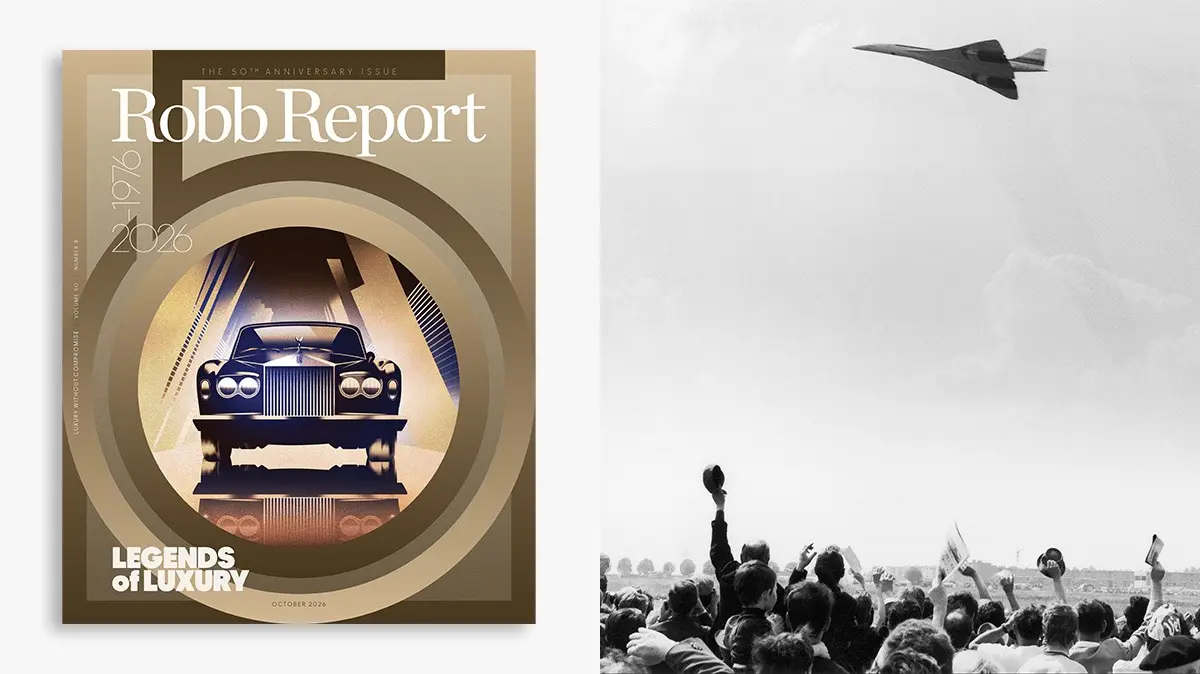
On January 21, 1976—the very year Robb Report was founded—the legendary Concorde began carrying commercial passengers at twice the speed of sound. While it would be a stretch to claim some grand, cosmic design behind the timing, it stands as a fitting coincidence. Just as the supersonic jet was radically shrinking the Atlantic Ocean and reshaping global travel, a new publication emerged to document such unprecedented feats of human daring, engineering, and ambition.
Now, half a century later, Robb Report is celebrating its golden anniversary. Any media institution that remains vibrant and influential after five decades has more than earned the right to look backward with a measure of nostalgia. When the editorial team began assembling "Legends of Luxury," the expansive feature at the heart of this milestone issue, the initial goal was simple: orchestrate a sprawling retrospective, indulge in a bit of institutional reminiscing, and celebrate the milestones that defined high-end culture since the mid-1970s.
Yet, a careful sifting through the past revealed something far more compelling than mere nostalgia. Many of the 74 iconic objects, influential people, legendary places, and transformative experiences chosen for the retrospective did not merely represent the pinnacle of consumption for their time. Instead, they served as prophetic blueprints for the world to come—a world that would fundamentally alter how humanity communicates, dresses, travels, dines, and pursues thrills.
Consider, for instance, the Motorola DynaTAC 8000X. When the world’s first commercial handheld cellular telephone hit the market in 1984, it commanded a staggering price tag of just under $4,000—equivalent to roughly $12,000 today—and tipped the scales at nearly two pounds. Owning one was an unambiguous statement of extreme privilege. If you were fortunate enough to afford the device universally known as "the Brick," you made certain that people saw you wielding it in public, a dynamic immortalized by cinematic fiction like Gordon Gekko in Wall Street. Today, the smartphone descendants of that bulky handset are vastly more ubiquitous than household televisions. What began its life as an ultra-exclusive luxury item has crossed the definitive threshold to become an absolute modern necessity.

Of course, technological disruption and cultural evolution do not always rely on microchips or silicon processors. In the late 1970s, Italian designer Giorgio Armani executed a quiet revolution in menswear by systematically stripping the rigid structure out of the traditional tailored suit. He softened the shoulders, relaxed the lines, and loosened the trousers, creating a silhouette that was at once louche, effortless, and deeply sophisticated. Hollywood quickly recognized its cinematic potential, famously outfitting a very well-dressed gigolo in the aesthetic. At the time, the relaxed tailoring looked radical, even transgressive. Today, that once-daring looseness has simply become foundational to the modern man’s wardrobe.
History also demonstrates that some visionary ideas can flame out spectacularly, yet still manage to fundamentally upend their respective fields along the way. At El Bulli, the avant-garde Catalan restaurant, master chef Ferran Adrià utilized food science to completely scramble diners’ expectations of what a culinary experience could be, pioneering the movement known as molecular gastronomy. In time, a wave of uninspired imitators reduced the discipline to a running punch line characterized by artificial foams, theatrical fogs, and an unpalatable culinary binding agent known colloquially as meat glue. Yet, despite the excesses and subsequent backlash, the best elements of Adrià’s culinary philosophy survived and permanently influenced an entire generation of ambitious chefs.
A similar trajectory can be observed on the high seas. When Octopus, a magnificent 414-foot vessel commissioned by the late billionaire Paul Allen and built by Lurssen, was delivered in 2003, it shattered conventional maritime paradigms. The ship successfully paired traditional superyacht luxury with the rugged, self-sustaining capabilities of a serious oceanographic expedition vessel. It was engineered to go virtually anywhere on the planet, transforming exploration itself into the primary purpose of yachting, even if sunbathing at anchor remained firmly on the itinerary. Today, explorer yachts have shed their novelty status to become a standard staple in the lineup of nearly every major luxury shipyard in the world.
Looking back across fifty years of cultural observation, it would be tempting for editors and critics alike to claim they recognized these profound shifts as they were happening. The reality, however, is far more humbling. None of these outcomes looked entirely obvious at the time of their inception. As the editorial team can attest from firsthand experience, predicting the future of luxury, technology, and lifestyle is an exercise vastly easier in hindsight.

To err is human, and cultural journalism is no exception. Robb Report once boldly declared the internal-combustion engine entirely dead, only to watch it persist with remarkable resilience. Conversely, other supposedly inevitable "next big things" that cultural commentators swore would revolutionize society disappeared almost as quickly as they arrived. One only needs to recall the dizzying heights and rapid descent of Bored Ape Yacht Club digital tokens to realize that the future perpetually humbles even the most seasoned observers.
Looking ahead, it is entirely probable that one of the extravagant pursuits, cutting-edge technologies, or high-end novelties chronicled in the pages of this 50th-anniversary issue will, in another two decades, be as commonplace as the smartphone is today. Another may vanish entirely from the cultural lexicon, leaving behind only a foundational idea that somehow outlives the physical product itself.
While no one can definitively predict which innovations will endure the test of time and which will fade into obscurity, half a century of publishing has imparted one enduring lesson: every so often, the future chooses to show up first disguised as a luxury. And as Robb Report enters its next half-century, the publication remains as endlessly curious as ever to see what the future brings next.