






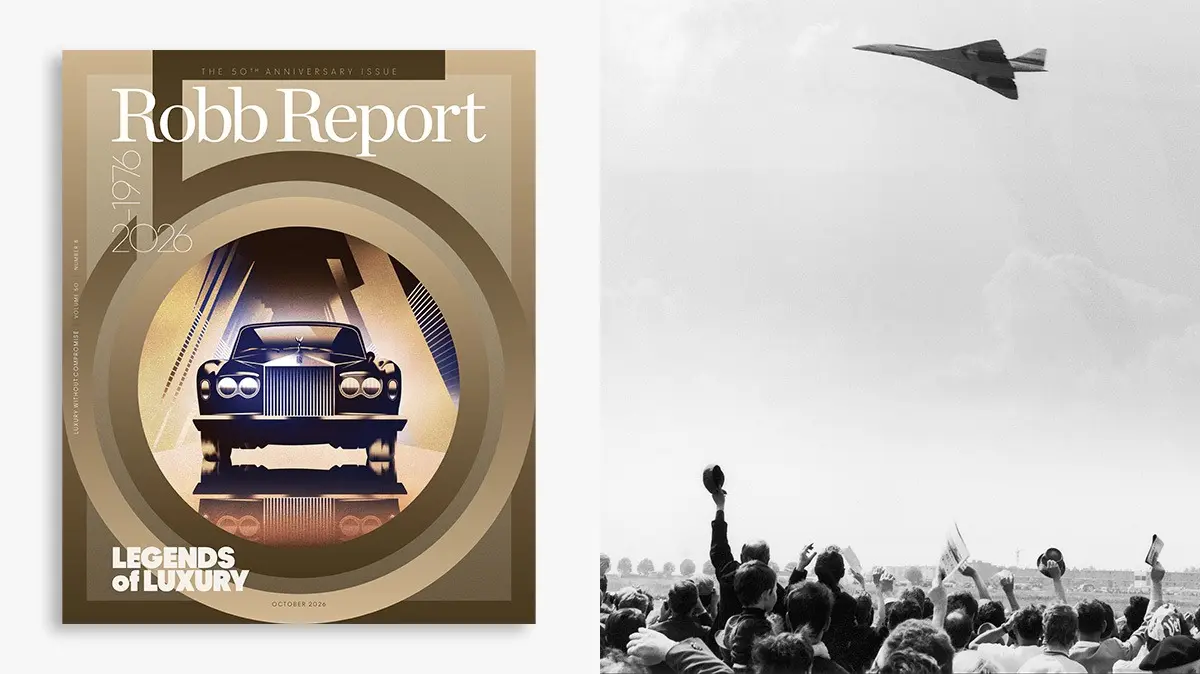
On January 21, 1976—the very year Robb Report was founded—the Concorde supersonic passenger jet officially entered commercial service, hurtling passengers across the Atlantic Ocean at twice the speed of sound. While it is tempting to attribute this timing to grand cosmic significance, it stands as a remarkably fitting coincidence. Just as the Concorde was abruptly shrinking the world and redefining the boundaries of global travel, a new publication emerged to chronicle such feats of daring, ingenuity, and high-end engineering.
Now, half a century later, Robb Report is celebrating its golden anniversary. Any publication that maintains its footing for five decades has more than earned the right to indulge in a bit of retrospection. Consequently, when the editorial team began assembling "Legends of Luxury," the defining feature at the heart of the anniversary issue, the goal was to create a sprawling, comprehensive retrospective—a moment to look back at the milestones that shaped high-end culture. However, a meticulous sifting through the archives revealed something far more compelling than mere nostalgia. Many of the 74 distinct objects, influential people, notable places, and transformative experiences selected for the feature served as prophetic glimpses of the future, charting a course that would fundamentally alter how society communicates, dresses, travels, dines, and seeks out thrills.
Consider, for example, the Motorola DynaTAC 8000X. When the world’s first commercial handheld cellular telephone hit the market in 1984, it came with a staggering price tag of just under $4,000—equivalent to roughly $12,000 today—and weighed in at a hefty two pounds. In its earliest days, owning such a device was an extraordinary privilege restricted to the financial and cultural elite. If an individual possessed what quickly became known as "the Brick," they invariably made certain that onlookers saw them wielding it in public, an ostentatious display of connectivity that later became immortalized on the silver screen by characters like Gordon Gekko. Today, the distant descendants of that cumbersome prototype—the modern smartphone—have achieved a level of ubiquity that arguably surpasses television sets. What was once the ultimate status symbol of exclusive luxury has quietly transitioned into an absolute, everyday necessity of modern life.

Of course, radical innovation does not always rely on advanced microchips or digital networks to upend convention. In the late 1970s, legendary Italian designer Giorgio Armani executed a quiet revolution in menswear by stripping the rigid internal structure out of the traditional tailored suit. By softening the shoulders, relaxing the fit, and loosening the trousers, Armani created a silhouette that was simultaneously louche and sophisticated. Hollywood directors quickly recognized its cinematic appeal, dressing high-profile characters in a style that was instantly adopted by the era’s most fashionable figures. At the time, the deconstructed suit looked startlingly radical, challenging decades of sartorial norms. Today, that relaxed elegance has simply been absorbed into the standard wardrobe of the modern man, proving that true luxury often lies in the effortless shedding of stiffness.
Other revolutionary ideas burned brightly and briefly, yet still managed to fundamentally disrupt their respective fields before fading or evolving into something else entirely. At the avant-garde restaurant El Bulli, visionary chef Ferran Adrià utilized food science to completely scramble diners’ preconceptions of what a meal could physically and sensorially be. While subsequent bad imitations eventually reduced the broader movement of molecular gastronomy to a cheap punch line revolving around artificial foams, mysterious fogs, and controversial ingredients like meat glue, the enduring core of Adrià’s culinary philosophy survived. The best elements of his experimentation stuck, rippling outward to permanently influence a brand-new generation of chefs who continue to push the boundaries of modern gastronomy.
Equally transformative was the arrival of Octopus, a staggering 414-foot vessel commissioned by the late billionaire Paul Allen. When the massive yacht, built by the renowned German shipyard Lurssen, was delivered in 2003, it successfully bridged two previously distinct worlds by pairing the lavish comforts of a traditional super-yacht with the rugged, self-sustaining capabilities of a serious oceanographic expedition ship. It was engineered to travel virtually anywhere on the globe, effectively shifting the purpose of luxury maritime travel from passive relaxation to active exploration. While sunbathing at anchor remained firmly on the itinerary, venturing into the remote, ice-choked reaches of the polar caps became an equally viable option. In the years since, the explorer yacht has graduated from a billionaire’s custom anomaly to a standard staple of nearly every major shipyard’s global lineup.

Looking back across these milestones, it would be easy to claim that the long-term trajectory of these innovations was entirely obvious from the start. Yet, reality rarely unfolds with such clarity, and predicting the future remains an exercise best executed in hindsight. The publication’s own historical archives serve as a humbling reminder of this truth; editors once confidently declared the internal-combustion engine entirely dead, only to watch it stubbornly persist as a vital cornerstone of automotive engineering. Conversely, other supposedly inevitable technological and cultural revolutions vanished almost as quickly as they materialized—a phenomenon illustrated by the sudden, dizzying rise and fall of digital assets like Bored Ape Yacht Club NFTs. The future, it seems, has a consistent way of humbling even the most astute observers.
Looking forward another twenty years, it is entirely certain that at least one of the extravagant pursuits, technologies, or design concepts showcased in the anniversary pages will eventually become as commonplace as the smartphone is today. Another may quietly vanish into obscurity, leaving behind only an inspiring seed of an idea that outlives the product itself. While no one can definitively predict which luxuries will endure the test of time and which will fade into historical footnotes, fifty years of publishing history have imparted one undeniable lesson: every so often, the future invariably chooses to show up first disguised as an indulgence. With the turn of the page, the curiosity to witness what the next era will bring remains as sharp as ever.